Central air conditioning, explained
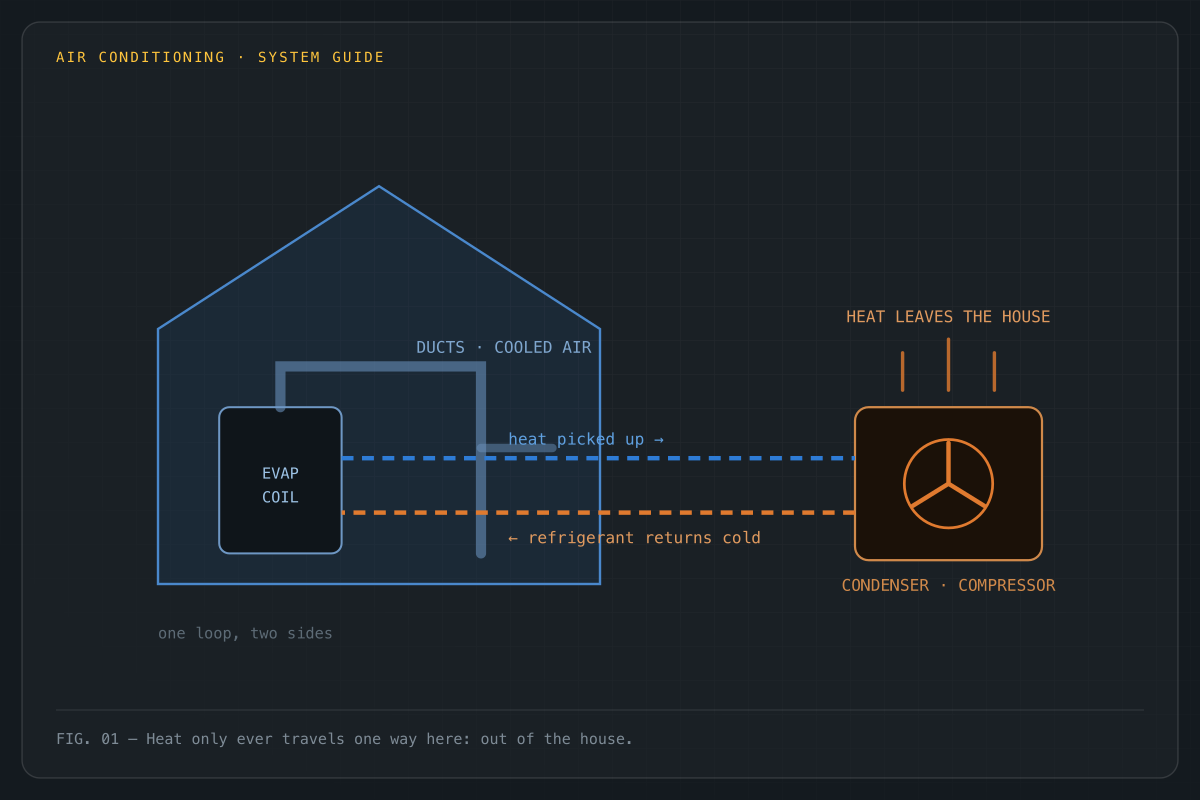
Central air conditioning cools your whole home from one system — an outdoor condenser and an indoor evaporator coil move heat out of the house through refrigerant, and ducts carry the cooled air to every room.
Nothing is sprayed or evaporated to cool you. The only water is condensation dripping off the cold coil into a drain.
A central AC recirculates the air already in your house. Only the heat goes outside.
There is no such thing as cold, only heat — and the system moves it rather than making anything.
What "central" means — and what isn't central air
Central means one cooling source feeding every room through ducts. Everything else cools a single room.
Four different machines get called "the AC," and confusing them is how people end up on the wrong repair page. A ducted split system is the classic: a condenser outside, a coil on the furnace or air handler inside, ducts between. A packaged unit puts all of that in one outdoor cabinet. A ductless mini split has no ducts at all — wall heads cool the rooms they're mounted in, which is why manufacturers do not classify it as central air. Window and portable units are retail appliances.
On this page
So: is central air the same as AC? When there are ducts, yes — the words are used interchangeably. "AC" just stretches further, down to the box in the bedroom window. We route repairs on ducted and ductless systems; window and portable units are retail products we don't service. If your outdoor unit also heats the house in winter, you don't have an air conditioner at all — you have a heat pump, and it deserves its own page.
The nine parts, indoor and outdoor
Nine parts, three groups: the hot side outdoors, the cold side indoors, and the lines, ducts and thermostat that connect them.
Knowing the anatomy is what makes every repair estimate legible. The table below is this page's spine: each part, what it does, where it lives, and — the column no manufacturer page prints — what you actually notice when it fails.

| Part | What it does | Where | What you notice when it fails |
|---|---|---|---|
| Compressor | Squeezes refrigerant gas hot so it can shed heat outside | Outdoor | Unit hums, never cools — the priciest line on any estimate |
| Condenser coil | Releases the house's heat into outdoor air | Outdoor | Poor cooling on the hottest days; coil packed with debris |
| Condenser fan | Pulls outdoor air across that coil | Outdoor | Outdoor unit hot to the touch, breaker trips mid-afternoon |
| Capacitor | Gives the motors the jolt they need to start | Outdoor | A click, then nothing; fan won't spin unless nudged |
| Evaporator coil | Absorbs heat from indoor air into the refrigerant | Indoor | Ice on the copper line, weak airflow, warm vents |
| Expansion valve | Meters refrigerant into the coil at the right pressure | Indoor | Coil freezes, or barely cools despite a full charge |
| Blower | Moves house air across the coil and into the ducts | Indoor | No air at any vent, though the outdoor unit runs |
| Air filter | Keeps dust off the coil and out of the blower | Indoor | Weak airflow everywhere — the least expensive fix in the building |
| Condensate drain | Carries away the moisture the coil pulls from the air | Indoor | Water near the furnace, or a safety switch shutting things off |
Most consumer pages skip the expansion valve. It's on every trade-school parts list and it's a real line item on a real invoice — see the repair scope, or what each part costs.
How it actually cools: the cold side and the hot side
Two things happen at once — indoors, warm air hands its heat to cold refrigerant; outdoors, that heat is dumped into your yard.
Cold side · indoors
- The thermostat decides the house is too warm and calls for cooling.
- The blower pulls house air through the return grille and the filter.
- That air crosses the cold evaporator coil. The refrigerant inside boils from liquid to gas, taking the heat with it.
- Cooled, dried air goes back out through the supply ducts.
Hot side · outdoors
- The compressor squeezes that gas until it's hotter than the outdoor air, and pushes it into the condenser coil.
- The condenser fan blows the heat away; the refrigerant condenses back to a liquid, then the expansion valve drops its pressure and it returns to the coil, cold again.
There's a second job in that sequence nobody advertises: dehumidification. Warm air hitting a cold coil leaves its moisture behind as condensation, which drips into the pan and out the drain. That single mechanism explains three separate service calls — the clammy house, the water on the floor, the system that never runs long enough to dry anything out — and it is exactly why a right-sized system feels better at 78°F than an oversized one does at 72°F.
Split, packaged, ductless — and which one you have
You can identify your system from the driveway in about ten seconds.
Split system
One box outside, a coil sitting on the furnace or air handler inside, ducts to every room. Quiet indoors, generally the most efficient — but it needs ductwork in decent shape and closet or attic space.
Packaged unit
Everything — coil, blower, compressor, condenser — inside one outdoor cabinet on the roof or a slab. Saves all indoor space, but it lives in the weather, and it's harder to zone.
Ductless mini split
An outdoor unit feeding wall or ceiling heads, each cooling its own room. No ducts, real zoning, and a head on every wall you want cooled. See the mini split guide.

Staging is the part the brochures skip, and it's what decides the comfort complaint. A single-stage system is full blast or off. A two-stage system has a low gear, so it runs longer at part load and dries the air better. An inverter (variable-speed) system ramps continuously — quietest, most efficient, most expensive, and the one that never leaves the house clammy.
Efficiency and size, in plain English
SEER2 tells you how cheap it is to run. Tons tell you how much house it can cool. Getting the second one wrong makes the first one irrelevant.
SEER2 measures cooling delivered per watt across a season — higher is cheaper to run for the same cooling. It replaced the older SEER measure under a more realistic test. Under the 2023 federal standards, a new split-system air conditioner must reach 13.4 SEER2 in the northern states and 14.3 SEER2 in the Southeast and Southwest, according to AHRI's summary of the Department of Energy rule; ENERGY STAR certification starts at 15.2 SEER2, and premium equipment climbs past 20.

Capacity is measured in tons: one ton equals 12,000 Btu per hour, and it has nothing to do with weight. The trap is that bigger is not better. An oversized system races to the setpoint, shuts off before it has dried the air, and leaves you cold and clammy while short-cycling the compressor to an early death. Sizing is a Manual J load calculation, not a rule of thumb — that math lives on what size AC do I need. Efficiency you buy once; you pay for it every month either way.
When it stops cooling: symptom, likely part, where to read next
Almost every AC failure announces itself in one of six ways, and each one points at a short list of parts.
| What you notice | Likely part | Check yourself first | Read next |
|---|---|---|---|
| Nothing turns on at all | Thermostat · breaker · capacitor · contactor | Breaker position and thermostat batteries | Won't turn on → |
| It runs, the air is warm | Refrigerant charge · compressor · condenser fan · dirty coil | Is the outdoor fan actually spinning? | Not cooling → |
| Weak airflow at every vent | Filter · blower motor · iced coil | Pull the filter and hold it to the light | Troubleshooting → |
| Ice on the copper line or coil | Airflow starvation · low charge | System OFF, fan ON, let it thaw before anything else | Low refrigerant → |
| It never shuts off | Oversized system · undercharge · dirty coil · thermostat | Compare the setpoint to the actual reading | Sizing → |
| Water on the floor by the furnace | Clogged condensate drain · cracked pan · frozen coil | Look for standing water in the drain pan | Troubleshooting → |
Filters, breakers, thermostat batteries and clearing debris from the outdoor unit are yours. Anything behind the electrical panel, anything that touches refrigerant, and anything needing a gauge set belongs to a licensed technician — handling refrigerant legally requires EPA Section 608 certification. A capacitor holds a charge after the power is off.
How long it lasts, and what the warranty actually covers
12 to 20 years for the system — and the warranty on paper is not the warranty in practice.
Most manufacturers back major parts with a 10-year limited warranty. Three conditions travel with it and rarely get read: registration within 60 to 90 days of installation, provable professional installation, and — the expensive one — labor is almost never covered. A covered compressor with uncovered labor is still a four-figure day, which is precisely why a compressor failure past year 15 usually tips toward replacement instead of repair.
We don't make that call for you; the age bands and the one-third rule live on repair or replace. One honest footnote: efficiency slips as a system ages, so a twenty-year-old unit that still cools is quietly charging you a premium every summer.
The refrigerant question every 2026 homeowner walks into
Pre-2010 systems mostly run R-22, which hasn't been produced since 2020. R-410A equipment stopped being manufactured in 2025. New systems ship with R-454B or R-32.
CFCs phased out
The first generation of ozone-depleting refrigerants leaves the market.
R-22 production ends
Only reclaimed supply remains — a leak on an R-22 system is now an expensive refill.
R-410A production ends
Existing systems stay legal to run, service and repair. Service parts may be produced through 2028.
R-454B and R-32
New equipment uses mildly flammable A2L refrigerants — new installer training, new leak sensors.
What this means in practice, in the order you'll hit it: an R-22 leak is usually the argument for replacing rather than recharging. A working R-410A system does not need replacing because of a phase-out — anyone telling you otherwise is selling. And a system bought today carries a refrigerant your local technician needed new training to handle. Dates and the full timeline: the refrigerant phase-out.
Keeping it alive between service calls
Three homeowner habits and one annual visit cover almost everything.
Yours, no tools required
- Change or clean the filter on schedule — thin filters monthly in cooling season, thick pleated ones every 3 to 12 months.
- Keep 2 to 3 feet of clearance around the outdoor unit and 5 feet overhead. A condenser that can't breathe can't dump heat.
- Glance at the condensate drain for standing water before every cooling season.
The technician's annual visit
- Clean and flush both coils; drain the pan and the drain line.
- Vacuum the blower compartment.
- Verify the refrigerant charge and check for leaks.
- Test the capacitor and the electrical connections before they fail in July.
Two facts that pay for that visit: leaky, unsealed ducts waste 20 to 30 percent of the energy the system uses, and per the Department of Energy every degree you raise the thermostat saves roughly 3 percent on the cooling bill — 78°F is the usual starting point. Maintenance doesn't make an AC immortal. It keeps the failures small and scheduled, instead of large and on the hottest day of the year. Book the annual tune-up, or read our unbiased take on maintenance agreements.
Everything about your AC
AC repair →
The problems we route, the free pre-call checks, and what a visit actually looks like.
AC repair cost →
Itemized by part and symptom, with the honest anatomy of a bill.
AC not cooling →
Warm air, fourteen causes, five of them free to check yourself.
AC won't turn on →
Nothing happening at all — the power-and-capacitor checklist, in order.
AC troubleshooting →
Symptom by symptom, with the exact moment to stop and call.
Low refrigerant signs →
Six signs that confirm a leak before you pay to search for one.
AC installation →
Replacing the system: what the day looks like and what decides the price.
What size AC do I need? →
Sizing by square footage, and why bigger is the expensive mistake.
One call routes you to a licensed local HVAC contractor for central air conditioning repair, 24/7, nationwide: (888) 810-2291 — or start at AC repair.
Same-day and 24/7 emergency services are subject to provider participation, location, technician availability, and demand. Availability is not guaranteed and may vary by market and appointment capacity.
Common questions
Does central AC use water?
No. Central air conditioning moves heat; it doesn't make cold and it doesn't use water to do it. The only water involved is condensation dripping off the cold evaporator coil into a drain pan — which is why a clogged drain shows up as a puddle near the furnace.
Does the AC pull in air from outside?
No. A central system recirculates the air already inside your house, cooling it as it passes over the evaporator coil. The outdoor unit expels the heat it collected, but it doesn't bring outdoor air in.
What is the outdoor unit called?
The condenser, or condensing unit. It holds the compressor, the condenser coil, and a large fan, and its job is to release the heat your system pulled out of the house.
Is central air the same as AC?
When there are ducts, yes — the terms are used interchangeably. 'AC' also loosely covers window and portable units, which cool a single room rather than the whole house.
How long does central AC last?
Typically 12 to 20 years with regular maintenance. Efficiency slips over time, and once a unit passes 15 years a major repair like a compressor usually tips toward replacing the system.
What does SEER2 mean?
SEER2 is the seasonal efficiency rating for cooling equipment — higher means lower running costs for the same cooling. New split systems must reach 13.4 SEER2 in the northern states and 14.3 in the Southeast and Southwest.
Is it cheaper to leave the air conditioner on all day?
Running it continuously at a low setpoint costs more. Rather than shutting it off, raise the thermostat 7 to 10 degrees while you're out — a smart thermostat does it for you and brings the house back down before you return.
Why does the house feel clammy even when the AC runs?
Cooling and dehumidifying are two jobs. An oversized system hits the setpoint fast and shuts off before it has removed enough moisture; a dirty coil or a starved airflow does the same. That's a sizing or a service problem, not a thermostat problem.
Can I run central AC in winter?
A standard AC only cools, so there's no reason to. If your outdoor unit also heats the home in cold weather, you have a heat pump — the same-looking box that runs in both seasons.
Who invented air conditioning?
Willis Carrier designed the first modern air conditioning system on July 17, 1902 — originally to control humidity in a printing plant, not to cool people.