Heat pumps, explained
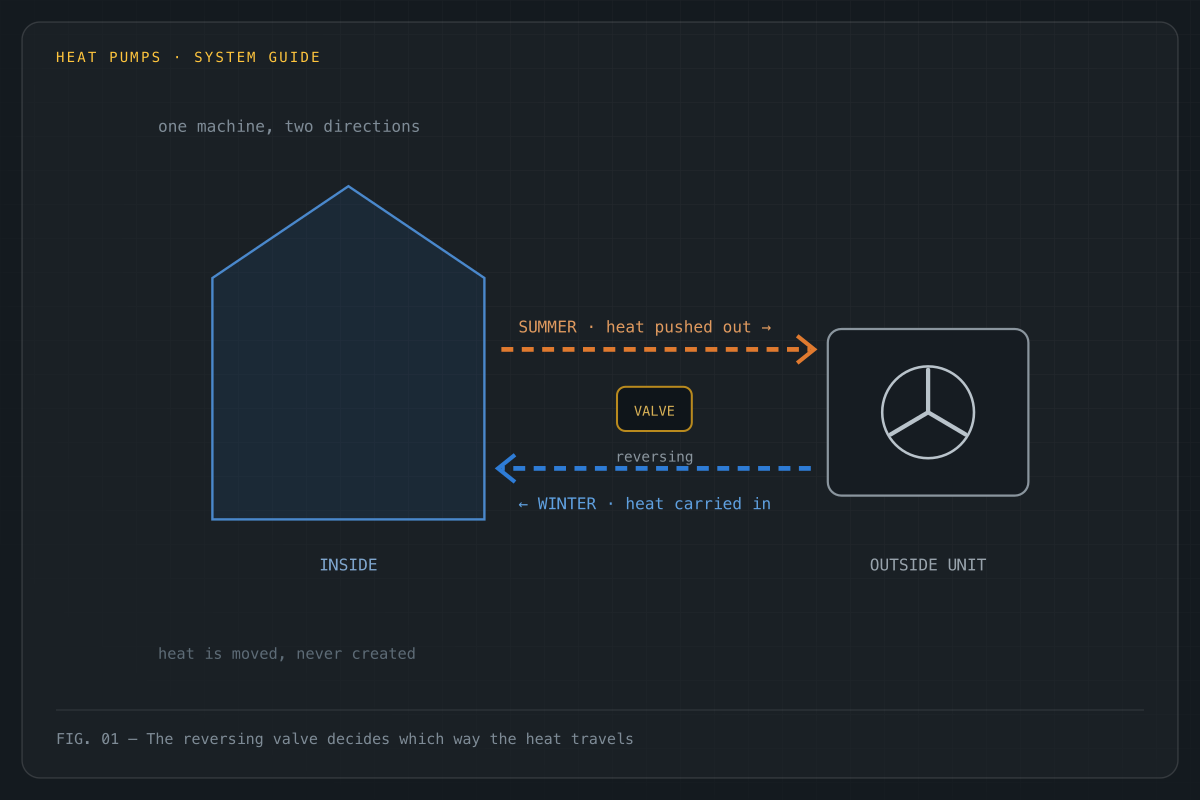
A heat pump moves heat between inside and outside using refrigerant and electricity — it burns no fuel. In summer it cools like an air conditioner. In winter it runs in reverse, collecting heat from the outdoor air and carrying it indoors.
A ducted heat pump looks exactly like central AC: a box outside, an air handler inside, ordinary vents.
It makes no heat and burns nothing. There is no flame, no flue, and no carbon monoxide.
The same machine is your air conditioner all summer. One box, two seasons.
What a heat pump is — and why yours might be one already
A heat pump does not make heat. It collects heat that already exists and carries it across your wall, in whichever direction you need.
This sounds impossible in January, and it is not. Even cold outdoor air holds a great deal of heat energy, and refrigerant boiling at a low enough temperature will absorb it. Run that refrigerant to a coil indoors, squeeze it with a compressor, and it gives that heat up into your house. In summer the same machine simply runs the loop the other way, which is precisely what an air conditioner does.
On this page
The most common question about heat pumps is asked by people who already own one. You bought a house, there is a box outside, there are no wall units anywhere, and nobody told you what it is. A ducted heat pump looks almost identical to central air conditioning — an outdoor unit, an indoor air handler, ordinary supply vents. The tell is the season, not the shape: an air conditioner has no reason to run on a freezing morning, and a heat pump does.
Which type you have, from where the equipment sits
Three shapes, and you can identify yours without opening anything.
Air-source, ducted
One outdoor unit and one indoor air handler, feeding the same ducts a furnace would. It looks exactly like a central air conditioner, because mechanically it nearly is one — with a valve that lets it run backwards.
Ductless mini split
An outdoor unit feeds wall or ceiling heads, each conditioning the room it hangs in. Real zoning, no ductwork, and a visible head on every wall you want heated.
Geothermal
Instead of trading heat with the outdoor air, it trades heat with the ground, which barely changes temperature all year. That stability is why it holds efficiency in deep cold — and why it costs what it costs.
There is a fourth arrangement worth naming, because installers will offer it. A dual-fuel or hybrid system pairs a heat pump with a gas furnace and hands heating over to the furnace once the outdoor temperature drops far enough that gas becomes the less costly way to make heat. It is not a separate kind of heat pump. It is a heat pump with a thermostat that knows your fuel prices.
One machine, two directions
A single component — the reversing valve — is the entire difference between a heat pump and an air conditioner.
Summer · cooling
- Refrigerant arrives at the indoor coil cold and boils, absorbing heat from the house air blowing across it.
- The compressor squeezes that gas until it is hotter than the outdoor air.
- The outdoor coil dumps the heat into the yard, and the refrigerant condenses back to a liquid.
- Cooled, dried air returns through the ducts. This is an air conditioner, exactly.
Winter · heating
- The reversing valve flips, and the two coils trade jobs.
- Refrigerant boils in the outdoor coil, absorbing heat from cold outdoor air.
- The compressor raises its temperature well above room temperature.
- The indoor coil releases that heat into the house. Nothing was burned to produce it.
That is why a stuck reversing valve produces the strangest complaint in heating: a system that cools the house when you asked it to heat. It also explains why a heat pump's supply air feels cooler than a furnace's. A furnace delivers air at perhaps 120 to 140°F in short bursts; a heat pump delivers a steadier stream nearer body temperature. It heats the room just as well. It simply does not feel hot on your hand.
What it does in winter — defrost, AUX, and emergency heat
Most "my heat pump is broken" calls in December describe a heat pump behaving exactly as designed.
Four winter behaviours account for nearly every worried phone call. None of them appear on the brochure, and three of them are entirely normal.
- Defrost cycle
In damp cold, frost forms on the outdoor coil. The heat pump briefly runs backwards to melt it — so the outdoor unit steams, and the indoor vents blow cool for a few minutes.
What is normalSteam off the outdoor unit and cool air indoors for 5–10 minutes is normal. Ice caked over the coil for hours is not.
- The balance point
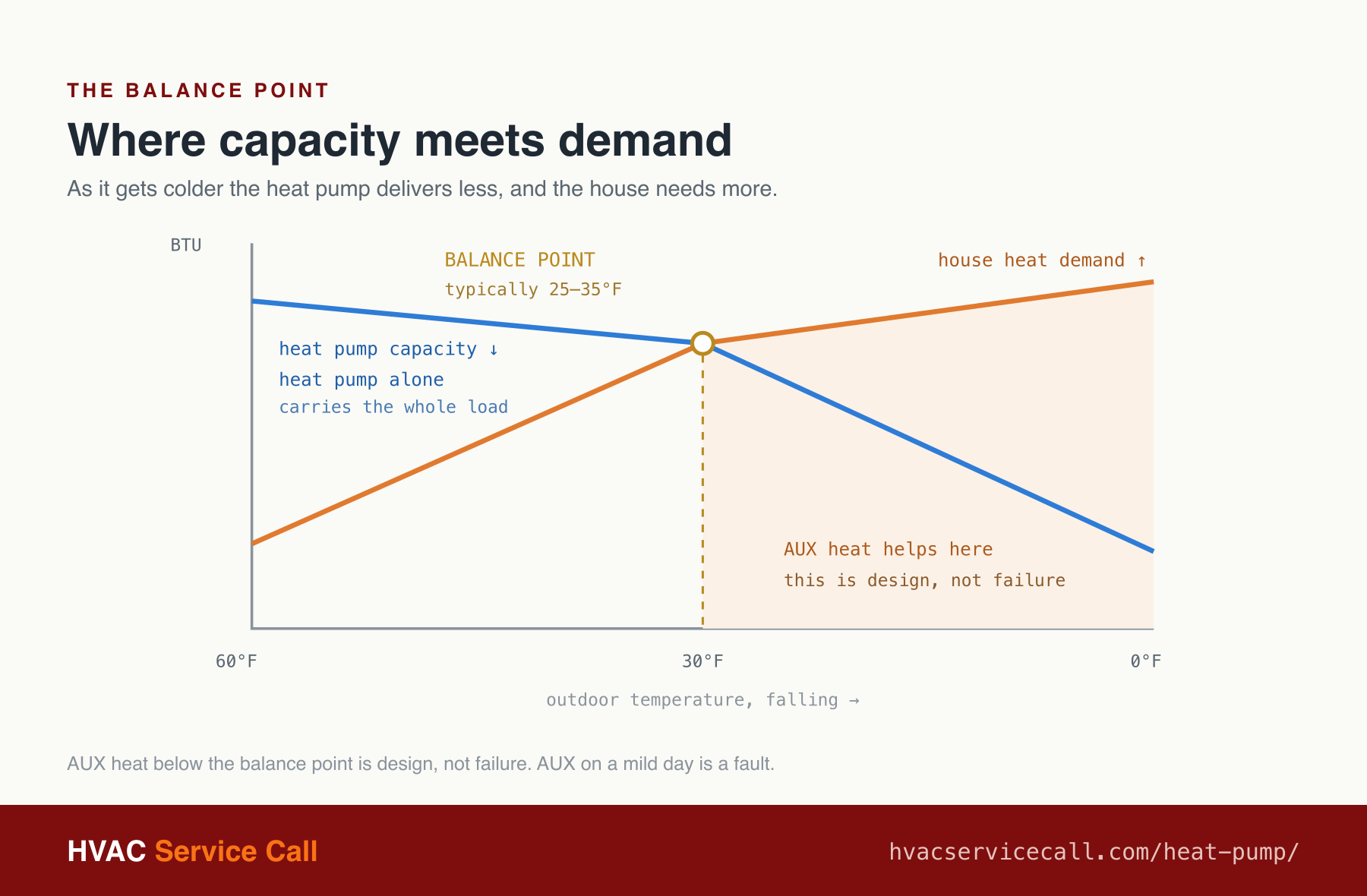
As it gets colder, a heat pump delivers less heat while the house needs more. The outdoor temperature where those two lines cross is the balance point — usually somewhere in the 25–35°F range, depending on the equipment and the house.
What is normalBelow it, backup heat starts helping. That is design, not failure.
- Auxiliary heat (AUX)
Backup heat — electric strips, or a gas furnace in a dual-fuel setup — switching on automatically to help the heat pump on cold days.
What is normalAUX on your thermostat during a cold snap is expected. AUX in mild weather points at a real fault.
- Emergency heat (EM)
A manual setting that shuts the compressor off entirely and heats with the backup alone. It exists for when the heat pump is broken.
What is normalEM heat is the expensive setting. Left on by accident, it is the single most common cause of a shocking winter electric bill.
Emergency heat is not a "heat harder" button. It shuts the compressor off and heats with electric resistance strips alone, which is the most expensive heat in the house. Homeowners switch it on during a cold snap, the house warms up, and it stays on for the rest of the winter. If your bill jumped and nothing broke, check that setting first.
Efficiency, and what the "three times" claim really says
A heat pump can deliver several units of heat per unit of electricity — because it is moving heat, not manufacturing it.
An electric baseboard heater is 100% efficient and can never do better: one unit of electricity becomes exactly one unit of heat. A heat pump is not bound by that, because most of the heat it delivers was never in the electricity at all. It was outdoors, and the electricity only paid to move it. In mild conditions a heat pump commonly delivers three to four units of heat for every unit of electricity it consumes. That ratio is its coefficient of performance, and it falls as the outdoor temperature drops.
Two ratings appear on the label, because the machine has two jobs. SEER2 measures how efficiently it cools across a season, exactly as it does on an air conditioner. HSPF2 measures how efficiently it heats. Higher is less costly to run in both cases. Neither number tells you what it will cost you, because that depends on the price of electricity where you live, set against the price of whatever fuel you would otherwise burn.
Honest pros and cons
A heat pump suits some houses very well and others poorly, and the deciding factors are local.
What it does well
- One machine heats and cools, so it replaces a furnace and an air conditioner together.
- It moves heat rather than making it, which is why it can deliver several units of heat per unit of electricity.
- No combustion anywhere, so no flue, no gas line, and no carbon-monoxide risk.
- Running costs usually beat electric resistance heat, propane, and oil.
Where it costs you
- Higher upfront cost than a straight furnace-and-AC replacement, and the federal credit that softened it has expired.
- Output falls as the outdoor temperature drops, so cold climates need backup heat below the balance point.
- It runs year-round instead of one season, and that duty tends to shorten its life relative to an AC.
- Your savings track your electricity price against your gas price — a local question, not a universal one.
We route repairs; we do not sell equipment, and we have no position on what you should install. The honest summary is that a heat pump replaces two machines with one and usually runs cheaper than resistance heat, oil, or propane — while a house with inexpensive natural gas and brutal winters is a genuinely harder case. Run the comparison on heat pump vs furnace rather than taking anyone's word, including ours.
Cost, and the federal credit that no longer exists
The 25C credit that paid up to $2,000 toward a heat pump ended on December 31, 2025. A great deal of advice online has not caught up.
IRA expands 25C
The Inflation Reduction Act rewrites the Energy Efficient Home Improvement Credit, with its own annual cap for heat pumps.
Up to $2,000 a year
Homeowners could claim 30% of a qualifying heat pump's cost, capped at $2,000 per year.
The credit ends
The One Big Beautiful Bill Act terminated 25C. The IRS states the credit covers improvements made through this date.
State and utility only
No federal 25C credit for a heat pump installed now. Local rebates may still apply, and they vary enormously.
The Energy Efficient Home Improvement Credit, known as 25C, allowed homeowners to claim 30% of a qualifying heat pump's cost up to $2,000 in a year. The IRS states that the credit applies to improvements made through December 31, 2025, and the One Big Beautiful Bill Act ended it. If a quote or an article still shows a $2,000 federal credit against a heat pump you would install today, it is out of date.
State programmes, utility rebates and local efficiency incentives are separate from the federal credit, and many of them continue to operate. They vary enormously by state and by utility, and some are generous. Check what your own utility offers before assuming the incentive is gone, and confirm anything tax-related with a tax professional — this page is not tax advice.
Installed price is driven by the same things it always was: capacity, whether ductwork exists and is in decent shape, the electrical service, and whether you need backup heat. What the day involves is on heat pump installation.
When it stops heating: symptom, likely cause, where to read next
Two of the seven complaints below describe a heat pump working correctly. Knowing which two saves a service call.
| What you notice | Likely cause | Check yourself first | Read next |
|---|---|---|---|
| Outdoor unit steams and the vents blow cool, briefly | Defrost cycle — normal | Wait ten minutes. Does it resume heating on its own? | How it works → |
| Blowing cold air on HEAT, and it does not recover | Reversing valve · low refrigerant · defrost stuck | Feel the outdoor unit — is it running at all? | Heat pump repair → |
| It heats in summer, or cools in winter | Reversing valve · thermostat wiring | Confirm the thermostat is not set to the opposite mode | Heat pump repair → |
| Ice covers the outdoor coil for hours | Defrost control · sensor · low charge · blocked drainage | Is the base of the unit clear of ice and debris? | Heat pump repair → |
| An enormous winter electric bill | Emergency heat left on · failing compressor | Check the thermostat is not sitting on EM HEAT | Heat pump repair → |
| AUX heat runs on a mild day | Low refrigerant · sensor · thermostat staging | Note the outdoor temperature when AUX appears | Heat pump repair → |
| No heat at all, outdoor unit silent | Breaker · contactor · capacitor | The breaker, and the outdoor disconnect box | Heat pump repair → |
Filters, thermostat settings and batteries, the breaker, and keeping snow and leaves clear of the outdoor unit are all yours. Anything that touches refrigerant is not: handling it legally requires EPA Section 608 certification, and a heat pump's charge is more sensitive than an air conditioner's because the machine has to work in both directions. A capacitor holds a charge after the power is off. And never chip ice off a coil with anything metal — the fins, and the tubing just behind them, are thin.
If the house is cold and dropping right now, work the no-heat survival guide while you wait.
How long it lasts, and what keeps it there
10 to 20 years — a little under an air conditioner, for the simple reason that it works in both seasons.
An air conditioner rests for half the year. A heat pump does not, and it accumulates roughly twice the running hours in the same calendar. That is the whole reason technicians recommend servicing one twice a year — before the cooling season and again before the heating season — and why neglect shows up sooner on a heat pump than on an air conditioner.
Yours, no tools required
- Change the filter on schedule. Airflow starvation hurts a heat pump in both seasons, not one.
- Keep 2 to 3 feet clear around the outdoor unit, and keep its base free of leaves and ice.
- In winter, clear snow away from the unit — it needs to breathe, and to drain its defrost meltwater.
- Check that the thermostat is not sitting on emergency heat.
The technician's visits
- Verify the refrigerant charge in both heating and cooling modes.
- Test the reversing valve and the defrost control.
- Clean both coils, and confirm the outdoor unit drains freely.
- Measure the backup heat strips, and check they only run when they should.
Book the annual tune-up, or read our unbiased take on maintenance agreements. When a compressor goes late in life, the age bands and the one-third rule on repair or replace are the honest way to decide.
Everything about heat pumps
How a heat pump works →
The refrigerant cycle, and the valve that lets it run in both directions.
Heat pump repair →
The faults we route, the free checks, and what a visit looks like.
Heat pump installation →
Replacing or adding one: what the day involves and what decides the price.
Heat pump vs furnace →
Two different machines for the same job — which suits your climate and fuel prices.
Ductless mini splits →
The no-ducts version, zone by zone, with a head on the wall.
HVAC repair cost →
What the common repairs actually run, part by part.
Repair or replace →
The age bands and the one-third rule, applied honestly.
Annual tune-up →
What a technician checks, and why a heat pump wants it twice as often.
One call routes you to a licensed local HVAC contractor for heat pump repair, 24/7, nationwide: (888) 810-2291 — or start at heat pump repair.
Same-day and 24/7 emergency services are subject to provider participation, location, technician availability, and demand. Availability is not guaranteed and may vary by market and appointment capacity.
Common questions
What is a heat pump, in one sentence?
A heat pump moves heat between the inside and the outside of your home using refrigerant and electricity. It burns no fuel. In summer it cools exactly like an air conditioner, and in winter it runs in reverse, collecting heat from the outdoor air and bringing it inside.
I have an outdoor unit and no wall units. Is that a heat pump?
It may well be. A ducted heat pump looks almost identical to a central air conditioner: one box outside, one air handler inside, ordinary vents in every room. The giveaway is the season. If that outdoor unit runs on a cold January day, it is a heat pump, because an air conditioner has no reason to.
Do heat pumps work below freezing?
Yes, though they deliver less heat as it gets colder. Below what installers call the balance point — often somewhere between 25 and 35°F, depending on the equipment and the house — backup heat begins helping. Cold-climate models are specifically designed to keep useful output well below freezing.
Why is my heat pump blowing cold air and steaming outside?
That is almost certainly a defrost cycle. Frost builds on the outdoor coil in damp cold, so the unit briefly reverses to melt it. The outdoor unit steams, the indoor air turns cool for a few minutes, and then normal heating resumes. Ice caked over the coil for hours is a different problem and needs a technician.
What is the difference between AUX heat and emergency heat?
Auxiliary heat switches on by itself to help the heat pump on a cold day, and the compressor keeps running. Emergency heat is a setting you choose, and it turns the compressor off entirely so the backup does all the work. AUX is normal in cold weather. EM heat is for when the heat pump is broken, and leaving it on is the classic cause of a shocking electric bill.
How long do heat pumps last?
Typically 10 to 20 years. They tend to sit a little below air conditioners in that band for a simple reason: a heat pump works in both seasons instead of one, so it accumulates roughly twice the running hours per year.
Is there still a federal tax credit for a heat pump?
No. The 25C Energy Efficient Home Improvement Credit, which offered up to $2,000 a year toward a qualifying heat pump, applied to improvements made through December 31, 2025 and was ended by the One Big Beautiful Bill Act. State and utility rebates may still exist where you live and vary widely. Confirm anything tax-related with a tax professional.
Is a heat pump the same as an air conditioner?
Nearly. The hardware is largely shared, and a heat pump in summer behaves the same way an air conditioner does. The difference is a reversing valve, which lets the refrigerant flow the other way so the machine can gather heat outdoors and release it indoors.