Forced-air furnaces, explained
A furnace heats your whole home by burning fuel — natural gas, propane, or oil — or by energizing electric elements, then blowing the warmed air through your ducts. Which fuel yours burns decides nearly everything about how it is repaired.
A furnace heats air. If you have radiators or baseboards instead of vents, you have a boiler.
A furnace makes heat. A heat pump moves heat, and cools in summer too.
The furnace never cools. Its blower is simply what your air conditioner borrows every summer.
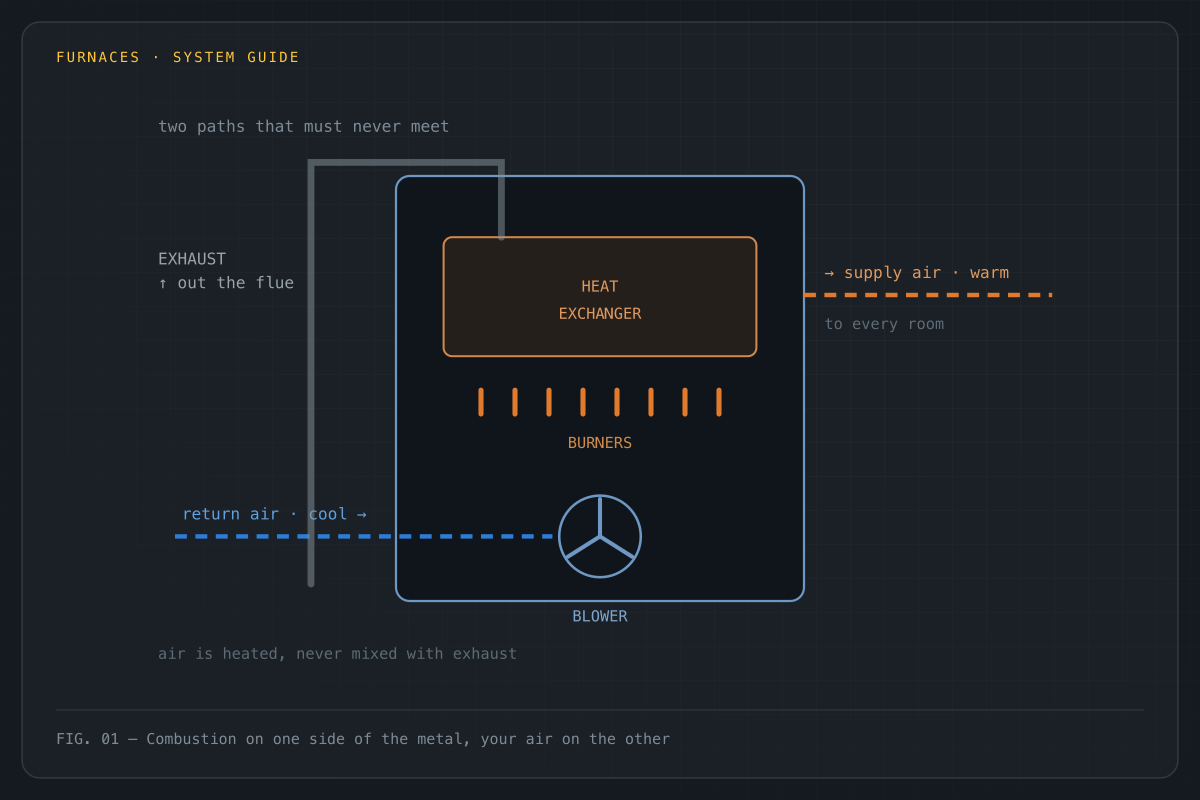
What a furnace is — and what keeps getting called one
A furnace heats air and blows it through ducts. Everything else in your basement heats something other than air.
Three machines get confused for each other, and picking the wrong one is how people end up reading the wrong repair page. A furnace heats air and moves it through ducts to vents in each room. A boiler heats water and sends it to radiators or baseboards — no ducts, no blower, entirely different repairs. A heat pump does not create heat at all; it moves heat in from outside, and reverses in summer to cool.
On this page
The quick test: walk to a room and look at how heat arrives. Vents blowing warm air mean a furnace. Radiators or baseboard fins mean a boiler. And if the box outside your house runs in January, you have a heat pump, whatever the previous owner called it. Furnaces are the most common heating equipment in American homes — roughly 46% of households heat with gas, according to the Appliance Standards Awareness Project.
Which fuel you burn, and what it changes
The fuel decides the running cost, the carbon-monoxide risk, and which parts a technician will ever replace.
This is the fork that governs every other page in this section. Two furnaces can look identical and share nothing on the repair invoice, because one lights a flame and the other does not.
| Fuel | How to tell | Running cost | CO risk | Parts that fail |
|---|---|---|---|---|
| Natural gas | A black iron pipe runs to the furnace; no tank on the property | Usually the least costly to run in metro areas | Yes — combustion | Ignitor, flame sensor, gas valve, heat exchanger |
| Propane | Same furnace, but fed from a tank in the yard | Higher per-unit cost than piped gas | Yes — combustion | Same as gas, plus regulator and tank supply |
| Oil | A basement tank and a burner that roars rather than clicks | Varies with heating-oil prices; common in the Northeast | Yes — combustion, plus soot | Nozzle, fuel pump, filter, electrodes |
| Electric | No flue, no gas line — heavy wiring and a big breaker instead | Highest running cost per unit of heat | None — no combustion | Elements, sequencers, contactors, blower |
An electric furnace has no flame, no flue and no heat exchanger to crack, so it carries no carbon-monoxide risk whatsoever. It also costs the most per unit of heat delivered, which is why it tends to appear where a gas line never reached.
The twelve parts, and what each one does when it dies
Most of a furnace exists to prove it is safe to open a gas valve — and most no-heat calls are one of those proofs saying no.
Manufacturer pages list four or five parts. A real furnace has a chain of interlocks, and the interlocks are what actually fail. The column on the right is the one no brochure prints.
| Part | What it does | Where | What you notice when it fails |
|---|---|---|---|
| Thermostat | Closes a 24-volt circuit that asks the furnace for heat | Living space | Nothing happens at all, or the furnace never shuts off |
| Inducer motor | Spins first to pull leftover gas out of the heat exchanger | Inside cabinet | A whine or grinding before ignition; then nothing lights |
| Pressure switch | Proves the inducer is actually drawing before gas is allowed | Inside cabinet | Inducer runs, ignitor never glows — often a blocked vent |
| Ignitor | Glows white-hot (or sparks) to light the burners | Burner compartment | You hear clicks or see nothing glow; no heat |
| Gas valve | Opens to release fuel to the burners once ignition is proven | Burner compartment | Ignitor glows, but the burners never light |
| Burners | Where the fuel actually burns, in a steady blue flame | Burner compartment | Yellow or lazy flames; soot; uneven heat |
| Flame sensor | A thin metal rod that proves a flame exists within seconds | Burner compartment | Lights, then dies a few seconds later — the classic no-heat call |
| Heat exchanger | The metal wall that heats your air while keeping exhaust out of it | Inside cabinet | Cracks release carbon monoxide — the one failure that is never DIY |
| Blower motor | Pushes the warmed air through the supply ducts | Inside cabinet | Heat builds but no air moves; the furnace trips on high limit |
| Limit switch | Shuts the gas off if the exchanger overheats, and keeps the blower running | Inside cabinet | Heats, then quits mid-cycle — usually a starved filter |
| Flame rollout switch | Trips when flame escapes the burner box, which it never should | Burner compartment | A hard lockout that keeps returning — a real combustion fault |
| Control board | Sequences every step above and flashes the diagnostic code | Inside cabinet | Random behaviour, or a blinking LED that names the fault |
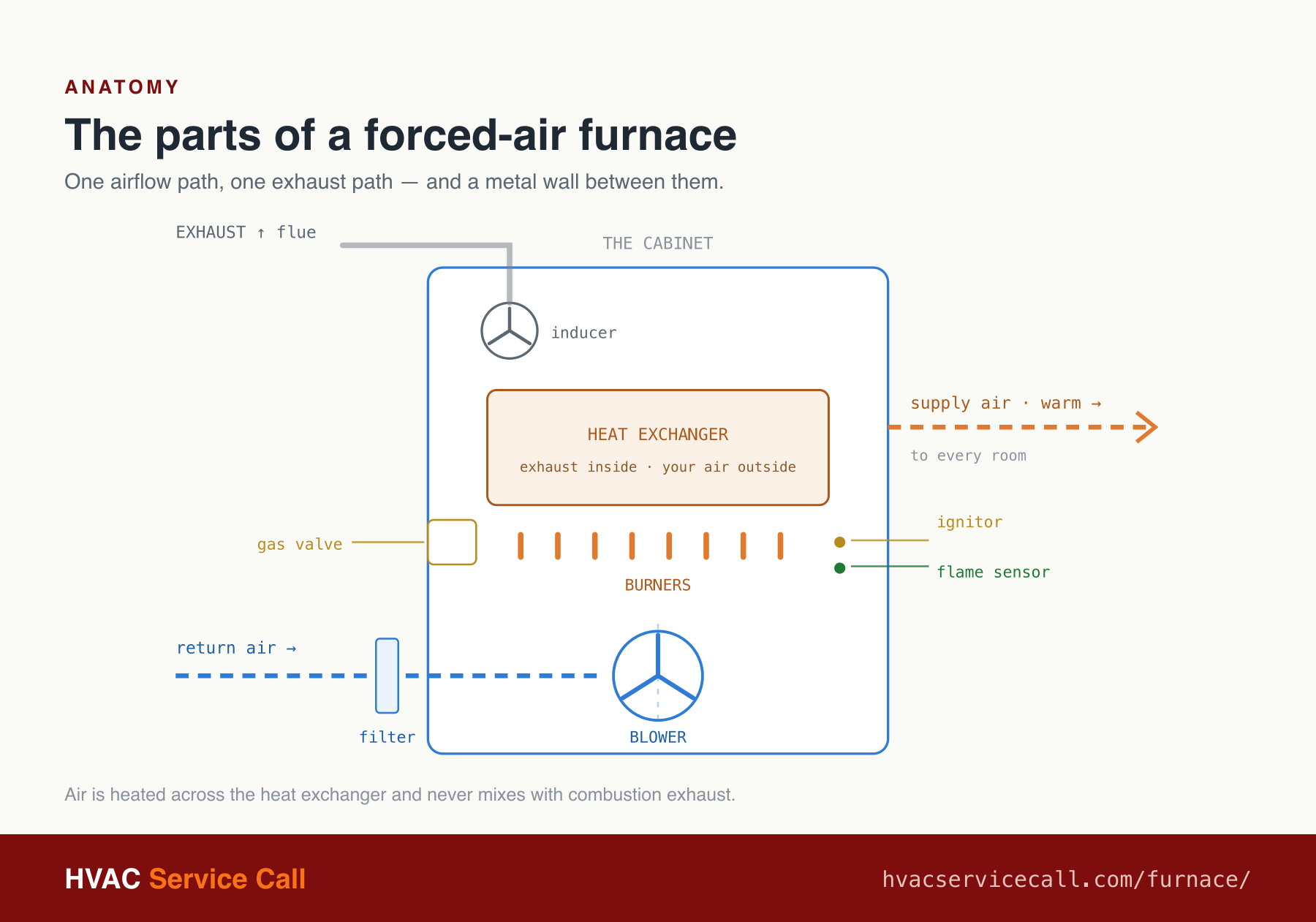
Notice how many of those are safety devices rather than heating devices: pressure switch, flame sensor, limit switch, rollout switch. A furnace spends its life refusing to light unless four separate things agree. See what a repair covers, or what each part costs.
How a furnace fires, step by step
Eight things happen in a fixed order every time you feel warm air. Knowing where the order broke names the part before anyone opens the cabinet.
Technicians call this the sequence of operation, and it is the single most useful thing a homeowner can understand about a furnace. Consumer pages skip it. But almost every symptom in the next section is simply this list stopping at a particular step.
- Thermostat calls for heat
A 24-volt circuit closes and the control board wakes up.
If it stops hereNothing at all: thermostat, power, or the door safety switch.
- Inducer purges
The inducer motor spins up and clears the heat exchanger of any unburned gas.
If it stops hereSilence, or a grinding inducer.
- Pressure switch proves draft
Only once suction is confirmed is the furnace allowed to open gas. No draft, no fuel.
If it stops hereInducer runs, ignitor never glows — a blocked vent, or a snow-covered sidewall pipe.
- Ignitor heats
A hot-surface ignitor glows white; older units throw a spark instead.
If it stops hereNo glow, no click — a cracked ignitor is a consumable, not a disaster.
- Gas valve opens, burners light
Fuel meets the glowing ignitor and the burner tray lights across.
If it stops hereIgnitor glows but nothing lights: gas valve, or no gas supply.
- Flame sensor proves flame
Within a few seconds a metal rod must confirm a real flame, or the board shuts the gas.
If it stops hereLights, then dies in seconds. A dirty sensor is the single most common no-heat cause.
- Blower starts, on a delay
The furnace waits ~30–60 seconds so it never pushes cold air at you first.
If it stops hereCold air at the vents right away, then it warms — often normal.
- Limit switch supervises
If the exchanger overheats, gas is cut but the blower runs on to carry heat away.
If it stops hereHeats, then shuts down mid-cycle. Start with the filter.
Two of those steps account for a startling share of winter calls. A dirty flame sensor stops step six, so the furnace lights and dies in a loop. A clogged filter starves airflow until the limit switch trips at step eight, so the furnace heats and then quits partway through. Neither is a broken furnace. Both are a furnace protecting itself exactly as designed.
Which furnace you have — read it off the exhaust
The pipe carrying exhaust out of your house tells you the efficiency of the furnace attached to it, without opening anything.
Natural draft
Exhaust rises up a chimney on its own, with no fan to help it. There is a constant open path from the burners to the outdoors, which is why these furnaces lose so much heat up the flue.
Induced draft
An inducer fan pulls exhaust out through a metal vent. Closing that path except when the furnace runs is exactly what raised efficiency from the 60s into the 80s.
Condensing
A second heat exchanger pulls so much heat out of the exhaust that the water vapour in it condenses. The exhaust leaves cool enough to travel through plastic pipe, and the condensate needs a drain.
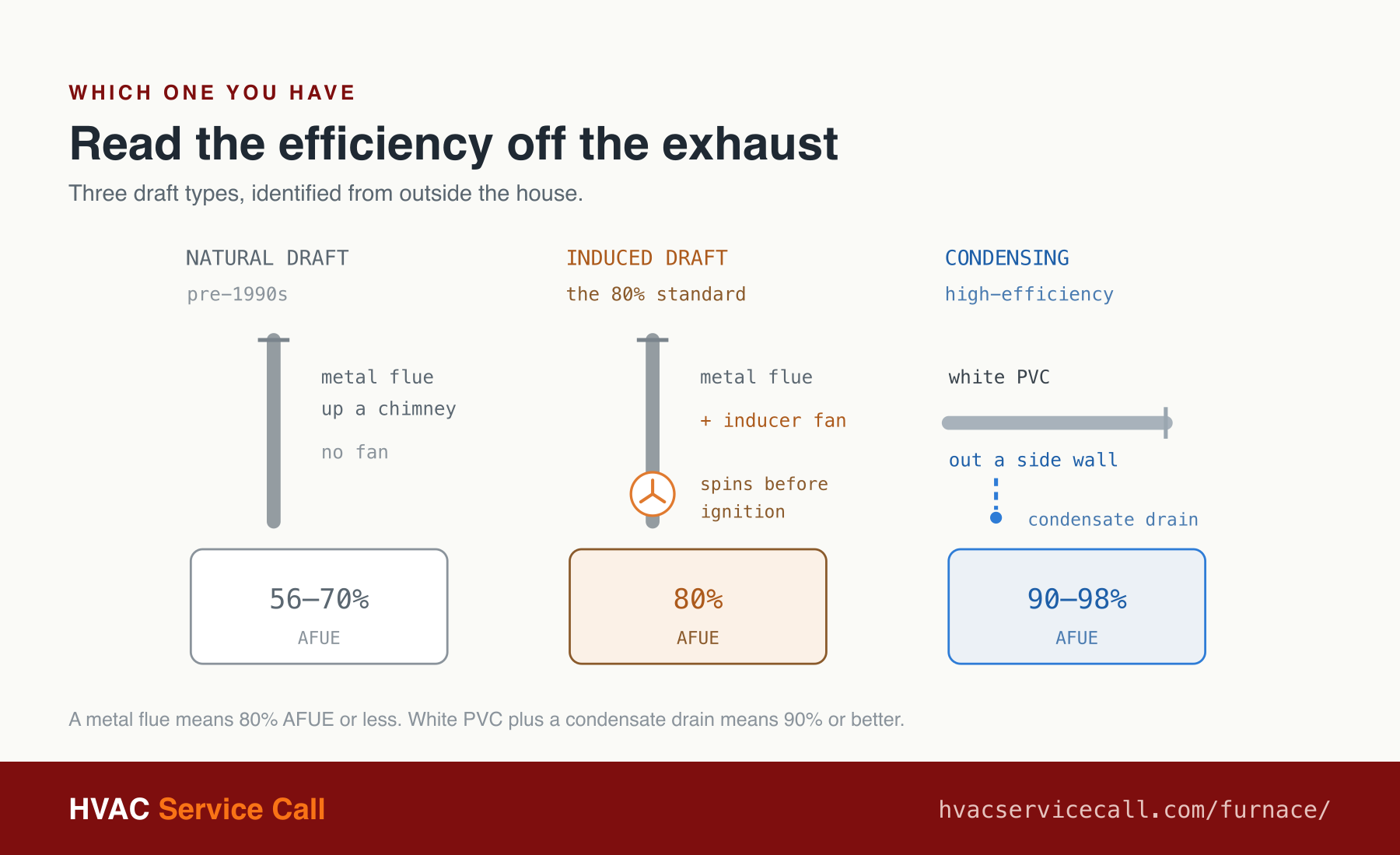
That white plastic pipe is doing something counterintuitive. A condensing furnace pulls so much heat out of its own exhaust that the water vapour inside condenses back to liquid — which is why the exhaust is cool enough for PVC, and why the furnace needs a drain. It also creates a failure mode the other two do not have: a condensate drain can clog, and a snow drift can block a sidewall vent, and either one will stop the furnace at step three of the sequence above.
AFUE and stages, in plain English
AFUE is the share of your fuel that becomes heat in the house. Stages decide how gently the furnace delivers it.
AFUE — Annual Fuel Utilization Efficiency — is a percentage, and it reads exactly how it sounds. An 80% AFUE furnace turns 80 cents of every fuel dollar into heat and sends the other 20 up the flue. A 95% AFUE furnace keeps 95 of them. That difference is the entire argument for condensing equipment, and the entire reason it needs a drain.
Staging is the part the brochures skip, and it decides the comfort complaint rather than the bill. A single-stage furnace is full blast or off, which means warm blasts and cold lulls. A two-stage furnace has a low gear it runs in most of the time, so temperatures hold steadier. A modulating furnace adjusts its flame continuously, holds a room within about a degree, and costs the most to buy. None of this changes AFUE much — it changes whether you notice the furnace running.
Sizing beats staging, though, and it beats efficiency too. An oversized furnace short-cycles: it satisfies the thermostat fast, shuts off, and hammers its own ignition components with far more starts than they were built for. That math is a Manual J load calculation, not a rule of thumb.
The 2028 rule every furnace shopper is about to meet
From December 2028, new non-weatherized gas furnaces must reach 95% AFUE. Your current furnace is untouched by this.
Natural draft
Standing pilots and open chimneys. Roughly 56–70% of the fuel became heat in the house.
80% AFUE floor
Induced draft is the federal minimum for non-weatherized gas furnaces, and most homes have one.
DOE finalizes 95%
The Department of Energy raises the minimum to 95% AFUE. Gas-industry challenges failed in court in 2025.
Condensing only
New non-weatherized gas furnaces must reach 95% AFUE — which in practice means condensing equipment.
The Department of Energy finalized the standard in September 2023, and the gas industry's legal challenge to it failed in 2025. Because 95% AFUE cannot realistically be met without condensing technology, the rule effectively ends the manufacture of new non-condensing residential gas furnaces.
Nothing in this rule requires you to replace a working furnace, and nothing makes it illegal to repair one. Efficiency standards govern what manufacturers may build after the compliance date — not what homeowners may own or service. If a salesperson tells you your 80% furnace must go because of 2028, that is a sales pitch, not the regulation.
One practical consequence is worth planning around: replacing an 80% furnace with a condensing one means new PVC venting and a condensate drain, which is real work in a house that has neither. Read that through on furnace replacement before you are deciding it on a January morning.
The heat exchanger, and the one failure that is never DIY
The heat exchanger is a metal wall between the fire and the air you breathe. When it cracks, exhaust crosses that wall.
Everything a gas furnace does depends on one idea: combustion happens on one side of a metal barrier, your household air passes over the other side, and the two never meet. Exhaust leaves through the flue. A cracked or corroded heat exchanger breaks that separation, and carbon monoxide — colourless, odourless — enters the air the blower is pushing into every room.
Warning signs worth knowing: soot around the burner area, flames that burn yellow and lazy instead of crisp and blue, unusual condensation on windows while the furnace runs, and headaches, dizziness or nausea among people in the house that ease when they leave it and return when they come back.
Leave the building immediately, taking everyone with you. Do not stop to open windows, shut the furnace off, or investigate. From outside, call 911 or your gas utility's emergency line. Do not go back in until they tell you it is safe. Carbon monoxide detectors belong on every level of the home and outside sleeping areas, and a cracked heat exchanger is condemned equipment — never a repair you attempt yourself.
The full picture, including how technicians actually inspect an exchanger for cracks, is on furnace carbon monoxide safety.
When it stops heating: symptom, likely part, where to read next
Nearly every furnace failure announces itself in one of seven ways, and each one points at a short list of parts.
| What you notice | Likely part | Check yourself first | Read next |
|---|---|---|---|
| Nothing happens at all | Thermostat · breaker · door switch | Batteries, breaker, and that the front panel is fully seated | Won't turn on → |
| It lights, then dies a few seconds later | Flame sensor | Watch the burners: a flame that appears then drops out | Blowing cold → |
| The blower runs but the air is cold | Flame sensor · gas valve · limit switch | Is the burner tray lighting at all? | Blowing cold → |
| It tries three times, then locks out | Flame sensor · gas supply · pressure switch | Read the blinking code on the control board | Won't turn on → |
| It heats, then quits partway through | Limit switch · dirty filter · closed vents | Pull the filter and hold it up to a light | Troubleshooting → |
| Yellow flames, soot, or a CO alarm | Heat exchanger · combustion air | Do not check. Leave, then call from outside | CO safety → |
| Water pooling at the base | Condensate drain or trap | Only 90%+ furnaces make condensate — look for a clogged hose | Troubleshooting → |
The filter, the thermostat batteries, the breaker, the furnace door seated properly, and clearing snow away from a sidewall vent are all yours. The gas line, the gas valve, the burners, the heat exchanger and anything behind the burner compartment belong to a licensed technician. One rule has no exceptions: never bypass, jumper or tape a safety switch. The pressure switch, limit switch and rollout switch exist to stop a fire or a poisoning, and a furnace that keeps tripping one is telling you something true.
If the house is already cold and dropping, work the no-heat survival guide while you wait.
How long it lasts, and what keeps it there
15 to 30 years for the furnace — but the ignitor is a consumable and the flame sensor wants cleaning every single year.
Gas furnaces sit in the middle of that band and electric furnaces reach the top of it, because an electric furnace has no combustion parts to corrode. Past about fifteen years, a major repair — a heat exchanger, a control board and a blower in the same season — starts to argue for replacement. The age bands and the one-third rule live on repair or replace.
Yours, no tools required
- Change the filter on schedule — thin filters monthly in heating season, thick pleated ones every 3 to 12 months. This one habit prevents most limit-switch shutdowns.
- Keep the area around the furnace clear, and never store paint, solvents or boxes against it.
- If you have PVC exhaust pipes through a side wall, keep snow and leaves away from them.
- Test every carbon-monoxide alarm at the start of each heating season.
The technician's annual visit
- Clean the flame sensor — the least expensive insurance against a mid-January no-heat call.
- Inspect the heat exchanger for cracks and the burners for soot or lazy flame.
- Test every safety: pressure switch, limit switch, rollout switch.
- Verify gas pressure, draft and venting, then measure the blower's current draw.
The first item on that second list is the whole argument for a tune-up. A flame sensor coated in a season's residue costs minutes to clean on a scheduled visit and a full emergency call-out once it strands you. Book the annual tune-up, or read our unbiased take on maintenance agreements.
Everything about your furnace
Furnace repair →
The problems we route, the free pre-call checks, and what a visit looks like.
Furnace repair cost →
Itemized by part, with the honest anatomy of a heating bill.
Furnace won't turn on →
No response at all — the power, thermostat, and ignition checklist in order.
Furnace blowing cold →
It runs, the air is cold. Flame sensor and limit-switch faults, explained.
Furnace troubleshooting →
Symptom by symptom, with the exact moment to stop and call.
Carbon monoxide safety →
Cracked heat exchangers, the warning signs, and what to do first.
Furnace replacement →
When repair stops making sense, and what the install day involves.
Furnace vs heat pump →
Two different machines for the same job — which one suits your climate.
One call routes you to a licensed local HVAC contractor for furnace repair, 24/7, nationwide: (888) 810-2291 — or start at furnace repair.
Same-day and 24/7 emergency services are subject to provider participation, location, technician availability, and demand. Availability is not guaranteed and may vary by market and appointment capacity.
Common questions
What's the difference between a gas and electric furnace?
A gas furnace burns natural gas or propane to heat air and vents the exhaust outside; an electric furnace uses heating elements, like a giant hair dryer, with no combustion and no carbon-monoxide risk. Gas costs less to run in most areas; electric costs less to install and often lasts longer, because it has fewer parts that can fail.
How long do furnaces last?
Typically 15 to 30 years with regular maintenance. Gas furnaces sit in the middle of that band; electric furnaces often last longer because they have no combustion parts. Past roughly 15 years, repeated repairs and slipping efficiency start to favour replacement.
What is AFUE?
AFUE, or Annual Fuel Utilization Efficiency, is how much of your fuel becomes heat in the house. An 80% AFUE furnace turns 80 cents of every fuel dollar into heat and sends the rest up the flue. High-efficiency models reach 90 to 98% but produce condensation that needs a drain.
How do I know if my furnace is high efficiency?
Look at the exhaust. A white PVC plastic pipe leaving through a side wall, plus a drain hose, means a condensing furnace at 90% AFUE or better. A metal flue going up a chimney means 80% or less. You do not need to open anything to tell the difference.
Why does my furnace light and then shut off after a few seconds?
That pattern almost always points at the flame sensor — a thin metal rod that must confirm a real flame within seconds, or the control board closes the gas valve as a safety measure. The rod gets coated over a season of burning and stops reading the flame. Cleaning or replacing it is a routine, inexpensive repair.
Is a furnace the same as a heat pump?
No. A furnace makes heat by burning fuel or energizing electric elements. A heat pump moves heat from outdoor air into your home, and reverses to cool in summer. If your outdoor unit runs in winter, you have a heat pump, not a furnace.
Will I have to replace my furnace in 2028?
No. The Department of Energy's 95% AFUE standard applies to furnaces manufactured after the compliance date in December 2028. Your existing furnace stays legal to run, service, and repair for its whole life. The rule changes what is built and sold, not what you already own.
Why does my furnace smell the first time it runs each winter?
That is dust burning off the heat exchanger after months of sitting idle. It is normal and clears within an hour or so. A burning-plastic smell, an electrical smell that lingers, or any smell of gas is a different matter and needs immediate attention.