Home heating, explained
Four different machines get called "the heat" — a furnace, a boiler, a heat pump, or a ductless mini split. Which one you own decides every piece of advice that follows, and you can identify it in about thirty seconds.
"Heating system" names four technologies that share almost no parts and almost no failures.
Advice written for a furnace is often actively wrong for a boiler or a heat pump.
Some alarming winter behaviour is by design — a heat pump's defrost cycle above all.
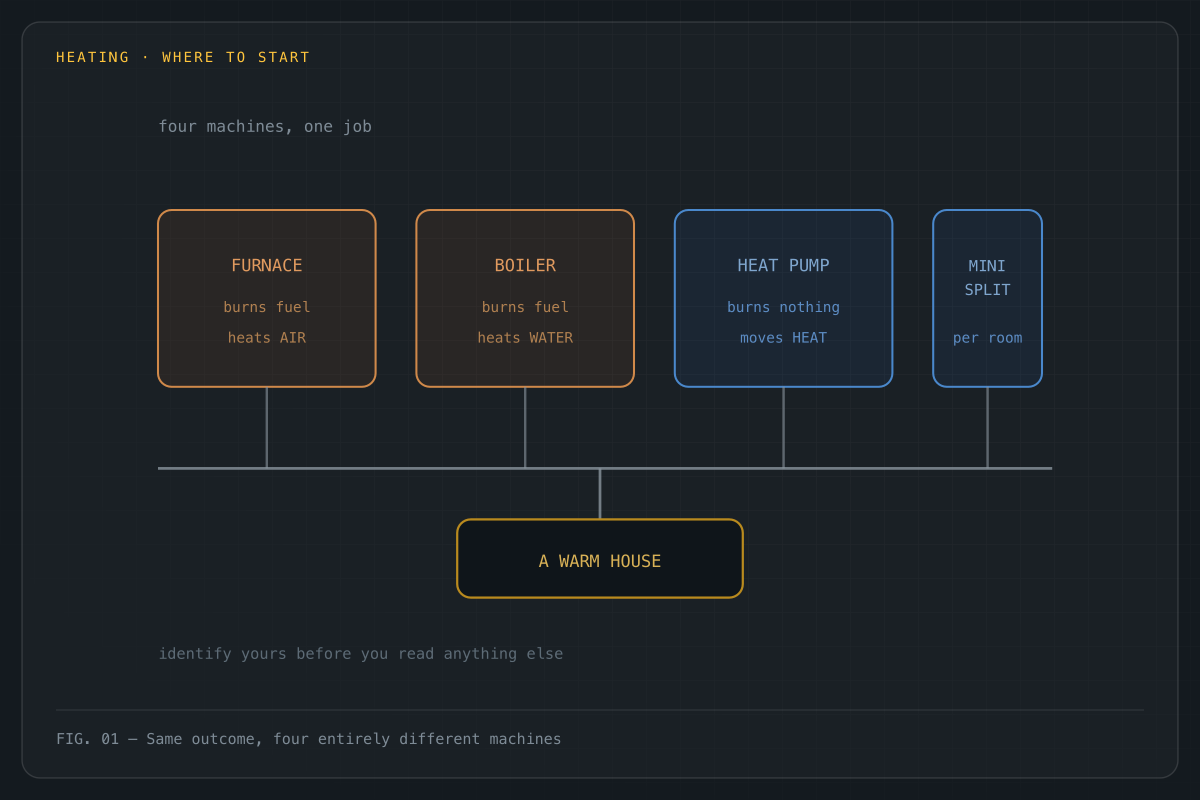
Four ways to heat a home
Two of them burn fuel to make heat. Two of them move heat that already exists. Everything else follows from that split.
A furnace burns gas, propane or oil and blows the warmed air through ducts. A boiler burns the same fuels but heats water instead, and pumps it to radiators. A heat pump burns nothing at all: it collects heat from the outdoor air and carries it inside, then reverses in summer to cool. A ductless mini split is a heat pump that skips the ducts and hangs a head in each room.
On this page
This page exists because almost every heating article on the internet assumes you already know which of the four you own — and then gives advice that is wrong, sometimes dangerously so, if you own a different one. Bleeding a radiator is sound advice for a boiler and meaningless for a furnace. A carbon-monoxide alarm matters enormously on the two that burn fuel and not at all on the two that do not. Start here, then read the page that applies to you.
Identify yours in thirty seconds
Walk into any room and look at how the heat arrives. That single observation narrows four systems to one or two.
| What you see | What you have | How to confirm it | Read next |
|---|---|---|---|
| Warm air from vents, and a metal cabinet with a flue | Furnace | A metal flue to a chimney means 80% or less. White PVC out a side wall means 90%+. | Furnaces → |
| Radiators or baseboard fins, and no vents anywhere | Boiler | A pressure gauge reading near 12 psi. A sight glass instead means it is a steam boiler. | Boilers → |
| Warm air from vents, and the outdoor unit runs in January | Heat pump | An air conditioner has no reason to run in winter. This one does, because it is heating. | Heat pumps → |
| Wall or ceiling heads, one per room, no ducts | Ductless mini split | Almost certainly a heat pump too, so it heats and cools from the same box. | Mini splits → |
| Baseboard heaters that get hot, with no pipes and no boiler | Electric resistance | No combustion, no refrigerant, and no outdoor unit. Simple, reliable, and costly to run. | Compare options → |
The one genuinely tricky pair is a furnace and a ducted heat pump, because both deliver warm air to ordinary vents and both have a cabinet indoors. The tiebreaker is the outdoor unit in winter. An air conditioner sits idle in January; a heat pump runs, because running is how it heats.
How the four compare
Only two of them can cool your house in summer. Only two of them can produce carbon monoxide.
| System | Heats | Needs ducts | CO risk | Also cools | Typical life |
|---|---|---|---|---|---|
| Furnace | Air | Yes | Yes — combustion | No | 15–30 yr |
| Boiler | Water | No | Yes — combustion | No | 15–30 yr |
| Heat pump | Air | Usually | None | Yes | 10–20 yr |
| Mini split | Air, per room | No | None | Yes | 15–20 yr |
Carbon monoxide is produced only by systems that burn fuel — furnaces and boilers running on gas, propane or oil. A heat pump, a mini split and electric resistance heat involve no combustion whatsoever and carry no CO risk. If you heat with fuel, working CO alarms on every level of the home are not optional. The warning signs and what to do are on carbon monoxide safety.
What "no heat" means on each system
The same complaint has four different meanings, and one of them usually means nothing is broken at all.
- Furnace
It refuses to light. A furnace spends its life proving four separate safeties agree before it opens a gas valve, and a no-heat call is usually one of those proofs saying no — most often a dirty flame sensor.
Where to read nextFurnace won't start →
- Boiler
The heat is made but not moved, or the pressure is wrong. A boiler that is hot while the radiators are cold has a pump, a zone valve, or an air lock. The gauge on the front tells you a great deal.
Where to read nextBoiler troubleshooting →
- Heat pump
Often nothing is wrong. Steam off the outdoor unit and cool air indoors for a few minutes is a defrost cycle. A shocking electric bill usually means the thermostat was left on emergency heat.
Where to read nextHeat pump repair →
- Mini split
The head blinks a fault code at you before anyone opens anything. Count the blinks. Water down the wall is the condensate drain, and it is the commonest call of all.
Where to read nextMini split repair →
If the house is cold and dropping right now, stop reading and work the no-heat survival guide, which is written to be useful before you know which system you have.
Efficiency is not one number
Fuel-burning systems are rated in AFUE. Heat pumps are rated in HSPF2. The two scales do not compare, and pretending they do produces nonsense.
AFUE measures the share of fuel that becomes heat in your house. A 95% AFUE furnace keeps 95 cents of every fuel dollar and sends 5 up the flue. It can never exceed 100%, because it is turning fuel into heat and some always escapes.
A heat pump can appear to exceed 100%, and this is not marketing. It is not converting electricity into heat; it is spending electricity to move heat that was already outdoors. In mild conditions it commonly delivers three to four units of heat per unit of electricity. That is why comparing a 95% furnace against a heat pump using percentages is meaningless — they are measuring different physical acts.
The comparison that does mean something is money per unit of delivered heat, which is a local question about the price of gas against the price of electricity. That is worked through on heat pump vs furnace.
What it costs to run
Running cost is decided by your utility rates, not by the badge on the equipment.
Ordered roughly by what most households pay per unit of delivered heat, electric resistance heat sits at the expensive end, oil and propane in the middle, and natural gas and heat pumps compete at the other end. Where exactly a heat pump lands against natural gas depends on the ratio of your electricity price to your gas price, and that ratio varies by state, by utility, and by year. Anyone who tells you one answer for the whole country is selling something.
Two structural facts are stable, though. A heat pump replaces a furnace and an air conditioner with one machine, so its cost is offset against two. And the federal 25C tax credit that used to soften the price of a heat pump applied to improvements made through December 31, 2025 and no longer exists — a detail a great deal of online advice has not caught up with. State and utility rebates may still apply where you live.
How long each lasts
Boilers and furnaces reach thirty years. Heat pumps rarely do, and there is a simple reason.
A furnace rests all summer and a boiler rests harder still. A heat pump works in both seasons and accumulates roughly twice the running hours in the same calendar, which is most of why it sits lower in the table. None of these numbers decide anything on their own — the age bands and the one-third rule on repair or replace are the honest way to weigh a specific repair against a specific machine.
Everything about heating
Furnaces →
Forced air, fuel types, the firing sequence that explains every no-heat call.
Boilers →
Hot water and steam, the pressure gauge, and why the relief valve drips.
Heat pumps →
Moves heat instead of making it — and heats and cools from one box.
Ductless mini splits →
No ducts, one head per zone, and the maintenance nobody mentions.
Heat pump vs furnace →
The comparison that actually turns on your local fuel prices.
No heat right now →
The survival guide, for while you wait for a contractor.
Carbon monoxide safety →
What a cracked heat exchanger does, and what to do first.
HVAC repair cost →
What common heating repairs actually run, part by part.
One call routes you to a licensed local HVAC contractor for heating repair, 24/7, nationwide: (888) 810-2291 — or start with the no-heat guide.
Same-day and 24/7 emergency services are subject to provider participation, location, technician availability, and demand. Availability is not guaranteed and may vary by market and appointment capacity.
Common questions
How do I know what kind of heating system I have?
Look at how heat arrives in a room. Vents blowing warm air mean a furnace or a heat pump; radiators or baseboard fins mean a boiler; a head on the wall means a ductless mini split. To separate a furnace from a heat pump, check whether the outdoor unit runs on a freezing day. An air conditioner has no reason to; a heat pump does, because that is how it heats.
What is the difference between a furnace and a boiler?
A furnace heats air and blows it through ducts to vents. A boiler heats water and pumps it to radiators or baseboards. They share almost no parts and almost no failures, which is why generic heating advice is often wrong for one of them.
Which heating system costs the least to run?
It depends on local fuel prices, not on the equipment. A heat pump moves several units of heat per unit of electricity, which usually beats electric resistance heat, oil and propane. Whether it beats natural gas is a question about the price of gas and the price of electricity where you live, and the answer changes by state and by year.
Does a heat pump work when it is freezing outside?
Yes, though it delivers less heat as the temperature falls. Below its balance point — often between 25 and 35°F — backup heat starts helping. Cold-climate models are designed to keep useful output well below freezing.
Which heating systems can produce carbon monoxide?
Only the ones that burn fuel: gas, propane and oil furnaces, and gas, propane and oil boilers. Heat pumps, mini splits and electric resistance heat involve no combustion and carry no carbon-monoxide risk. Every home with combustion heating should have working CO alarms on each level.
How long should a heating system last?
Broadly, 15 to 30 years for a furnace or a boiler, 10 to 20 for a heat pump, and 15 to 20 for a mini split. Heat pumps sit lower because they run in both seasons and accumulate roughly twice the hours per year.
My heat is blowing cold air. What is wrong?
It depends entirely on the system. On a furnace, cold air usually means it lit and then shut off — a flame sensor. On a heat pump, a few minutes of cool air while the outdoor unit steams is a normal defrost cycle. Identifying your system first, on this page, will save you reading the wrong advice.