Emergency HVAC repair in Covington, KY
Looking for emergency HVAC repair in Covington, KY? Call (888) 810-2291 — the call is free and connects you with a licensed local contractor on emergency duty 24/7, whether the furnace quit at 3°F or the AC folded in a 92°F stretch. Expect $70–$180 for the diagnostic visit, typically credited when the repair goes ahead. Routing reaches every corner of the city — MainStrasse Village, Latonia, Wallace Woods, Peaselburg, Botany Hills — and all 32 Kenton County ZIPs, 41011, 41014, 41015, and 41017 among them.
When is an HVAC problem an emergency in Covington?
Covington's emergency calendar leans hard toward winter. The city logs 4,627 heating degree-days against a design low of 3°F — the coldest of the Kentucky cities we cover — and its gas-majority housing shapes the risk: in the 52% of homes on gas, a freeze failure is a furnace that won't light, plus the carbon-monoxide question that rides with combustion; in the 41% on electric heat, it's usually the backup strips quitting and the vents going lukewarm. Summer brings the mirror image for a shorter stretch, with design highs at 92°F. And any day of the year, a gas odor or CO alarm outranks everything: out of the house first, calls from outside.

When is it not an emergency — and can it wait until morning?
Plenty of after-hours calls could have been cheaper morning appointments. An air conditioner that slips two or three degrees at the peak of a 92°F river-valley afternoon is at its physical limit, not failing is running at its physical limit, not failing; a bedroom that won't match the hallway, or a rattle that comes and goes while heat and cooling both keep working, will still be there — fixable at the standard rate — tomorrow. Save the emergency line for the list below.
Warning signs: call now, safe to wait, or check yourself first?
Run the triage before you decide what kind of call this is.
Call now
- A gas odor anywhere in the house, or a carbon-monoxide alarm
- Burning, electrical, or hot-plastic smells from a vent or the unit
- Grinding, shrieking, or visible sparking
- Water spreading toward the furnace, air handler, or wiring
- No heat at 3°F — or no cooling in a 92°F stretch — with a baby, an older adult, or a medically fragile person home
Usually safe to wait
- A set point the system misses by a few degrees during a temperature extreme, while it keeps running
- One room that runs off-temperature while the rest of the house holds steady
- An intermittent rattle from a system that still heats and cools
Check yourself first
- Thermostat mode, schedule, or dead batteries
- A tripped breaker, or the furnace power switch someone bumped in the basement
- A clogged filter choking off airflow
- An all-electric home blowing cool-ish air in a freeze — set the thermostat to emergency heat and call; that pattern usually points at the backup strips, not the whole system
Deeper walk-throughs: furnace won't start, AC won't start, and HVAC smells.
What should you do while you wait for the technician?
Help booked, hours to fill — and in Covington the safe way to fill them turns on the season and the housing. This is a 52%-gas-heat town on some of the oldest stock we cover, so a winter no-heat call is really a frozen-pipe race: in the older rowhouses the plumbing often runs inside uninsulated exterior walls, so before anything else open the cabinet doors on outside walls and set one faucet to a slow drip. On a summer no-cool day the priority flips to people — move to a low, shaded floor, keep water close, and pull the blinds on the sun side of the house.
The full hour-by-hour playbook for each case lives on two guides: what to do when the AC quits in the heat and what to do when the heat quits in the cold. Work from whichever one fits while the contractor is on the way.
Gas smell or a CO alarm: this outranks every step above — leave the house immediately, touch no switches, and call the gas utility and 911 from outside before anyone re-enters.
Carbon monoxide — the emergency that isn't about comfort
Covington is a gas-heat town — 52% of homes burn gas, on the oldest housing stock we cover — so here one furnace failure is a life-safety event rather than a comfort problem: a cracked heat exchanger or a blocked flue leaking carbon monoxide into the supply air. The gas is odorless and colorless, and the poisoning imitates the flu without the fever:
Detectors go on every level and near sleeping areas, not beside the furnace, tested each fall. An alarm or those symptoms mean everyone outside, then the gas utility and 911 from the street. Full guide: furnace carbon-monoxide safety.
Emergencies and vulnerable residents — the health signs that mean 911
Lost heating or cooling lands hardest on infants, elders, and anyone managing a chronic condition. The equipment is the contractor's job — but these signs in a person come first and go to 911.
Heat
Warning: Heat exhaustion: heavy sweating, cramps, weakness, light-headedness.
Call 911: Heat stroke (call 911): hot dry skin, confusion, body temperature above 103°F.
Cold
Warning: Early cold stress: hard shivering, numb fingers and toes, fatigue.
Call 911: Hypothermia (call 911): shivering that stops, slurred speech, drowsiness.
How much does emergency HVAC repair cost in Covington?
The daytime diagnostic in Covington runs $70–$180 — walk away and that's the whole bill; approve the repair and most shops fold it into the total, mechanics covered in the service-call fee guide. Off the clock the math changes: evenings, weekends, and holidays typically price at roughly 1.5 to 2 times standard, and a straight answer on which window you're in comes before the truck moves.

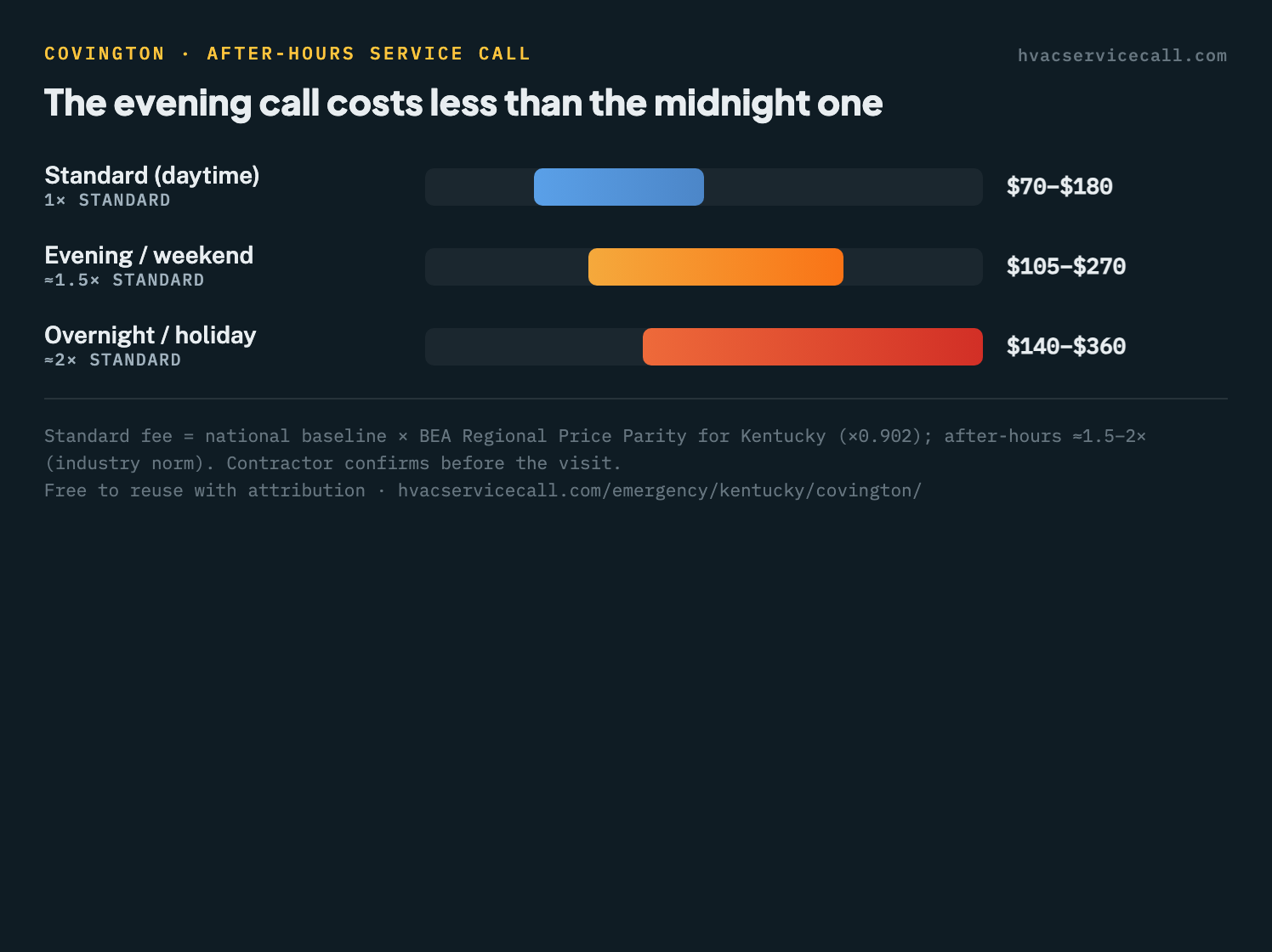
| Time window | Low | High | Vs standard |
|---|---|---|---|
| Standard (daytime) | $70 | $180 | 1× |
| Evening / weekend | $105 | $270 | ≈1.5× |
| Overnight / holiday | $140 | $360 | ≈2× |
Is it a power problem or an equipment failure?
Rule out the electrical panel before declaring the equipment dead — plenty of midnight "failures" are one tripped breaker.
- Whole-home outage
- if the lights are out too, it's Duke Energy's problem rather than your equipment — the system should restart on its own once power returns, after the compressor's built-in delay.
- One dead circuit
- check the main panel and the outdoor disconnect; a single tripped breaker earns one reset.
- It keeps tripping
- a second trip right after a reset is the system shielding you from a real electrical fault. Leave it off and make the call — resetting into a fault can take out the compressor.
Which HVAC emergencies do Covington contractors handle?
Every failure below has a taker on the emergency roster — each card opens the full Covington page for that system.
What can actually be fixed tonight — and what waits for morning?
Set the expectation before the driveway conversation: overnight work is limited to what's already on the truck, with everything else bridged until parts arrive.
- Fixed on the overnight visit (truck stock)
- Capacitors, contactors, hot-surface igniters, flame-sensor cleanings, thermostats, drain clears, fuses, low-voltage repairs — the short list behind most of Covington's no-heat and no-cool calls, usually running again before the technician backs out.
- Diagnosed tonight, finished later (ordered parts)
- Compressors, coils, blower and inducer motors, boards, gas valves, reversing valves. The night visit nails the diagnosis and produces a written quote; the part shows up in one to three days — sometimes longer on the discontinued components common in Covington's older systems.
- Bridged in the meantime
- For an electric-heat home, backup strips can carry a heat-pump house through the gap at a higher power bill. Otherwise it's a rated space heater in one closed room, or fans and a thawed coil in July — the technician names the bridge before leaving.
- Never fixed at night
- A condemned heat exchanger or an active gas leak stops the visit cold — the utility clears the house before any repair gets scheduled. On Covington's aged gas furnaces that's a real possibility, and it's the safety line, not a service gap.
Your furnace sat in water — can it be dried out and restarted?
No, and this is the one HVAC emergency where the honest answer is the expensive one: equipment that has been submerged has to be replaced, not repaired. The industry position is unambiguous — AHRI (formerly GAMA) has held since 2004 that flood-damaged heating and cooling equipment should be replaced, because corrosion starts inside gas valves and control boards where it cannot be seen. A furnace whose exterior has been wiped clean and dried can still hold a valve that will fail weeks later, and a gas valve that fails is not a reliability problem, it is a combustion one.
Covington earns its own section on this. The city sits behind a floodwall built after the 1937 Ohio River flood — the one that put roughly 40% of Covington under water when the river crested at 79.99 feet against a 52-foot flood stage and stayed above that stage for nineteen days. The wall was engineered to the 1937 crest plus three feet, and it has held since, including the 1997 crest of 64.7 feet. But a floodwall protects against the river; it does not protect a basement from groundwater, a failed sump pump, or a burst supply line — and in a housing stock whose median build year is 1974, the furnace and water heater are usually in that basement.
So the sequence after any basement flooding is: gas off at the meter and power off at the panel before anyone goes down there, then a licensed contractor inspects — not a dry-out crew, and not you. If the burner assembly, the gas valve, or the control board went under, the unit is a replacement. If the water stopped below the cabinet, it may be a cleaning and a parts inspection. That call needs eyes on the equipment, which is why the line is answered at any hour: (888) 810-2291.
Will homeowners insurance pay for an HVAC emergency in Covington?
The cause decides the claim. Equipment that simply gave out — the compressor that died mid-heat-wave, the igniter that failed at 3°F — is wear and tear, excluded from standard homeowners policies (Allstate and Progressive both spell this out). What a storm does is different: lightning, hail, wind, a limb through the condenser, or a burst pipe flooding the furnace are covered perils under dwelling coverage, paid minus the deductible.
Storm-caused? Photograph before anything moves, file quickly, and keep the emergency invoice — the technician's written cause-of-failure note is the evidence an adjuster wants. For plain mechanical death, the only insurance answer is an equipment-breakdown endorsement added before the failure; it can't be bought after.
One distinction matters more here than in most of our markets, and it catches people out: rising water is not a homeowners peril at all. A pipe that bursts and floods the basement is generally covered; the river or the groundwater table coming up into that same basement is not, at any deductible — that is a separate NFIP flood policy, and it carries a waiting period, so it is bought in advance or not at all. If a submerged furnace has to be replaced under the rule above, which policy applies turns entirely on where the water came from.
No heat as a renter — what Kentucky law requires
Covington is a river-city rental market, and this one matters here: the city has adopted Kentucky's residential landlord-tenant act, so KRS 383.595 governs. A landlord owes tenants running water, hot water, and reasonable heat from October 1 through May 1. The lever is written notice — it starts a repair window of up to 14 days, compressed when health or safety is at imminent risk. Date and keep everything. A licensed contractor can be routed to the property either way, but the bill's owner is a landlord-tenant question, so the paper trail comes first.
How fast can a contractor reach you across Covington?
The line answers around the clock; the wait behind it depends on that night's on-call rosters and on the weather, and in a river city the weather has two ways of stacking the queue — a hard freeze against the coldest design low in our Kentucky set, and basement water that turns a heating call into an equipment-replacement call. Northern Kentucky's on-call pool is also smaller than the metro across the river suggests. A search for "emergency HVAC near me" in Covington resolves through your location, and because many businesses ranking for the city are Ohio companies across the river, that filtering matters: calls from MainStrasse Village, Latonia, Wallace Woods, or Peaselburg — ZIPs 41011, 41014, 41015, 41017 — land with a Kentucky contractor who covers that ground, not a truck crossing the bridge to reach you.
How can you avoid the 2 a.m. HVAC emergency?
Most overnight failures telegraph themselves weeks ahead — maintenance is how you hear it.
- Book the fall tune-up before the first hard freeze — on Covington's gas-majority, older stock it's the visit that catches igniters, flame sensors, and cracked heat exchangers before they strand you.
- Change the filter monthly whenever the system runs daily.
- Test CO and smoke detectors in October, before the heating season leans on an old furnace.
- Find the breaker panel, the furnace switch, and the outdoor disconnect before a 2 a.m. hunt in a cold basement.
What a visit actually covers: HVAC maintenance & tune-ups.
What should you read once the house is stable?
An emergency page ends where the repair decision starts. Whatever was dispatched tonight has a system behind it, and the three pages below carry the diagnosis, the cost ranges, and the repair-or-replace call for that system in Covington.
- If it was a gas furnace that quit — the 52% majority here — Covington furnace repair names the fault chain behind a no-heat call and explains why a condemned heat exchanger should be shown to you, not merely announced.
- If the bill, not the thermostat, was the symptom — Covington heat pump repair covers the strip-heat failure that hides in plain sight when a 3°F night pushes a unit past its balance point.
- The July version of this page — Covington AC repair sets out what a 92°F stretch does to a system idle since September, and which cooling failures actually warrant an after-hours dispatch.
HVAC services in Covington, KY — the city hub: all four services, the local cost table, and Kentucky's tenant-side heat rules under KRS 383.595.
Where these numbers come from
Every figure on this page comes from a published dataset rather than an estimate. The sources are listed below with the vintage of each, so you can check any number yourself — and so you can see when a figure is due for a refresh.
- Degree-days & design temperatures Open-Meteo ERA5 · 2014-2023 normals · retrieved 2026-07-15
- Heating fuel mix & housing age Census ACS5 2022 (county) · Kenton County, Kentucky table · retrieved 2026-07-15
- Residential electricity rate U.S. Energy Information Administration · state average, cents per kWh · retrieved 2026
- National cost ranges (before local adjustment) HomeGuide, Angi, Forbes Home, corpus-observed 2026-07 · retrieved 2026-07-15
- Local price adjustment BEA SARPP all-items · all-items RPP, applied to the national range · retrieved 2026-07-15
- Contractor licensing & verification Kentucky Division of HVAC (Department of Housing, Buildings & Construction) · retrieved 2026-07-15
Cost ranges are national published ranges adjusted to local price levels, not quotes. The independent licensed contractor who takes the call sets the actual price, in writing, before any work begins.
Covington emergency HVAC — questions homeowners ask
My furnace died overnight in a Covington freeze — what's the order of operations?
Close everyone into one room, layer up, and run only a listed space heater with clearance — never the oven, never a generator indoors. In these older homes the pipes often run in uninsulated outside walls, so open the sink cabinets on exterior walls and start a faucet dripping. Then dial (888) 810-2291; the line is answered overnight and dispatch follows whichever Northern Kentucky contractors run on-call crews that night. At a 3°F design low — the coldest in our Kentucky set — no heat is genuinely urgent for anyone cold-sensitive.
My heat pump is blowing cool air in a hard freeze — is the whole system dead?
Probably not. In the roughly four-in-ten Covington homes on electric heat, the classic freeze failure is the backup heat strips: the heat pump keeps moving air but can't cover the load below its balance point, and if the strips or their relay have failed the vents turn lukewarm. Switch the thermostat to emergency heat; if the air warms, the compressor side needs a look — if it doesn't, the strips do. Either way it's a same-day call at 3°F.
The AC quit in a July heat wave and there's a newborn here — emergency or not?
Treat it as one. Small bodies shed heat poorly, and a humid 92°F afternoon indoors climbs fast. Keep the baby on a lower, shaded floor, hydrate, close the blinds, run fans, and if the vents blow warm switch the AC off with the fan on to thaw a likely-frozen coil. Then call (888) 810-2291 and say an infant is in the home — that detail changes the urgency conversation.
How do I tell a real emergency from something that can wait for a standard visit?
Immediate: a gas odor, a CO alarm, burning smells, sparking, water near electrical, or lost heating or cooling in an extreme with a vulnerable person home. Wait-and-save: a system that runs but drifts a couple degrees on a brutal day, or one stubborn room. The daytime visit costs less and the fee usually rolls into the repair — the after-hours premium is only worth paying when the situation genuinely can't hold.
What does an emergency visit cost in Covington, and does the fee count toward the repair?
The daytime diagnostic runs $70–$180, and at most shops approving the work turns that fee into a credit against the bill. Overnight, weekend, and holiday windows price at roughly 1.5–2× that figure, quoted before anyone drives. Two Covington-specific notes: several firms ranking for emergency work here are Ohio companies whose posted fees are Cincinnati fees, so confirm the number applies on the Kentucky side before agreeing to it — and if water reached the equipment, the visit is an assessment rather than a repair, because submerged units are replaced, not fixed. The routing call itself costs nothing.
I smell gas near the furnace — what exactly do I do, in order?
Walk everyone out now, touching no switches, lighters, or phones until you're outside. From the sidewalk, call the gas utility and 911 from outside — in Northern Kentucky, Duke Energy Kentucky is the gas provider — and stay out until they clear the house. The furnace repair happens after the utility says the home is safe, never before.
Most of Covington heats with gas — what does carbon-monoxide exposure actually feel like?
Like the flu with no fever: headache, dizziness, nausea, shortness of breath, mental fog. Concentration is what makes it lethal — around 200 ppm brings symptoms in hours, 400 ppm can kill in one to two. On Covington's older gas furnaces a cracked heat exchanger is the classic source, which is why detectors belong on every level and near bedrooms, away from the furnace itself. An alarm means everyone leaves first and calls from outside.
I rent one of the older Covington places and my landlord is slow on a dead furnace — what does Kentucky law give me?
Covington has adopted Kentucky's landlord-tenant act, so KRS 383.595 applies: your landlord owes you reasonable heat from October 1 through May 1. Put the problem in writing — that starts a repair clock of up to 14 days, shorter when health or safety is at imminent risk — and keep dated copies. A routed contractor can do the work, but who pays for it is between you and the landlord, so the written notice comes first.
How do I keep the pipes from freezing until the technician arrives?
Warm air has to reach them, and in Covington's pre-1980 rowhouses that is the whole problem — plumbing tucked into uninsulated exterior walls freezes first, and a 3°F design low is the coldest in our Kentucky set. Open the cabinet doors under sinks on outside walls, let one faucet drip so water keeps moving, and hold the house as warm as a safe space heater allows. If a line does freeze, no open flame on it — gentle warmth or a plumber, nothing hotter.
Frost on the outdoor line and warm air inside — what is that?
An iced evaporator coil; the system can't cool through a block of ice, and Covington's river humidity makes a marginal unit freeze faster. Shut the cooling off but leave the fan running — thawing takes hours, not minutes — and check the filter, since starved airflow is the usual cause. If it re-freezes after a clean filter and a full thaw, the refrigerant charge needs a gauge set on it: call (888) 810-2291.
Power came back after an outage but the HVAC didn't — is it broken?
Give it a few minutes first — compressors hold a start-delay timer after a power loss. Then check the thermostat has power, and work the main panel, the HVAC breaker, and the outdoor disconnect. Duke Energy Kentucky carries both the gas and the electric here, so a restoration that brings lights back should bring the furnace's ignition back with it; if the lights are on and the furnace still will not fire, that is now an equipment fault rather than a supply one. One reset is fine. A breaker that will not hold is a fault, and forcing it risks the compressor.
A lot of "Covington" emergency listings show Cincinnati numbers — will I get a Kentucky crew tonight?
It's a real quirk of this market: Covington is across the river from Cincinnati, and several businesses ranking for emergency work here are Ohio companies with 513 or 937 numbers. When you call (888) 810-2291, routing is filtered to your Kentucky ZIP, so the contractor who answers actually covers Kenton County — not a truck being dispatched from across the bridge. It still helps to call earlier in the night than later.
When does an HVAC failure become a 911 call?
When a person, not the machine, is failing: hypothermia signs in the cold (shivering that quits, slurred words, drowsiness) or heat stroke in the heat (hot dry skin, confusion, 103°F+). A gas odor and a CO alarm are also 911 territory once everyone is outside. The equipment itself never is — that's the contractor's call to take.
A storm took out the system overnight — does homeowners insurance pay the emergency bill?
When the storm is the cause — a lightning strike, hail, wind, a dropped limb — most dwelling policies treat it as a covered peril, less your deductible. Photograph everything before it's disturbed, hold onto the emergency invoice, and ask the technician to write the cause into the diagnosis; that document carries the claim. If the system simply died of age during the storm, that's excluded wear and tear — only an equipment-breakdown endorsement bought beforehand covers it. One Covington-specific catch: if water reached the equipment from the ground up rather than from a burst pipe, that is flood, and flood is excluded from homeowners entirely — it needs a separate NFIP policy bought well in advance.
The basement took water and the furnace was standing in it — can it just be dried out?
No. Submerged heating equipment is a replacement, not a repair: AHRI, the industry body, has held since 2004 that flood-damaged HVAC should be replaced, because corrosion begins inside the gas valve and the control board where nobody can see it, and a clean dry-looking cabinet tells you nothing about the valve inside it. Covington sits behind a floodwall built to the 1937 crest plus three feet, but a wall does not stop groundwater, a failed sump pump, or a burst line — and in housing this age the furnace is usually in the basement. Kill the gas at the meter and the power at the panel before anyone goes down, then have a licensed contractor decide what is replaceable and what is scrap.
Emergency HVAC coverage across Covington, KY
Emergency routing spans 32 ZIP codes — the whole of Covington and Northern Kentucky, riverfront to the Kenton County line — plus the neighborhoods below. Whether the search was "emergency HVAC near me in Covington," a bare ZIP, or your own street's neighborhood, the provider that answers is filtered to where you actually are.
Covington-area ZIPs with emergency routing: