AC repair in Louisville, KY
Looking for AC repair in Louisville, KY? Call (888) 810-2291 — one free call routes you to a trusted, licensed local contractor for 24/7 or same-day no-cool service. Repairs typically cost $115–$720, with a $70–$180 diagnostic usually credited toward the work. The network covers all of Louisville — Highlands, St. Matthews, Jeffersontown, Okolona, Valley Station — and every Jefferson County ZIP, including 40202, 40204, 40207, 40219, and 40299.
Why do air conditioners fail in Louisville?
Louisville sits in a mixed-humid climate that logs about 1,490 cooling degree-days against a 93°F summer design temperature (Open-Meteo climate normals), so air conditioners here run long hours against heavy humidity rather than extreme heat. That latent moisture load is why the two most common local failures are clogged condensate drains and frozen evaporator coils — both symptoms of a system fighting humidity, not just temperature.
Age compounds it: the median Jefferson County home was built around 1970, roughly 56 years ago (U.S. Census ACS 5-year), so many cooling systems are near the end of a 12–15-year service life and still run legacy R-410A refrigerant. At 13.24¢/kWh (EIA 2025), an aging, low-efficiency unit also costs more to run every long Louisville summer.

What are the most common AC problems in Louisville homes?
The eight signs below separate a quick self-check from a real repair — each links to a full troubleshooting guide so you can tell which one you have before you call. Any that involve burning smells, grinding, or a unit that won't start are call-now situations.
Every symptom above points at one or two parts — the full list of repair types below shows which.
What AC repairs do Louisville contractors handle?
Every repair type on a residential central AC is in scope — the fourteen below run from a same-visit capacitor swap to the compressor job that triggers the repair-or-replace decision. Costs for the common ones are charted in the next section; each entry notes whether the part usually rides on the truck (fixed the same visit) or has to be ordered.
- Refrigerant leak repair & recharge
- Finding and fixing the leak, then recharging R-410A to weight — a top-off without a leak search just delays the same call. Sealed-system work, EPA 608 licensed only. Several-hour job.
- Run capacitor replacement
- The single most common no-cool fix: the capacitor swells and the outdoor unit hums but won't start. Truck stock, same visit.
- Contactor replacement
- Pitted contacts stop the condenser from pulling in — often mistaken for a dead unit. Truck stock, same visit.
- Condenser fan motor
- The top fan quits and the compressor overheats and trips. Common truck stock; same visit on most makes.
- Blower motor (indoor)
- Weak or no airflow at the vents with a running outdoor unit. ECM variable-speed motors usually get ordered; PSC motors often ride the truck.
- Compressor replacement
- The big one — a several-hour, ordered-part job whose quote should always be weighed against replacement on an older unit ($5,000 rule).
- Evaporator coil replacement
- A leaking or frozen-and-damaged indoor coil; pairs with a refrigerant recharge. Ordered part, second visit typical.
- Condenser coil cleaning & repair
- Cottonwood and grass clippings choke Louisville condensers by mid-summer — cleaning is a maintenance-priced fix that restores capacity.
- Expansion valve (TXV)
- A sticking TXV mimics low refrigerant or a weak compressor and is a classic misdiagnosis — worth asking about before approving a compressor quote. Ordered part.
- Control board & relays
- Intermittent starts, dead thermostat signals, or a unit that ignores calls for cooling. Ordered on most brands.
- Thermostat repair or replacement
- Miswired, failing, or placed in direct sun — a minor fix that reads like a broken AC. Truck stock, same visit.
- Condensate drain & float switch
- Louisville humidity keeps drain lines full all summer; a clogged line trips the float switch and shuts the system off. Same-visit clear.
- Hard-start kit
- Buys time on an aging compressor that struggles to start — a stopgap, not a cure, and honest contractors present it that way. Truck stock.
- Electrical: wiring, fuses, disconnect
- Chewed low-voltage wire, a blown fuse in the disconnect, or a tripped breaker that won't hold. Same visit unless the fault is in the panel.
Every one of these starts with the same diagnostic visit, and all fourteen are answerable through the 24/7 line — the chart below prices the common ones for Louisville.
Broken AC in Louisville, KY?
You don't have to know — describe the symptom, and the technician pins the part. One free call reaches a licensed Louisville contractor, 24/7.
☏ Call (888) 810-2291Availability is subject to provider participation, location, technician availability, and demand.
What should you check before calling for AC repair in Louisville?
These five checks solve the simplest no-cool calls without a service fee — run them first, and if the system still won't cool, it's a real repair. None of them involve opening the sealed refrigerant system, which is a licensed technician's job.
- Thermostat: set to cool, target below room temp, and swap the batteries — a dead thermostat mimics a dead AC.
- Air filter: a clogged filter chokes airflow and freezes the coil; replace it if it's gray.
- Breaker & disconnect: reset the breaker and check the outdoor disconnect box after any storm or outage.
- Outdoor unit: clear leaves, grass, and cottonwood from the condenser so it can shed heat.
- Condensate drain: a full drain trips the float switch and shuts the system off — clear the line.
Still warm after all five? See the full AC troubleshooting guide, or call for a diagnosis.
Need AC repair in Louisville, KY?
Then it's a real repair. Tell the technician what you already ruled out — it shortens the diagnosis — and a licensed Louisville contractor picks up at any hour.
☏ Call (888) 810-2291Availability is subject to provider participation, location, technician availability, and demand.
What does AC repair cost in Louisville?
A diagnostic service call in Louisville runs $70–$180, and most contractors apply that amount to the repair bill when you approve the work the same visit — read how the service-call fee works first. From there, most Louisville AC repairs land between $115–$720; the part that failed decides where you land, from a capacitor near the bottom to a compressor near the top.

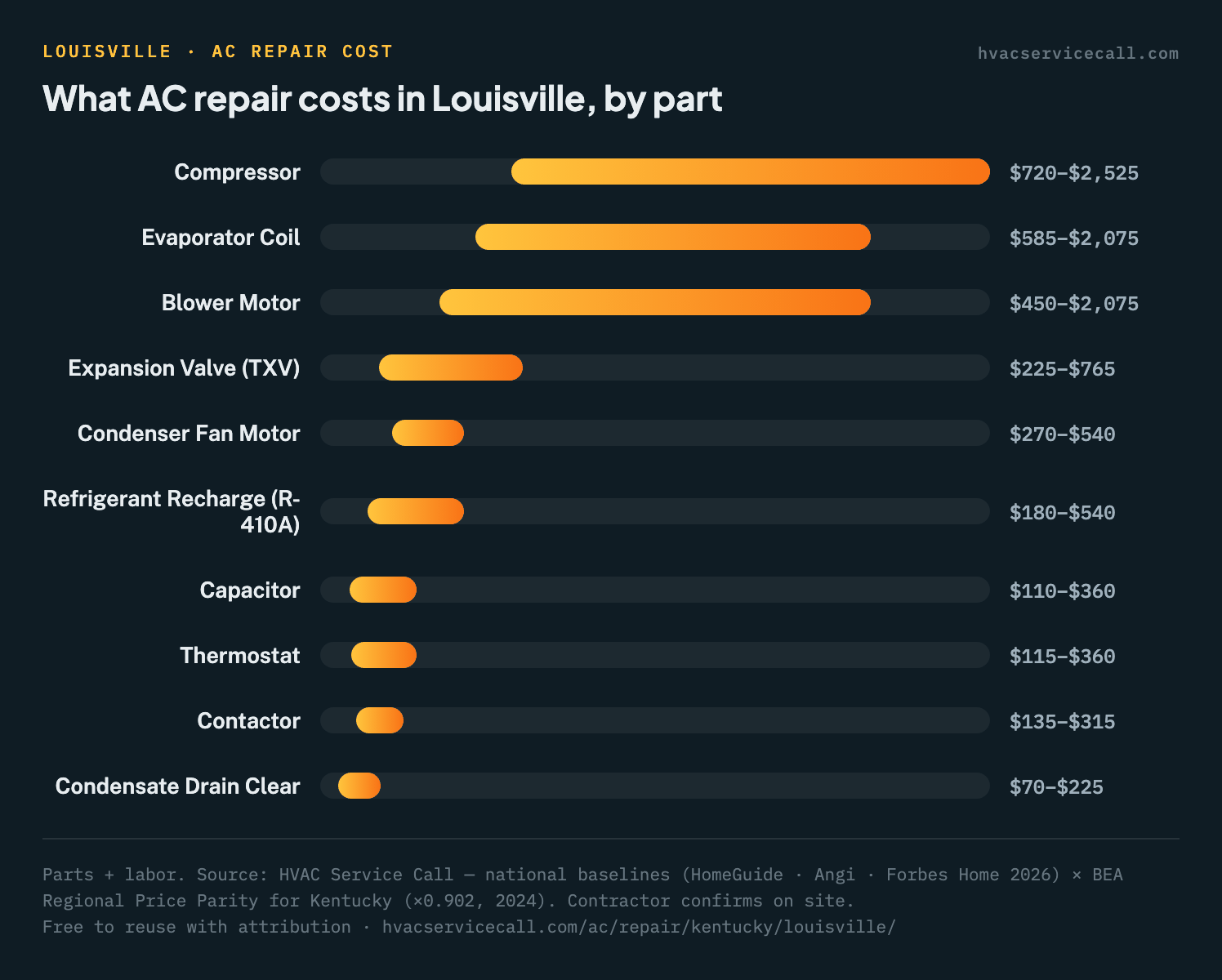
| Repair | Low | Typical | High | Note |
|---|---|---|---|---|
| Diagnostic / service call | $70 | $125 | $180 | usually credits toward the repair |
| Compressor | $720 | $1,625 | $2,525 | the repair-or-replace pivot |
| Evaporator Coil | $585 | $1,330 | $2,075 | ordered part; pairs with a recharge |
| Blower Motor | $450 | $1,265 | $2,075 | ECM motors usually get ordered |
| Expansion Valve (TXV) | $225 | $495 | $765 | the classic compressor misdiagnosis |
| Condenser Fan Motor | $270 | $405 | $540 | common truck-stock fix |
| Refrigerant Recharge (R-410A) | $180 | $360 | $540 | a leak search comes first |
| Capacitor | $110 | $235 | $360 | the most common no-cool call |
| Thermostat | $115 | $240 | $360 | same-visit swap |
| Contactor | $135 | $225 | $315 | truck stock, same visit |
| Condensate Drain Clear | $70 | $150 | $225 | the quick end of the range |
| Typical repair, all parts | $115 | $295 | $720 | where most AC repair bills land |
| After-hours service call | $105 | $235 | $360 | nights, weekends, holidays (≈1.5–2×) |
| Full AC replacement (installed) | $3,430 | $6,160 | $8,885 | the repair-vs-replace threshold |
How we price this: national baseline ranges cross-referenced from HomeGuide, Angi, and Forbes Home, adjusted to Louisville by the BEA Regional Price Parity index for Kentucky (×0.902). That multiplier isn't ours — it's the Bureau of Economic Analysis' official 2024 measure of Kentucky's overall price level, which runs about 9.8% below the U.S. average. No honest contractor quotes a repair by phone — the exact price is set on site after diagnosis. In the table, Typical is the published national average for the overall-repair row (adjusted the same way); for individual parts it's the midpoint of the local range — a planning figure, not a survey average. For the replace side, see AC repair vs replacement cost.
Check your ZIP, then make the call
The chart gives the range; the on-site diagnosis sets the number. Enter your ZIP to confirm a contractor already covers your block.
In a hurry? Call (888) 810-2291 now.
Licensed contractors serve . One call routes you to one for .
☏ Call (888) 810-2291Availability is subject to provider participation, location, technician availability, and demand.
What makes AC repair cost more or less in Louisville?
Five factors explain most of the spread between a $115 fix and a $700 one, before any after-hours premium.
- Part vs. labor
- labor runs about $75–$150 an hour; a $30 capacitor and a $1,800 compressor sit at opposite ends.
- Unit age & size
- a larger tonnage system and an older platform cost more to source parts for.
- Refrigerant type
- older R-22 systems cost far more to recharge than R-410A, and neither is a fix for a leak.
- After-hours
- nights, weekends, and holidays typically add 1.5–2× to the service-call fee.
- Warranty status
- a system under 10 years with maintenance records often has parts covered, though labor is still owed.
How long does AC repair take in Louisville — and what happens on the visit?
Most Louisville AC repairs are finished the same visit. The technician starts with the fast checks — thermostat, breaker, filter — then moves to the unit itself: refrigerant pressures, capacitor, contactor, and electrical connections. That diagnosis takes anywhere from 5 to 60 minutes, and ends with a written quote — nothing gets replaced until you approve it. A simple part swap — a capacitor, contactor, or condenser fan motor the truck already carries — adds another 30–60 minutes; a big job like a compressor or evaporator coil runs several hours and may need a second visit if the part has to be ordered, typically one to three days out.
Two things speed the visit up: clear access to both the indoor air handler and the outdoor condenser, and a quick rundown of what the system was doing when it failed — when it started, what you heard, what you already checked.
Why humidity — not just heat — breaks Louisville air conditioners
Louisville's summers are more humid than hot, and that changes what fails. Your AC does two jobs at once: it lowers the temperature (sensible load) and wrings moisture out of the air (latent load). In this mixed-humid climate the latent load is heavy, so the system runs longer and the coil stays wet — which is exactly why the two signature local failures are a clogged condensate drain and a frozen evaporator coil. The drain carries away gallons of condensed water on a humid day; when algae blocks it, the pan overflows or a float switch shuts the system down. And a coil already running cold and wet freezes fast the moment airflow drops from a dirty filter or low refrigerant.
Two practical takeaways for Louisville: if your AC cools but the house still feels clammy, the unit may be oversized or short-cycling — it hits temperature before it removes enough moisture — and clearing the condensate line is the single most valuable bit of summer maintenance here.
How fast can a contractor reach you in Louisville?
Kentucky heat waves stack the queue, but the line answers at any hour and contractors triage by severity and availability — same-day visits are common even in peak weeks. Call (888) 810-2291 and dispatch runs on your ZIP code; flag it early if the house holds people for whom indoor temperature is a medical issue, not a comfort issue.
Searching “AC repair near me” in Louisville resolves by your location, so a request from the Highlands, St. Matthews, Jeffersontown, or Fern Creek — ZIP codes 40204, 40207, 40299, and the rest of the metro — connects you to a contractor who serves that specific neighborhood.
Does homeowners insurance cover AC repair in Louisville?
Usually no — and knowing why saves a pointless claim. Homeowners insurance pays only when the damage comes from a covered peril: lightning, hail, wind, fire, or a falling tree, the sudden-and-accidental category (per Allstate and Progressive policy guidance). Louisville's spring storm season makes those claims real — a lightning-struck condenser or hail-flattened coil fins is typically covered under your dwelling coverage, minus the deductible. But the ordinary repair call — a worn capacitor, a failed compressor, a refrigerant leak — counts as wear and tear or mechanical breakdown, which standard policies exclude.
Two gap-fillers exist: an equipment-breakdown endorsement (an inexpensive policy add-on that does cover mechanical failure) and a home warranty, which is a service contract rather than insurance. If a storm did hit your unit, photograph the damage before anything is moved, file promptly, and keep your maintenance records — insurers ask.
Which AC brands do Louisville contractors repair — and how do they fail?
The brand on your condenser rarely decides whether a repair is possible — parts availability and the failed component do, and every major residential brand is serviceable through the network. Across brands, the failures that bring a technician out are the same three: a run capacitor that swells and quits, a contactor that pits and stops pulling in, and — the expensive one — a compressor. Because many Louisville homes still run systems from the early R-410A (Puron) era, brand age matters more than the badge: an older unit of any brand is a stronger repair-or-replace candidate than a newer one.
Tier reflects general US-market positioning (efficiency ceiling and parts cost), not a ranking — no single brand wins for every home, and a well-installed value unit outlasts a neglected premium one. Source: manufacturer 2026 lineups; verify the model on the condenser's data plate. Age and refrigerant era weigh more than the badge — which is exactly what the phase-out below changes.
Is R-410A being phased out — and what does that mean for repairs?
R-410A (sold as Puron) is being phased down under the 2025 federal refrigerant transition to lower-GWP replacements such as R-454B, which is why a recurring leak on an older Louisville system is a repair-or-replace signal rather than a yearly top-off. A recharge still runs $180–$540, but on a 15-plus-year unit that money is better weighed against replacement. Older R-22 systems, phased out earlier, cost the most to service and are rarely worth a major repair.
Why an aging AC costs more to run every Louisville summer
Repair cost is only half the decision — an old, low-efficiency unit also spends more electricity doing the same cooling. Efficiency is measured in SEER, and Louisville's long, humid cooling season means the gap adds up. At the Kentucky rate of 13.24¢/kWh, a typical 3-ton home running a 1990s-era 10 SEER condenser can cost about $196 more a year than the same home on a modern 16 SEER unit:
A qualifying ENERGY STAR replacement also earns the LG&E/KU $300 rebate below — factor the annual savings into the repair-vs-replace math.
Is it worth repairing or replacing your AC in Louisville?
Use the $5,000 rule: multiply the repair quote by the age of the unit in years, and if the result tops 5,000, replacement usually makes more financial sense. With Louisville's median home built around 1970, many air conditioners are already past the 12–15-year mark, so a compressor or coil failure on an older system often tips toward replacing — a full AC replacement here runs $3,430–$8,885 installed. The R-410A phase-out below adds to that math for older units.
When should you schedule an AC replacement in Louisville?
If the repair-vs-replace math says replace, when you do it changes what you pay and how long you wait. HVAC demand collapses in the shoulder seasons, and installers price and schedule accordingly: the two windows are late February through early March and September through mid-October. Louisville's dual-season climate gives you both windows every year — a planned October changeout beats an emergency swap in July on price, scheduling, and the time to compare quotes. With central ACs lasting 12–15 years, a unit already limping through its second expensive repair is a candidate to replace on your calendar, in the off-season, rather than on the system's.
What AC rebates can Louisville homeowners get?
If a repair turns into a replacement, LG&E and KU residential rebates offset part of the cost for qualifying ENERGY STAR equipment. The federal 25C tax credit that covered 30% of a heat-pump upgrade ended December 31, 2025, and Kentucky's federal Home Energy Rebates are not yet available — so utility rebates are the main local incentive today. Confirm current amounts and eligibility with your utility before you buy.
Amounts per LG&E and KU residential rebates, as of July 2026. Utility programs change — verify current amounts and eligibility before purchase.
Can you finance an AC repair or replacement in Louisville?
Most contractors don't finance a repair — at $115–$720 it's a credit-card-sized expense — but nearly all offer financing on a $3,430–$8,885 replacement, typically a 0% intro-APR promotion or a fixed-rate equipment loan. Before you sign, subtract what you don't have to borrow: the LG&E/KU rebates above come off the project cost, and a smaller principal beats a longer promo period. How the offers actually compare — deferred-interest traps included — is covered in the HVAC financing guide.
Do you need a permit or a licensed contractor for AC work in Louisville?
A straightforward repair doesn't need a permit, but an AC replacement in Louisville Metro typically requires a mechanical permit and inspection, which the contractor pulls. Kentucky requires HVAC work to be done by a licensed contractor through the Kentucky Division of HVAC (Department of Housing, Buildings & Construction) — master-contractor licensing is set by 815 KAR 8:010 — and you can verify a license at dhbc.ky.gov before work begins. Because the network connects you with independent contractors, confirming license and insurance is the homeowner's step; a legitimate contractor supplies both on request.
What should you ask an AC contractor before approving the work?
Whether the contractor came through this network or anywhere else, the same short checklist separates a solid outfit from a headache. Before a repair: are you licensed and insured (Kentucky HM license, verifiable at dhbc.ky.gov), is the estimate written and itemized, and is the diagnostic fee credited if I approve the work? Before a replacement, add three more: will you do a Manual J load calculation instead of matching the old tonnage, will you evaluate the ductwork, and what does the warranty cover — labor as well as parts, and for how long?
The red flags are just as short: a replacement quoted over the phone without seeing the house, pressure to sign today, and a large cash deposit up front. A legitimate contractor answers every question above without friction, and puts the price on paper before starting.
How can you prevent AC breakdowns in Louisville?
An annual tune-up runs about $75–$150 — a fraction of a mid-summer repair — and targets exactly the humidity-driven failures common here: a technician flushes the condensate drain, cleans the coil, checks refrigerant charge, and tightens electrical connections. Between visits, changing the filter monthly through cooling season does the most to keep the coil from freezing.
Which Louisville page covers the rest of the year?
Cooling is roughly a quarter of Louisville's HVAC demand — 1,490 cooling degree-days against 4,150 heating. The three pages below carry the other three quarters, on the same ductwork and usually the same contractor.
- When the ducts switch from cooling to heating in October — Louisville furnace repair covers ignition and exchanger faults on a gas-majority market where the median home dates to 1970.
- If you would rather one machine did both seasons — Louisville heat pump repair walks what changes when the same unit heats, and what the winter side costs to run.
- No cooling during a heat advisory with someone vulnerable at home — Louisville emergency HVAC sets out what earns same-night dispatch and what safely waits.
HVAC services in Louisville, KY — the city hub — the whole Louisville service set, the LG&E picture, and the permit and licensing rules in one place.
Where these numbers come from
Every figure on this page comes from a published dataset rather than an estimate. The sources are listed below with the vintage of each, so you can check any number yourself — and so you can see when a figure is due for a refresh.
- Degree-days & design temperatures Open-Meteo ERA5 · 2014-2023 normals · retrieved 2026-07-15
- Heating fuel mix & housing age Census ACS5 2022 (county) · Jefferson County, Kentucky table · retrieved 2026-07-15
- Residential electricity rate U.S. Energy Information Administration · state average, cents per kWh · retrieved 2026
- National cost ranges (before local adjustment) HomeGuide, Angi, Forbes Home, corpus-observed 2026-07 · retrieved 2026-07-15
- Local price adjustment BEA SARPP all-items · all-items RPP, applied to the national range · retrieved 2026-07-15
- Contractor licensing & verification Kentucky Division of HVAC (Department of Housing, Buildings & Construction) · retrieved 2026-07-15
Cost ranges are national published ranges adjusted to local price levels, not quotes. The independent licensed contractor who takes the call sets the actual price, in writing, before any work begins.
Louisville AC repair — questions homeowners ask
What do I do if my outside AC unit is running but the vents blow warm on a hot Louisville day?
First check that the air filter isn't clogged and the outdoor condenser is clear of debris — both choke cooling on a high-load day. If airflow is fine and the air is still warm, the likely cause is low refrigerant or a failing capacitor or compressor, which needs a technician — call (888) 810-2291 and the network matches you with a licensed contractor working your part of Louisville.
How much is a service call for AC repair in Louisville, and does it get credited?
A diagnostic service call in Louisville runs $70–$180, and most contractors credit that fee toward the repair when you approve the work on the same visit. The call that connects you through the network is free; the service-call fee is the contractor's, quoted before the visit.
Can someone come out the same day during a Louisville heat wave?
Usually, yes — heat waves stack the queue, but same-day slots are common and no-cool emergencies get answered around the clock, subject to demand and technician availability. Treat the call as urgent if the home has older adults or people with heart or respiratory conditions.
Will a Louisville contractor honor my manufacturer's warranty?
Most manufacturer parts warranties travel with the equipment, and the contractors this line reaches work with them routinely — have your model number and installation date ready so the technician can confirm coverage before ordering parts. Systems under 10 years with maintenance records often have parts covered, while labor is usually still owed.
Is my old R-410A air conditioner worth recharging, or should I replace it?
An R-410A recharge in Louisville runs $180–$540, but R-410A is being phased down under the 2025 federal refrigerant transition, so a recurring leak on an older system is a repair-or-replace signal rather than a yearly top-off. With Louisville's median home built around 1970, many systems are already past the 12–15-year mark where replacement makes more sense.
Does LG&E offer a rebate if I have to replace my AC in Louisville?
LG&E and KU residential rebates include $300 for a qualifying ENERGY STAR central air conditioner and $400 for an air-source or ductless heat pump, though the federal 25C tax credit ended December 31, 2025. Confirm current amounts and eligibility with your utility before you buy, since programs change.
Why does my AC keep freezing up in Louisville's humidity?
A coil freezes when it gets too cold for the airflow across it — and Louisville's heavy summer humidity makes it worse, because moisture condenses and then freezes on a coil that's already starved for air. The usual causes are a clogged filter, a dirty coil, a blocked return, or low refrigerant from a leak. Turn the AC off and the fan on to thaw it, replace the filter, and if it refreezes it's a refrigerant or airflow fault for a technician, not the ice itself.
How long does an air conditioner last in Louisville, and when should I plan to replace it?
A central AC here typically lasts 12–15 years; the long, humid cooling season and salt-free but pollen-heavy air are average wear, not extreme. With Jefferson County's median home built around 1970, many units are already past that window, so once yearly repairs start stacking up or the compressor or coil fails, replacement usually wins the math — especially with R-410A being phased down.
Why is my summer electric bill so high even though the AC is "working"?
An aging or low-efficiency AC does the same cooling for more electricity. A 1990s-era 10 SEER unit can cost noticeably more to run each Louisville summer than a modern 16 SEER system doing the same job — see the operating-cost estimate above. A dirty coil, low charge, or a system short-cycling also spikes the bill, which is why a tune-up often pays for itself.
What SEER2 rating should I buy if I replace my AC in Louisville?
For Louisville's long cooling season, most homeowners land on a 15–17 SEER2 system as the value sweet spot — high enough to cut the summer bill meaningfully, without paying for premium variable-speed efficiency you may not recoup. A qualifying ENERGY STAR unit also earns the LG&E/KU $300 rebate. The right size (tonnage) matters more than chasing the highest number; an oversized unit short-cycles and dehumidifies poorly in this humid climate.
Is it cheaper to leave the AC on all day or turn it off when I'm out?
In Louisville's humidity, a modest setback beats shutting it off entirely. Letting the house get hot and damp means the AC has to remove both heat and a lot of moisture when you get home, which can run longer than if it had held a steady, slightly higher temperature. A programmable or smart thermostat set up a few degrees while you're out is the efficient middle ground.
Can I recharge the refrigerant in my AC myself?
No — refrigerant is federally regulated and requires EPA Section 608 certification to handle, and "low refrigerant" almost always means a leak, not normal loss. Adding refrigerant without finding the leak just vents more of it and delays the real fix. A licensed technician finds and repairs the leak, then recharges to the correct weight.
Why is my AC short-cycling — turning on and off every few minutes?
Short-cycling is the system starting and stopping before it finishes a cooling cycle, and it's hard on the compressor. Common Louisville causes are a frozen or dirty coil, low refrigerant, an oversized unit, a failing capacitor, or a thermostat in direct sun. Because several causes overlap with a real fault, persistent short-cycling is worth a diagnosis rather than a wait.
Can a contractor come out the same day for a no-cool AC in Louisville?
Same-day is the norm for no-cool calls most of the season; peak heat-wave weeks stretch it, and that day's technician availability rules either way. (888) 810-2291 reaches a contractor who already works your Louisville ZIP — say so early in the call if anyone home can't ride out a hot night for medical reasons.
A storm came through Louisville last night and now my AC won't start — will my homeowners insurance pay for this?
Maybe — this is the one AC failure insurance does cover. If lightning, hail, wind, or a falling limb damaged the unit, that's a covered peril under most dwelling policies, minus your deductible. Photograph the damage before anything is moved and file promptly. If the technician instead finds ordinary wear — a failed capacitor or compressor with no storm damage — standard policies exclude it, unless you carry an equipment-breakdown endorsement.
How long will I actually be without cooling once the technician arrives at my Louisville home?
Diagnosis takes 5–60 minutes and ends with a written quote. If the fix is a part the truck carries — capacitor, contactor, fan motor — cooling is usually back within the hour. A compressor or coil job runs several hours, and if the part has to be ordered you're looking at one to three days; in a heat wave, ask the technician about temporary options for vulnerable residents in the meantime.
The contractor quoted me a big AC repair in Louisville — what should I ask before I say yes?
Four things: is the estimate written and itemized, is the diagnostic fee credited toward the work, is the part covered by a manufacturer warranty (have your model number ready), and — if the quote is large on an old unit — what would a replacement cost instead, with the $5,000 rule as your yardstick. You can verify the contractor's Kentucky HM license at dhbc.ky.gov before approving anything.
AC repair coverage across Louisville, KY
Coverage runs from the urban core to the county line — 182 ZIP codes spanning Jefferson County and Southern Indiana, plus the neighborhoods below. Whether you searched “AC repair near me in Louisville,” a specific ZIP, or your neighborhood, the call reaches a contractor who already works it.
Every metro Louisville ZIP the network serves: