Furnace repair in Louisville, KY
Looking for furnace repair in Louisville, KY? Call (888) 810-2291 — one free call routes you to a trusted, licensed local contractor for 24/7 no-heat service. Repairs typically cost $90–$540, with a $70–$180 diagnostic usually credited toward the work. The network covers all of Louisville — Highlands, St. Matthews, Jeffersontown, Okolona, Pleasure Ridge Park — and every Jefferson County ZIP, including 40202, 40204, 40207, 40219, and 40258.
Why do furnaces fail when Louisville gets cold?
Louisville logs about 4,150 heating degree-days against a 7°F winter design low (Open-Meteo climate normals), so furnaces here run for months, not days — and the hardest failures show up on the coldest nights, exactly when a call is most urgent. January and February average below freezing, so a furnace that was quietly weak all fall fails on its first real cold snap.

What are the signs your Louisville furnace needs repair?
These six signs separate a quick self-check from a real repair — each links to a full troubleshooting guide. A gas smell or a carbon-monoxide alarm is never a self-check: leave the house and call your gas utility and 911 first.
Each of these signs traces back to a specific part — the next section names every repair type that gets routed here, so you can see where yours fits.
What furnace repairs do Louisville contractors handle?
A gas furnace fails in more ways than the famous flame-sensor call — the twelve repair types below cover the full scope of what gets routed here, ignition to venting. The common ones are priced on the chart in the cost section; each entry notes whether it's typically a same-visit fix or an ordered-part return trip.
- Flame sensor cleaning or replacement
- The classic lights-then-dies fault — a sooted rod stops "seeing" flame and the gas shuts off. A minor, same-visit fix.
- Hot-surface igniter
- Clicks but never lights, or a visible crack in the element. The most common winter no-heat part; truck stock, same visit.
- Gas valve replacement
- No gas flow despite a working igniter — a safety-critical part only a licensed tech should touch. Often ordered; combustion check follows.
- Pressure switch
- The furnace refuses to start its sequence because it can't prove the flue is drafting — sometimes the switch, sometimes an actual vent blockage. Same-visit diagnosis either way.
- Limit switch
- Short bursts of heat then shutdown — the overheat safety doing its job, usually because of airflow. Part is minor; the airflow cause matters more.
- Inducer / draft motor
- A whine or rattle before the burners even light; without draft the sequence never starts. Frequently ordered on older models.
- Blower motor & wheel
- Heat at the furnace but weak or roaring airflow at the vents. ECM motors get ordered; PSC motors often same-visit.
- Control board
- Blinking fault codes, intermittent starts, dead thermostat circuits. Ordered on most brands; a return-trip repair.
- Heat exchanger inspection & condemnation
- The safety call — a confirmed crack leaks combustion gases and retires the furnace. Demand to see the crack on camera or a combustion-analysis reading before accepting the verdict.
- Thermostat & low-voltage wiring
- A dead display or chewed wire that reads like a dead furnace. Same visit, and among the mildest outcomes on this list.
- Filter & airflow correction
- The overheat-shutdown cycle a clogged filter causes — solved same-visit, and the reason monthly winter filter changes prevent repeat calls.
- Flue & venting repair
- A blocked or corroded vent is a carbon-monoxide pathway, found during the same combustion check that clears a gas-valve or exchanger job.
All twelve route through the same line, day or night — pricing for the common ones is charted below, and anything gas-side ends with a combustion-safety check.
Broken furnace in Louisville, KY?
Describe what the furnace does — clicks, lights then dies, nothing at all — and a licensed Louisville contractor takes it from there. Free call, any hour.
☏ Call (888) 810-2291Availability is subject to provider participation, location, technician availability, and demand.
What should you check before calling for furnace repair?
These five checks solve the simplest no-heat calls without a service fee — run them first, and if the furnace still won't light, it's a real repair. Never troubleshoot the gas line or heat exchanger yourself; that's a licensed technician's job.
- Thermostat: set to heat a few degrees above room temp, with fresh batteries — a dead thermostat mimics a dead furnace.
- Air filter: a clogged filter overheats the furnace and trips the limit switch; replace it if it's gray.
- Furnace power switch: the light-switch on or beside the furnace is often flipped off by mistake — check it and the breaker.
- Gas supply: confirm the gas valve is open and other gas appliances work; if nothing gas-fired runs, call the utility.
- Condensate line (high-efficiency): a frozen or clogged condensate drain shuts a high-efficiency furnace down — clear it.
Who fixes furnaces in Louisville, KY?
Stop before the burner compartment — igniters, gas valves, and flame sensors are technician territory. The line reaches a licensed Louisville furnace tech at any hour.
☏ Call (888) 810-2291Availability is subject to provider participation, location, technician availability, and demand.
What does furnace repair cost in Louisville?
Budget $70–$180 for the diagnostic visit itself — if the repair goes ahead, that money usually counts toward it; read how the service-call fee works first. From there, most Louisville furnace repairs land between $90–$540; the part that failed decides where you land, from an igniter near the bottom to a heat exchanger near the top.

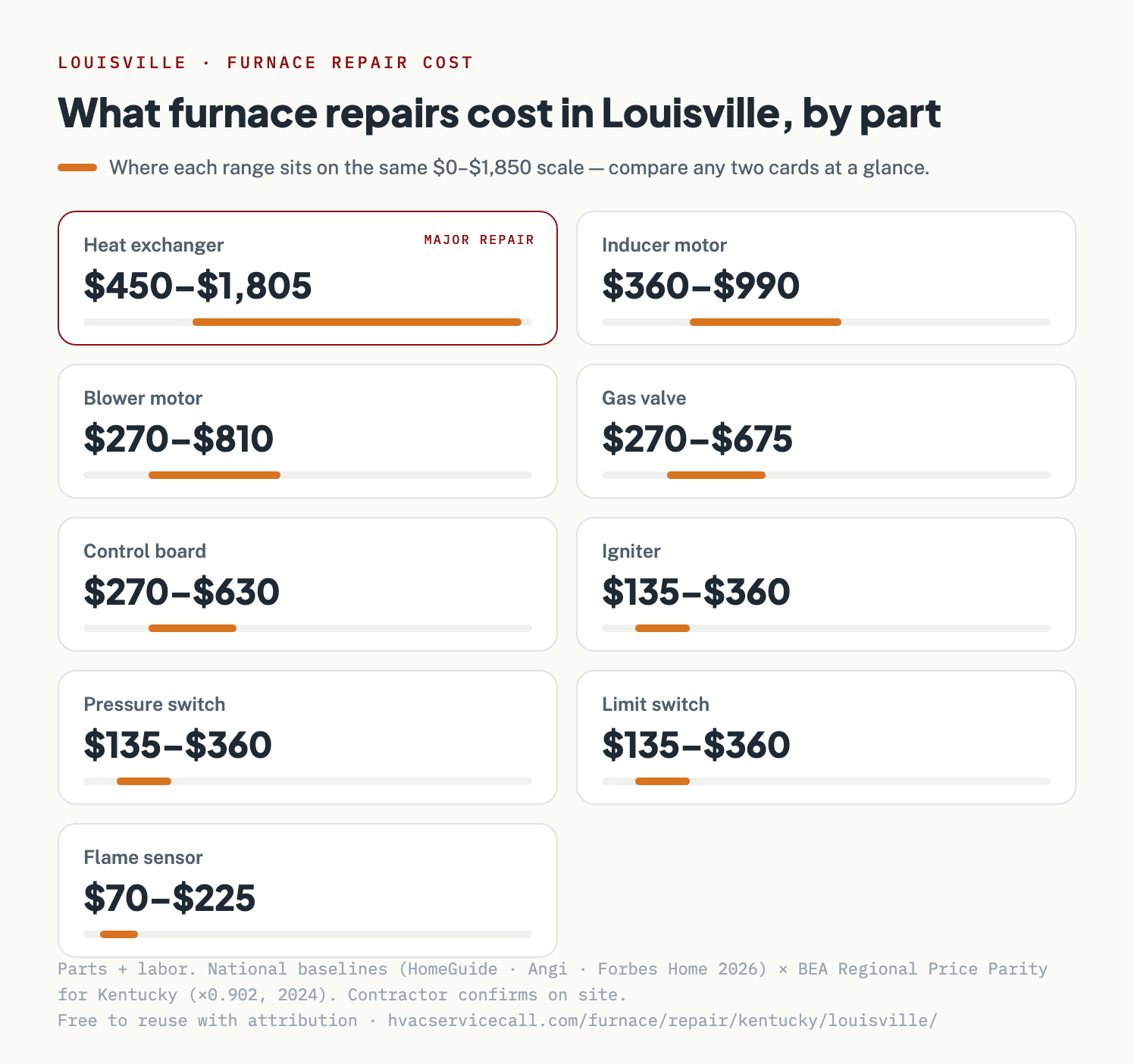
| Repair | Low | Typical | High | Note |
|---|---|---|---|---|
| Diagnostic / service call | $70 | $125 | $180 | typically applied to the repair bill |
| Heat Exchanger | $450 | $1,130 | $1,805 | a confirmed crack retires the furnace |
| Inducer Motor | $360 | $675 | $990 | frequently ordered on older models |
| Blower Motor | $270 | $540 | $810 | ECM motors usually get ordered |
| Gas Valve | $270 | $475 | $675 | safety-critical; combustion check follows |
| Control Board | $270 | $450 | $630 | typically a return-trip part |
| Igniter | $135 | $250 | $360 | the classic winter no-heat part |
| Pressure Switch | $135 | $250 | $360 | switch or an actual vent blockage |
| Limit Switch | $135 | $250 | $360 | the airflow cause matters more |
| Flame Sensor | $70 | $150 | $225 | often just a cleaning |
| Typical repair, all parts | $90 | $210 | $540 | most no-heat fixes fall here |
| After-hours service call | $105 | $235 | $360 | ≈1.5–2× premium after hours |
| Furnace replacement (installed) | $3,430 | $6,000 | $8,570 | gas furnace, installed |
How we price this: national baseline ranges cross-referenced from HomeGuide, Angi, and Forbes Home, adjusted to Louisville by the BEA Regional Price Parity index for Kentucky (×0.902). In plain English, the index is the federal Bureau of Economic Analysis' official price-level figure: 2024 data puts Kentucky roughly 9.8% under the national average, and the multiplier simply applies that difference. No honest contractor quotes a repair by phone — the exact price is set on site after diagnosis. On the Typical column: the overall-repair row carries the sources' published average (adjusted identically), while part rows show the midpoint of the local range — a planning number rather than a measured one. For the replace side, see furnace repair vs replacement cost.
Is your block covered? Punch in the ZIP
The ranges above are Louisville-adjusted; dispatch works street by street. A ZIP check confirms the network reaches you before you dial.
In a hurry? Call (888) 810-2291 now.
Licensed contractors serve . One call routes you to one for .
☏ Call (888) 810-2291Availability is subject to provider participation, location, technician availability, and demand.
What makes furnace repair cost more or less in Louisville?
Five factors explain most of the spread between a $90 fix and a $540 one, before any after-hours premium.
- Part vs. labor
- labor runs about $75–$150 an hour; a $150 igniter and a $2,000 heat exchanger sit at opposite ends.
- Gas vs. electric
- a gas furnace adds a gas valve, flame sensor, and heat exchanger — more parts that can fail than an electric unit.
- Single vs. two-stage
- two-stage and modulating furnaces carry more electronics (control boards, pressure sensors), so their repairs lean pricier.
- Heat-exchanger cracks
- a cracked heat exchanger is a carbon-monoxide safety failure that usually points to replacement, not a repair.
- After-hours
- nights, weekends, and holidays typically add 1.5–2× to the service-call fee.
How long does furnace repair take in Louisville — and what happens on the visit?
Most no-heat calls end the same visit. The technician runs the fast checks first — thermostat, furnace power switch, filter — then works through the ignition sequence: flame sensor, igniter, gas valve, pressure switch, control board. Diagnosis takes 5 to 60 minutes and produces two things: the fault and a written quote — the work waits for your yes. The common fixes — a flame-sensor clean, a hot-surface igniter, a capacitor — are parts the truck carries, so heat is usually back within the hour. A blower motor, control board, or heat-exchanger inspection runs several hours, and an ordered part means a return visit, typically one to three days out.
To speed it up: clear a path to the furnace (many Louisville units sit in basements or tight closets), and be ready to describe exactly what it does when it fails — clicks but won't light, lights then dies, or nothing at all. Each points to a different part.
Gas or electric — how do most Louisville homes heat?
What the visit looks like also depends on what's in the basement — and here that usually means gas. 60% of Jefferson County homes run a gas furnace versus 37% electric (U.S. Census ACS 5-year). That matters for a repair, because a gas furnace adds parts an electric one never has — a gas valve, a flame sensor, and a heat exchanger whose cracks are a carbon-monoxide risk — so a gas no-heat call is diagnosed differently from an electric one.
Carbon monoxide and the heat exchanger — the furnace failure that's a safety issue
Because most of Louisville heats with gas, one furnace failure stands apart from the rest: a cracked heat exchanger. The heat exchanger is the sealed metal chamber that lets your air pick up heat while keeping the combustion gases — including carbon monoxide — separate and vented outside. When it cracks with age or metal fatigue, those gases can mix into the air the blower sends through your house. Carbon monoxide is colorless and odorless, and the early symptoms mimic the flu without a fever: headache, dizziness, nausea, and shortness of breath.
This is why a suspected crack is a replacement decision, not a patch — a heat exchanger can't be safely welded back into service. Protect the home with a CO detector on every level and near bedrooms (not right beside the furnace), test it before heating season, and have the exchanger inspected at the annual tune-up. If a CO alarm sounds, leave the house first, then call your gas utility and 911 from outside. For an active no-heat emergency, see Louisville emergency HVAC.
When is a furnace problem an emergency in Louisville?
No heat during a hard Louisville freeze — the winter design low is 7°F — is urgent for any home, and genuinely dangerous for anyone whose health can't ride out a cold night indoors, so no-heat calls are answered at every hour. A gas smell or a sounding CO alarm is a different order of emergency — first move is the door, not the phone: once outside, call the gas utility and 911; the repair call is the last one you make.
Searching “furnace repair near me” in Louisville resolves by your location, so a no-heat call from the Highlands, St. Matthews, Jeffersontown, or Fern Creek — ZIP codes 40204, 40207, 40299, and the rest of the metro — connects you to a contractor who serves that specific neighborhood.
Does homeowners insurance cover furnace repair in Louisville?
For the ordinary no-heat call — a failed igniter, flame sensor, or blower motor — no. Standard homeowners policies exclude wear and tear and mechanical breakdown, which covers nearly every furnace repair on an aging system (per Allstate and Progressive policy guidance). What insurance does pay for is damage from a covered peril: a house fire, lightning, a burst pipe flooding the furnace closet, or a tree through the roof — sudden, accidental events, paid under dwelling coverage minus your deductible.
If you want mechanical failures covered, ask your insurer about an equipment-breakdown endorsement — a low-cost add-on that covers exactly what the standard policy excludes. A home warranty is the other route; it's a service contract, not insurance, and read the fine print on older units. Either way, keep maintenance records: they support any claim and any warranty call.
Which furnace brands do Louisville contractors repair — and how do they fail?
Every major furnace brand gets serviced through the network — the badge rarely decides whether a repair is possible; the failed part and parts availability do. Across brands, furnace repairs cluster on a few parts: a hot-surface igniter or flame sensor (the most common no-heat call), a blower motor, and — the serious one — a cracked heat exchanger, which is a carbon-monoxide risk on any brand. Higher-end two-stage and modulating furnaces add control boards and pressure sensors, so their repairs lean more electronic; older single-stage units are simpler but nearer the end of their life in Louisville's 1970-era housing.
Tier reflects general US-market positioning (efficiency ceiling and parts cost), not a ranking — no single brand wins for every home, and a well-installed value furnace outlasts a neglected premium one. Source: manufacturer 2026 lineups; verify the model on the furnace's rating plate. Whatever the badge, age is the bigger question — which is where the repair-or-replace math comes in.
Is it worth repairing or replacing your Louisville furnace?
Use the $5,000 rule: multiply the repair quote by the furnace's age in years, and if the result tops 5,000, replacement usually makes more sense. With Louisville's median home built around 1970, many furnaces are near or past a 15–20-year service life, so a cracked heat exchanger or a second major failure on an aging unit typically tips toward replacing — a new gas furnace here runs $3,430–$8,570 installed.
When should you schedule a furnace replacement in Louisville?
If the $5,000 rule says replace, pick the season yourself instead of letting the furnace pick it. Installer demand collapses in the shoulder windows — late February through early March and September through mid-October — which means faster scheduling, time to compare quotes, and off-season pricing. The worst time is the one most Louisville furnaces choose: the first hard freeze, when every installer's book is full and you're deciding under no-heat pressure. A gas furnace lasts 15–20 years; one that's past that and limping through repairs is a candidate for a planned September changeout, not a January emergency.
What furnace rebates can Louisville homeowners get?
Utility rebates in Louisville favor high-efficiency electric equipment, not standard gas furnaces — so if an aging gas furnace fails for good, switching to a heat pump is where the local rebate money is. LG&E residential rebates run $400 for a qualifying air-source heat pump and $300 for a central air conditioner, while a standard gas furnace carries no utility rebate; the federal 25C tax credit ended December 31, 2025.
Amounts per LG&E residential rebates, as of July 2026; utility programs change — verify current amounts and eligibility with LG&E before purchase.
Can you finance a furnace repair or replacement in Louisville?
Repairs at $90–$540 rarely get financed, but a $3,430–$8,570 furnace replacement almost always can be — most contractors offer a 0% intro-APR promotion or a fixed-rate equipment loan. Since gas furnaces earn no LG&E rebate, the number you finance is close to the full quote; if the replacement decision is open, that's one more point for the heat pump route, where the $400 rebate trims the principal. How the loan offers actually compare — deferred-interest traps included — is in the HVAC financing guide.
Do you need a permit or a licensed contractor for furnace work in Louisville?
A straightforward furnace repair doesn't need a permit, but a furnace replacement in Louisville Metro typically requires a mechanical permit and inspection — which the contractor pulls — and gas-fired work adds a gas and combustion-safety check that protects against carbon-monoxide leaks. Kentucky requires the work to be done by a licensed contractor through the Kentucky Division of HVAC (Department of Housing, Buildings & Construction) — master-contractor licensing is set by 815 KAR 8:010 — and you can verify a license at dhbc.ky.gov before work begins. Because the network connects you with independent contractors, confirming license and insurance is the homeowner's step, and a legitimate contractor supplies both on request.
What should you ask a furnace contractor before approving the work?
The same checklist applies whether the contractor came through this network or a neighbor's recommendation. Before a repair: are you licensed and insured (Kentucky HM license, verifiable at dhbc.ky.gov), is the estimate written and itemized, and is the diagnostic fee credited if I approve the work? For a gas furnace, add one: will you inspect the heat exchanger and show me — a technician who condemns a furnace for a crack should be able to point to it on a camera or show a combustion-analysis reading, not just declare it. Before a replacement: will you do a Manual J load calculation, evaluate the ductwork and venting, and what does the warranty cover — labor as well as parts?
Red flags: a replacement quoted over the phone, a same-day-only price, a large cash deposit, and a heat-exchanger condemnation with no evidence shown. A legitimate contractor answers all of it without friction.
How can you prevent a furnace breakdown in Louisville?
An annual tune-up runs about $75–$150 and matters more on a gas furnace than on almost any other system, because the same visit that cleans the flame sensor and checks the igniter also inspects the heat exchanger for the cracks that leak carbon monoxide. Between visits, changing the filter monthly through heating season is the most reliable way to keep the furnace from overheating and tripping its limit switch.
Which other Louisville HVAC page do you need?
Louisville heats far more than it cools — 4,150 heating degree-days against 1,490 cooling — so a furnace page carries the bulk of the year but not all of it. Three companion pages pick up where this one stops.
- If the replacement quote has an electric option on it — Louisville heat pump repair covers what a heat pump does across both Louisville seasons, and the storm-and-hail exposure that comes with an outdoor unit here.
- No heat, and it is already dark — Louisville emergency HVAC runs the after-hours triage order for a 60%-gas city, carbon monoxide included.
- The Ohio River valley collects humidity by June — Louisville AC repair takes the cooling half, where latent load rather than raw heat drives most of the summer failures.
HVAC services in Louisville, KY — the city hub: all four services, LG&E's territory, Louisville Metro permit rules, and the local cost ranges together.
Where these numbers come from
Every figure on this page comes from a published dataset rather than an estimate. The sources are listed below with the vintage of each, so you can check any number yourself — and so you can see when a figure is due for a refresh.
- Degree-days & design temperatures Open-Meteo ERA5 · 2014-2023 normals · retrieved 2026-07-15
- Heating fuel mix & housing age Census ACS5 2022 (county) · Jefferson County, Kentucky table · retrieved 2026-07-15
- Residential electricity rate U.S. Energy Information Administration · state average, cents per kWh · retrieved 2026
- National cost ranges (before local adjustment) HomeGuide, Angi, Forbes Home, corpus-observed 2026-07 · retrieved 2026-07-15
- Local price adjustment BEA SARPP all-items · all-items RPP, applied to the national range · retrieved 2026-07-15
- Contractor licensing & verification Kentucky Division of HVAC (Department of Housing, Buildings & Construction) · retrieved 2026-07-15
Cost ranges are national published ranges adjusted to local price levels, not quotes. The independent licensed contractor who takes the call sets the actual price, in writing, before any work begins.
Louisville furnace repair — questions homeowners ask
Why is my furnace blowing cold air in my Louisville home?
Cold air from a running furnace usually means the burners aren't staying lit — a dirty flame sensor, a failing igniter, or a gas-supply issue — or the thermostat is set to "on" instead of "auto," which runs the blower between heating cycles. If the filter is clean and the thermostat is on "heat/auto" and it still blows cold, it needs a technician — calling (888) 810-2291 costs nothing, and the network forwards you to a licensed contractor who covers your neighborhood.
How much does furnace repair cost in Louisville, and is the service call credited?
Most Louisville furnace repairs run $90–$540, with a diagnostic service call of $70–$180 that is usually credited toward the repair when you approve the work the same visit. The exact figure depends on the failed part — an igniter sits near the low end, a cracked heat exchanger near the top.
When is a furnace problem an emergency — and what should I do if I smell gas?
A gas smell or a CO alarm means the order matters: leave the house, call your gas utility and 911 from outside, and book the repair last. No heat during a hard Louisville freeze is also urgent for households with infants, elderly family members, or home medical equipment — no-heat calls get answered around the clock.
How long does a furnace repair usually take in Louisville?
A common repair such as an igniter, flame sensor, or capacitor is typically done in under an hour once the technician has the part, while a blower motor or heat-exchanger job can take several hours or a return visit for parts.
Should I repair or replace a furnace in an older Louisville home?
Apply the $5,000 rule — repair cost multiplied by the furnace's age, where a result over 5,000 leans toward replacement. With Louisville's median home built around 1970, a cracked heat exchanger or repeated failures on an aging gas furnace usually favor replacing; a new furnace here runs $3,430–$8,570 installed.
Does LG&E offer rebates on a new furnace or heat pump in Louisville?
LG&E residential rebates focus on high-efficiency electric equipment — $400 for a qualifying air-source heat pump and $300 for a central air conditioner — rather than gas furnaces, and the federal 25C credit ended December 31, 2025. Confirm current amounts with LG&E before you buy.
What is a flame sensor, and why does it cause so many no-heat calls in Louisville?
The flame sensor is a thin metal rod that confirms the burners actually lit; when it gets coated with soot or corrosion it can't "see" the flame, so the furnace shuts the gas off as a safety measure — often after running for a few seconds and then quitting. It's one of the most common and least expensive no-heat repairs, usually a clean or a low-cost replacement. If your furnace lights then shuts down repeatedly, this is a likely suspect.
My carbon-monoxide alarm went off — is my furnace the cause, and what do I do?
Treat it as an emergency: get everyone out of the house, don't flip switches, and call your gas utility and 911 from outside before going back in. A gas furnace can leak carbon monoxide through a cracked heat exchanger or a blocked flue, and CO is odorless — headache, dizziness, and nausea without a fever are warning signs. Once it's safe, a licensed contractor can inspect the heat exchanger; a confirmed crack means the furnace is condemned and needs replacement, not a patch.
Is a cracked heat exchanger repairable, or do I need a new furnace?
A cracked heat exchanger is not safely repaired — it's the barrier that keeps combustion gases, including carbon monoxide, out of your home's air. The fix is either a heat-exchanger replacement (often close to the cost of a new furnace) or, more commonly on an older Louisville unit, replacing the furnace. If it's still under a parts warranty the exchanger may be covered, though labor is usually owed.
How long does a furnace last in a Louisville home?
A well-maintained gas furnace typically lasts 15–20 years. With Jefferson County's median home built around 1970, plenty of furnaces here are at or past that age, so once a major part like the heat exchanger or blower motor fails, the $5,000 rule usually favors replacement over another repair. Annual tune-ups are what push a furnace toward the top of that range.
Why does my furnace short-cycle — turning on and off every few minutes?
Short-cycling means the furnace starts, runs briefly, and shuts off before the house warms. In Louisville the usual causes are a clogged filter (the most common), a furnace overheating and tripping its high-limit switch, a flame-sensor fault, or a blocked flue. Start by replacing the filter; if it keeps cycling, it needs a diagnosis, because running that way stresses the ignition components.
Why does my furnace smell like burning dust when it first turns on for the season?
A brief burning-dust smell on the first cold day is normal — dust that settled on the heat exchanger over summer burns off and clears within an hour or so. What isn't normal is a persistent burning-plastic or electrical smell (shut it off and call) or any gas or rotten-egg smell, which means leave the house and call your gas utility and 911 first.
Would it make sense to switch from a gas furnace to a heat pump in Louisville?
It can. If an aging gas furnace fails for good, a heat pump is where the LG&E/KU rebate money is ($400 air-source), it handles Louisville's many mild days efficiently, and it also gives you cooling. A dual-fuel setup keeps the furnace for the coldest snaps. Gas heat is still cheap here, so the math depends on your equipment's age and fuel costs — see heat pump repair and repair or replace.
Can a contractor come out the same day for a no-heat furnace in Louisville?
Most of the winter, yes — the phone works 24/7, and scheduling follows each contractor's real capacity, which tightens during a hard freeze. Dial (888) 810-2291 and dispatch runs on your Louisville ZIP code, so the technician who calls back already covers your street.
A pipe burst and soaked my furnace in my Louisville basement — will homeowners insurance pay for it?
Likely yes — a burst pipe is a covered peril under most dwelling policies, so water damage to the furnace is claimable minus your deductible. Photograph everything before cleanup and file promptly. The distinction that matters: insurance covers sudden accidental damage like water, fire, or lightning, but not the furnace simply wearing out — an igniter or blower that fails on its own is excluded unless you carry an equipment-breakdown endorsement.
A technician says my heat exchanger is cracked and the furnace must be replaced today — how do I know it's true?
Ask to see the evidence: a legitimate technician can show you the crack on an inspection camera or a combustion-analysis reading showing carbon monoxide in the supply air. A condemned furnace is a common pressure-sales script, so a second opinion on a big-ticket call is reasonable and normal — the diagnosis fee is small next to a $3,430–$8,570 replacement. If the crack is real, though, take it seriously: that's the barrier keeping CO out of your air.
What should I ask before saying yes to a big furnace repair quote in Louisville?
Four things: is the estimate written and itemized, is the diagnostic fee credited toward the work, is the part still under manufacturer warranty (have the model and install date ready), and what would a replacement cost instead — with the $5,000 rule as the yardstick on an older unit. You can verify any Kentucky contractor's HM license at dhbc.ky.gov before approving.
Furnace repair coverage across Louisville, KY
Louisville proper and its first-ring suburbs are all in range — 182 ZIP codes spanning Jefferson County and Southern Indiana, plus the neighborhoods below. Whether you searched “furnace repair near me in Louisville,” a specific ZIP, or your neighborhood, the network puts a contractor who works that area on the phone.
All metro Louisville ZIPs on the routing list: