Furnace repair in Nashville, TN
Looking for furnace repair in Nashville, TN? Call (888) 810-2291 — one free call routes you to a trusted, licensed local contractor for same-day or after-hours no-heat service. Repairs typically cost $90–$550, with a $70–$185 diagnostic that is commonly credited or waived when you approve the work. The network covers all of Nashville — East Nashville, Donelson, Madison, Bellevue, Antioch — and every Davidson County ZIP, including 37207, 37211, 37214, 37216, and 37221.
Why do furnaces fail in Nashville?
Not from overwork. Nashville's heating load is real — roughly 3,366 heating degree-days against a 16°F winter design temperature, nearly double the city's cooling load — but it arrives in short, sharp bursts. January averages a 47.2°F high and a 30.9°F low, and only 3 months of the year — December, January and February — average a low at or below 40°F. A Middle Tennessee furnace therefore spends about seven months switched off and is then asked for full output on the first genuinely cold night of the season.
That idle profile decides the failure list. The parts that quit here are the ones that degrade while sitting still: a hot-surface igniter that cracks, a flame sensor that oxidizes over a long, humid summer, an inducer motor with stiff bearings, a pressure switch whose port has gummed up. Davidson County's median home dates to 1984 (U.S. Census ACS 5-year), which puts a large share of the city's gas furnaces in the vintage where the heat exchanger itself becomes a live question — the section further down deals with that honestly.

What are the most common furnace problems in Nashville homes?
Eight signs cover most heating calls here, each linked to a full troubleshooting guide. They are ordered the way a lightly-used furnace actually fails, first-fire trouble at the top. A gas smell or a sounding carbon monoxide alarm is not on that ladder at all — those mean leave the building first and call from outside.
A symptom narrows it to a part or two — the full scope of what actually gets repaired comes next.
What furnace repairs do Nashville contractors handle?
Twelve residential furnace repair types are in scope, from a ten-minute flame-sensor clean to the heat-exchanger verdict that reopens the replacement question. The common ones carry Nashville prices in the next section; each line flags whether the part usually rides the truck or has to be ordered.
- Flame sensor clean or replacement
- The burner lights, then shuts down seconds later — the classic Nashville first-fire fault after a humid summer. Cleaned or swapped on the same visit.
- Hot-surface igniter
- A brittle ceramic element that cracks while the furnace sits idle. Truck stock on most brands, minutes to change.
- Pilot assembly & thermocouple
- On the city's older standing-pilot furnaces, a thermocouple that no longer holds the gas valve open. Same visit.
- Pressure switch
- Stuck or reading no draft after seven months off, so the board refuses to light. Usually stocked.
- Limit switch
- Trips when a choked filter or blocked return overheats the cabinet — the fault the pre-call filter check often prevents.
- Inducer motor
- Draft motor with stiff bearings that will not spin up on the first cold morning. Frequently an ordered part.
- Gas valve replacement
- Combustion work with a safety check and analysis attached; licensed hands only, no exceptions.
- Blower motor
- Weak or no airflow while the burner behaves. ECM versions wait on an order; PSC motors are often same-visit.
- Control board & relays
- Intermittent no-starts and ignored heat calls — typically ordered on a furnace of Nashville's median vintage.
- Heat exchanger inspection or replacement
- The safety verdict rather than a routine part. Ask to see the crack; on an older furnace this is where replacement usually wins.
- Flue & venting repair
- Disconnected, corroded or blocked venting — a combustion-safety item that gets fixed before the furnace runs again.
- Thermostat repair or replacement
- Miswired, dead-battery, or simply failing — sorted before the technician packs up.
One line dispatches every one of the twelve, whatever the hour — and the chart below prices the common ones for Nashville.
Broken furnace in Nashville, TN?
Clicked and glowed then quit, blew cold, made no sound at all: each points somewhere different, and the technician sorts it fast. One free call, Davidson-County-routed.
☏ Call (888) 810-2291Availability is subject to provider participation, location, technician availability, and demand.
Before you call for furnace repair in Nashville, what's worth checking?
Five checks clear the false alarms and cost nothing to run. None of them touches the burner, the gas valve or the venting — that is licensed territory. And to be plain about one of them, because some pages in this market are not: changing the filter is your job, not an emergency call-out. It is the most common reason a healthy furnace stops delivering heat, and if a fresh filter fixes it you have kept a service fee in your pocket.
- Thermostat: heat mode, setpoint a few degrees above the room, fresh batteries — the trivial cause first, and it costs nothing to rule out.
- Filter: change it yourself. A choked filter overheats the cabinet and trips the limit switch, and it is the single most common reason a working furnace stops blowing heat. If a fresh filter fixes it, you just kept a service fee.
- The switch that looks like a light switch: the furnace service switch, usually on or beside the cabinet, gets flipped by anyone working in a basement or crawlspace.
- Breaker: even a gas furnace needs power for the board, igniter and blower; check the panel before assuming the worst.
- Registers and returns: closed vents and a blocked return starve airflow and produce the same overheating lockout a dirty filter does.
Smell gas at any point? Stop the checklist, leave, and call the gas utility from outside. Still cold after all five? The furnace troubleshooting guide goes deeper, or you hand it straight to a diagnosis.
Who fixes furnaces in Nashville, TN?
Tell the technician which ones you already ruled out — thermostat, filter, service switch, breaker, vents — and the diagnosis starts three moves ahead. Licensed Nashville pros, any hour.
☏ Call (888) 810-2291Availability is subject to provider participation, location, technician availability, and demand.
What does furnace repair cost in Nashville?
Set aside $70–$185 for the diagnostic visit. Whether that money comes back to you depends on the company — commonly it is credited toward the repair or waived outright when you approve the work, but it is not universal, so get the answer before a truck is dispatched; the service-call fee guide explains how contractors handle it. Most finished Nashville furnace repairs then land between $90–$550, and the failed part sets the spot on that range: sensors and switches near the floor, inducers and gas valves in the middle, the heat exchanger in its own category above.

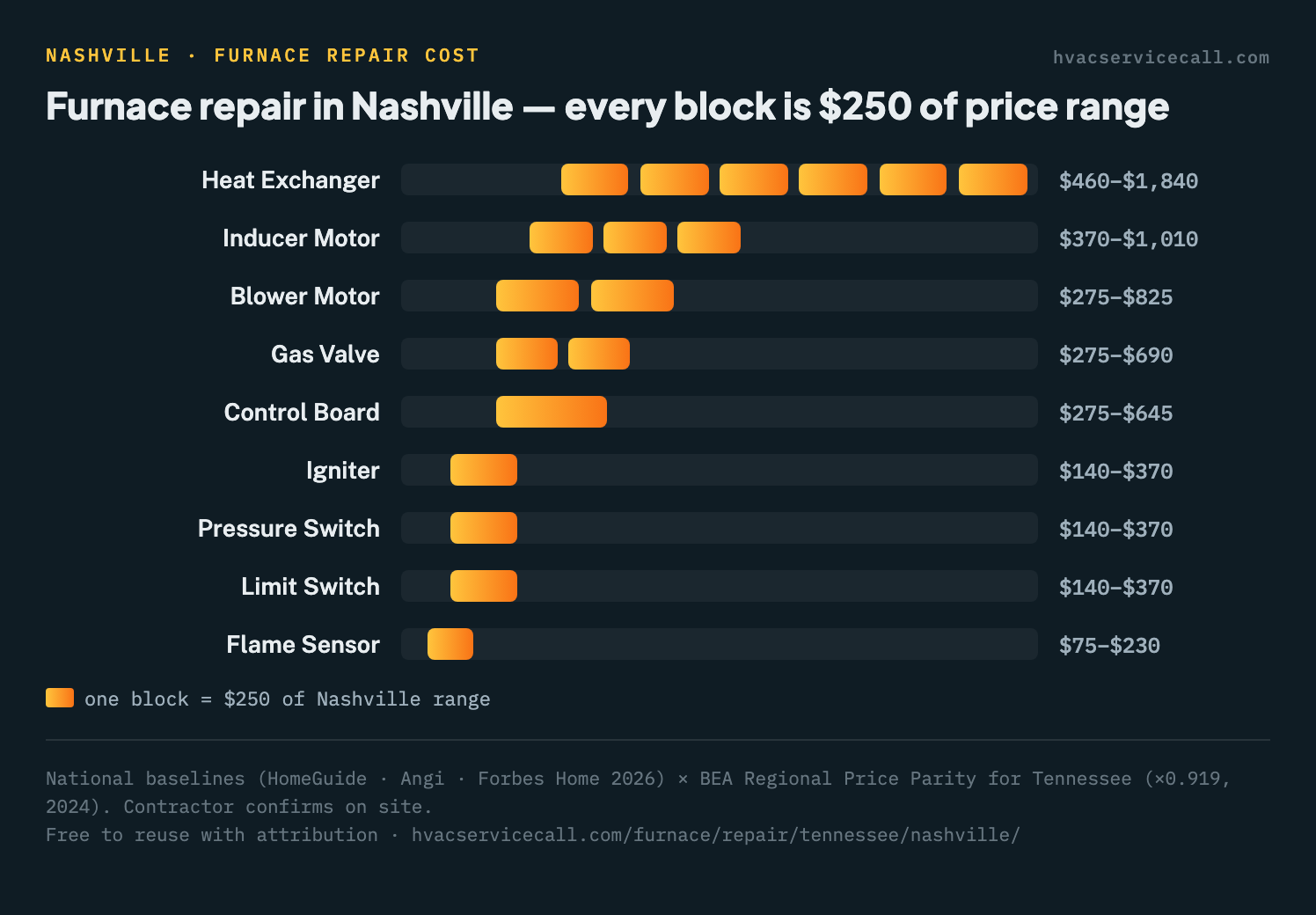
| Repair | Low | Typical | High | Note |
|---|---|---|---|---|
| Diagnostic / service call | $70 | $130 | $185 | commonly credited or waived — confirm first |
| Heat Exchanger | $460 | $1,150 | $1,840 | the part that decides whether the furnace is finished |
| Inducer Motor | $370 | $690 | $1,010 | a classic dormancy casualty; usually ordered |
| Blower Motor | $275 | $550 | $825 | ECM versions have to be ordered |
| Gas Valve | $275 | $485 | $690 | combustion work — licensed hands only |
| Control Board | $275 | $460 | $645 | intermittent no-starts; typically ordered |
| Igniter | $140 | $255 | $370 | cracks while sitting idle all summer |
| Pressure Switch | $140 | $255 | $370 | stuck after seven idle months |
| Limit Switch | $140 | $255 | $370 | trips first when a filter is choked |
| Flame Sensor | $75 | $155 | $230 | sits at the bottom of this table for a reason |
| Typical repair, all parts | $90 | $210 | $550 | where the bulk of bills come to rest |
| After-hours service call | $105 | $240 | $370 | nights, weekends, holidays: 1.5–2× |
| Full furnace replacement (installed) | $3,490 | $6,110 | $8,730 | the number every big quote answers to |
How we price this: what a Nashville repair actually costs isn't the national-guide headline — the federal Bureau of Economic Analysis put Tennessee's 2024 overall price level about 8.1% below the U.S. average, so this page scales HomeGuide, Angi, and Forbes Home baseline ranges by that official ×0.919. For a local sanity check on the replacement side: a family-run Nashville installer publishes its own furnace installation range at $2,900 to $4,200 with a $3,500 average — below our replacement band, which is what a single contractor's own quoted work often does against national baselines that include high-efficiency and difficult installs. The real figure is set on site after diagnosis, never over the phone. In the Typical column, the overall-repair row shows the sources' published average adjusted the same way; the part rows show each local range's midpoint, a planning figure since no survey average exists per part.
Now confirm a contractor works your block
Five digits, one lookup — dispatch runs ZIP by ZIP across Davidson County, and whatever quote follows gets measured against the table above.
In a hurry? Call (888) 810-2291 now.
Licensed contractors serve . One call routes you to one for .
☏ Call (888) 810-2291Availability is subject to provider participation, location, technician availability, and demand.
What pushes a furnace repair bill up or down in Nashville?
Five levers separate the light bills from the heavy ones, before any after-hours multiplier is added.
- Part vs. labor
- labor runs about $75–$150 an hour — a flame-sensor clean is minutes, an inducer or gas valve is most of a morning.
- Combustion work
- anything touching the burner, gas valve or venting carries a safety check and combustion analysis on top of the part, which straight electrical work does not.
- The idle-system tax
- a furnace that ran a few hundred hours all winter can hide two faults at once — the failed part and the one that failed quietly last February.
- Age of the system
- Davidson County's median home dates to 1984, and parts for a furnace of that vintage are increasingly ordered rather than stocked.
- After-hours
- an evening, weekend or holiday visit typically runs the fee at 1.5–2× — though it is worth asking, because it is not universal.
How long does furnace repair take in Nashville, and what does the visit involve?
Diagnosis runs 15 to 60 minutes — thermostat and filter first, then the ignition sequence watched end to end, a meter on the sensor and switches, and a look at the burner and venting — and it closes with a written quote; nothing is swapped until you sign off. Same-visit fixes cover truck-stock parts: flame sensor, igniter, thermostat, most pressure and limit switches. An inducer motor, gas valve or control board takes a morning or waits one to three days on an ordered part.
Clear a path to the furnace, and be ready to describe exactly what it did. "Clicked, glowed, then shut off after thirty seconds" and "never made a sound" send the diagnosis down entirely different roads, and the first of those is close to a diagnosis on its own in this city.
Gas heat is the minority in Nashville — and that changes your repair
Here is the fact the rest of this SERP skips: about 32% of Davidson County homes heat with gas, against 65% on electricity (U.S. Census ACS 5-year). Heating is the bigger seasonal load in Nashville — 3,366 heating degree-days against 1,783 cooling — yet two in three homes never burn anything to produce it.
Two consequences follow, and they point in opposite directions. If you own a gas furnace, you are in the minority, and the part of the job that matters most is combustion safety — burner, flue, heat exchanger, carbon monoxide — on a housing stock whose median build year is 1984. Ask for the technician who works gas equipment daily rather than the one who mostly sees heat pumps. If you are not certain what you own, a large share of Nashville "furnace" calls turn out to be an electric air handler with resistance strips or a heat pump, where the fault list, the parts and the running cost are all different — start with Nashville heat pump repair instead, and the section below on what heat actually costs here explains why so many of your neighbours ended up electric.
In Nashville your gas company isn't your power company — and it changed hands this year
Worth knowing before something goes wrong at 11pm. Nashville Electric Service (NES) is the municipal electric utility, distributing power from the Tennessee Valley Authority. The natural gas is sold by an entirely separate regulated company — and that company changed owners recently: Duke Energy's Piedmont Natural Gas business in Tennessee was acquired by Spire, with the sale closing on March 31, 2026. The residential tariff now publishes as Spire Tennessee Inc. Almost no local page has caught up with the change.
The practical version: a gas smell goes to the gas utility, an outage goes to NES, and the furnace contractor is a third party from both. Contrast Knoxville, where one municipal utility sells electricity and gas together and a single phone number covers everything — Nashville homeowners have two accounts, two emergency numbers, and two tariffs setting what heat costs. One of those tariffs also carries a charge specific to this county: gas customers metered inside Davidson County pay an additional 5.78% to collect the Metro Franchise Fee, where Hendersonville pays 2%, Nolensville 3%, and Franklin, Mt. Juliet, White House and several neighbours 5.0%. Two identical furnaces on either side of the county line genuinely do not cost the same to run.
What does heat actually cost in Nashville, by system?
Both governing tariffs are published, so this is arithmetic rather than opinion. Gas: the residential winter rate is $1.36311 per therm from November through March, plus that 5.78% Davidson County franchise fee. Electricity: NES bills a 9.254¢/kWh base rate plus a monthly fuel-cost adjustment, 2.803¢ in July, for roughly 12.06¢/kWh of energy — NES's own worked example puts a 1,000 kWh home at $144.86 once the service charge and TVA grid access charge are added. Converted to one million BTU actually delivered into the house:
Three readings a Nashville homeowner can use. First, a working heat pump beats even a condensing furnace here — $11.78 against $15.02 — which is a large part of why two thirds of the county heats electrically; the majority is an economic outcome, not an accident. Second, electric resistance strips cost roughly twice what an 80% furnace costs, so an electric-heat home whose compressor has quietly failed is paying furnace money plus a heavy penalty and often does not know it. Third, the honest caveat: on a genuinely cold morning a heat pump drifts toward a COP near 2 and lands level with an older gas furnace, which is exactly why keeping a sound gas furnace is a defensible choice in this climate rather than an obviously wrong one.
None of this is a savings promise — it is what the two tariffs say today, and both move seasonally. It belongs in the repair-or-replace decision further down, where the third option is pricing a heat pump instead of assuming a like-for-like swap.
The first-fire failure — why idle Nashville furnaces quit on the coldest night
The call volume here spikes on the first hard freeze rather than the coldest night of the year, and the reason is dormancy. A furnace that works a few hundred hours a season sits still through a long, humid Middle Tennessee summer, and four faults develop in storage: a flame sensor slowly oxidizes until it can no longer prove the flame, a hot-surface igniter goes brittle and cracks on the next thermal shock, an inducer motor's bearings stiffen, and a pressure-switch port gums up so the board never gets permission to light.
Each has a recognizable signature. Clicks, glows, lights, then dies within a minute is the flame sensor almost every time. Clicks but never glows is the igniter. A hum with no draft before anything else happens is the inducer or the pressure switch. And a delayed whoomp at ignition is gas pooling before it lights — dirty burners, and worth fixing promptly because that repeated pressure pulse is hard on the heat exchanger. The countermeasure is unglamorous: a fall tune-up that cleans the flame sensor, tests the igniter, checks the draft and runs a combustion analysis, booked before the first cold snap rather than during it.
Heat exchangers, carbon monoxide, and Nashville's 1980s furnaces
The heat exchanger is the steel wall between the burner's combustion gases and the air your blower pushes through the house. Intact, the two never mix. Cracked, combustion products — including carbon monoxide — can cross into circulated air, which is why a cracked exchanger condemns a furnace rather than being patched. With Davidson County's median home dating to 1984, plenty of Nashville furnaces are in the vintage where this stops being theoretical.
What to watch for: a CO alarm on any level, a burner flame that visibly rolls or shifts the moment the blower starts, soot streaking around the cabinet or the flue, and headaches, nausea or drowsiness that ease when everyone steps outside. If an alarm sounds, get out and call from outside — do not restart the furnace to check. On the money side, replacing an exchanger runs $460–$1,840 here, which on a furnace past fifteen is most of the way to a $3,490–$8,730 replacement. Ask the technician to show you the crack, by photo or scope, before approving anything at that price; it is a fair request and a straight answer to it tells you a great deal about the company. The carbon monoxide guide covers detection and symptoms in depth.
How fast can a contractor reach you in Nashville?
The line answers around the clock; how fast a contractor arrives depends on who is available in the Nashville market and the day's queue — the season's first hard freeze stretches it, an ordinary week does not. Flag it early if indoor temperature is a medical matter in your home, because those calls move up the list. While you wait, close off unused rooms, and never heat the house with an oven, a grill, or a generator indoors — that is how a no-heat night turns into a carbon monoxide call. When it is genuinely urgent — no heat near a 16°F design low, or a storm outage — emergency HVAC in Nashville covers the overnight triage and what gets fixed tonight versus morning.
A "furnace repair near me" search in Nashville lands on location, so whether you are in East Nashville, Donelson, Madison, Bellevue, or Antioch — 37207, 37211, 37214, 37216, and the rest of Davidson County — the call reaches a contractor routed to you by ZIP, not handed off by a distant call center.
Does homeowners insurance cover furnace repair in Nashville?
For wear — the igniter, the inducer, the tired blower motor — no; standard policies exclude mechanical breakdown and wear and tear outright (per Allstate and Progressive policy guidance). For covered perils, yes: a lightning strike that takes out the control board, or fire, or storm damage to the equipment, is paid under dwelling coverage minus the deductible. A furnace sits indoors, so it draws fewer weather claims than the outdoor condenser its AC sibling depends on — but a house fire traced to the heating system is exactly the scenario the policy exists for.
To close the gap: an equipment-breakdown endorsement covers the mechanical side for a small premium, and a home warranty is a service contract with its own fine print rather than insurance. Keep tune-up records either way, because adjusters ask for maintenance history — and on a combustion appliance, documented annual service is worth having for its own sake.
Which furnace brands do Nashville contractors repair — and how do they fail?
Every major residential brand is serviceable through the network, and they fail in a strikingly similar order: ignition components first, then safety switches and the draft assembly, then the expensive structural part. Brand decides parts logistics more than reliability; sister brands share platforms, so a "premium" badge and its value-line twin often take the identical igniter. In Nashville's 1984-median housing, the furnace's age and whether the exchanger is sound say far more about the bill than the nameplate ever will.
Tier maps market positioning — efficiency ceilings and parts pricing — and isn't a ranking; installation quality and venting decide more than the logo. Source: manufacturer 2026 lineups; the data plate inside the furnace door settles what you own, along with its build date.
Repair or replace? Making the call on a Nashville furnace
Repair quote × furnace age — the $5,000 rule — and anything over 5,000 points at replacement. Three specifics tip a Nashville decision: a cracked heat exchanger (which settles it outright), a repair quote crossing roughly a third of the $3,490–$8,730 replacement cost, or a second major failure in two winters on a furnace already past fifteen. Davidson County's 1984 median build year means a great many local furnaces are already in that window.
The Nashville-specific wrinkle is the third option. Because a heat pump delivers heat here for less than a condensing gas furnace at today's tariffs, and because it replaces the air conditioner in the same installation, a replacement quote in this city should include that comparison rather than defaulting to a like-for-like swap — with the caveat that a 16°F design morning narrows the gap, and dual-fuel keeps the furnace for exactly those nights. The repair-vs-replace guide walks the general math.
When should you schedule a furnace replacement in Nashville?
In the windows when installers are quiet: late February into spring, as the heating calls taper off, and on through summer before the fall rush arrives. Both bring open calendars, room to collect and compare quotes, and time to price a heat pump against a gas furnace properly instead of deciding at 10pm in a cold house. A furnace that only limped through last winter on a replaced igniter and a nursed inducer has effectively booked itself into that spring window — take it on your own terms rather than the first freeze's.
What heating rebates can Nashville homeowners get?
Honestly: fewer than a gas-furnace shopper hopes. Nashville's electricity comes from the Tennessee Valley Authority through Nashville Electric Service, and TVA's EnergyRight program incentivizes qualifying high-efficiency electric equipment installed through its contractor network — which means a straight gas-furnace-for-gas-furnace replacement generally earns nothing from it, while a switch to a qualifying heat pump can. Because amounts move with efficiency ratings and program updates, confirm the current figure through EnergyRight or NES rather than trusting a number off a contractor's flyer. The federal 25C tax credit ended December 31, 2025, so a utility program is the live incentive to check first.
Can you finance a furnace repair or replacement in Nashville?
A $90–$550 repair fits on a card; the $3,490–$8,730 replacement is where installers bring out 0% intro-APR promotions and fixed-rate equipment loans — several Nashville companies advertise both, along with multi-year terms that keep the monthly number small and the total large. Trim the principal before you compare offers: any TVA EnergyRight incentive comes off the top, and on deferred-interest products the starting balance is the whole game. The HVAC financing guide lays out the offer structures and the traps buried in them.
For furnace work in Nashville, when is a permit or license required?
Repairs need no permit. A replacement does: a furnace changeout in Nashville takes a mechanical permit through Metro Nashville's ePermits system, pulled by the contractor rather than by you, with an inspection to follow — and on a combustion appliance that inspection is doing real work, since venting and gas connections are exactly where a bad install becomes dangerous rather than merely inefficient.
Tennessee's licensing rule is unusual enough to be worth stating plainly: the state requires a Tennessee Board for Licensing Contractors license on mechanical projects of $25,000 or more (classification CMC-C), so ordinary repair work often sits below that threshold and is governed locally instead. That makes the other checks matter more, not less — EPA Section 608 certification for any refrigerant work, a current certificate of insurance, and a business with a verifiable local presence. Any state license verifies free at verify.tn.gov, and on a replacement the license's monetary limit is worth a glance too.
What should you ask a furnace contractor before approving the work?
Every repair starts from a price you have signed off on — that is the baseline. Before you say yes: is the estimate itemized and in writing, is the diagnostic fee credited or waived on approval in the same words you were given on the phone, is the part still under manufacturer warranty (the data plate settles it), and — if a heat exchanger is being condemned — have you seen the crack? On an older furnace add the fifth: what is the replacement number, so the $5,000 rule has something to work with. A replacement quote should also carry a Manual J load calculation, a combustion-safety and venting evaluation, and warranty terms that name labor, not just parts.
The red flags travel in a pack: a replacement quoted sight-unseen, sign-today pricing, a large cash deposit, a condemned heat exchanger nobody will show you, and — in a market this thick with franchise listings — a company that cannot produce a Tennessee license or EPA certification. A local outfit with verifiable credentials, checkable at verify.tn.gov, treats the whole checklist as ordinary business.
How can you prevent furnace breakdowns in Nashville?
Three habits carry this climate. A fall tune-up before the first cold snap is the highest-leverage one by a distance, because it targets the exact dormancy faults this city's furnaces develop: flame sensor cleaned, igniter tested, draft and pressure switch checked, burners inspected, combustion analyzed. Fresh filters through the heating months keep the limit switch from tripping on a starved cabinet. And a working carbon monoxide alarm on every level, tested twice a year, is the one item on this page that is about something other than money — on a 1984-median housing stock running combustion appliances, it earns its place.
Memphis inverts both halves of this: heating fuel there is a near coin-flip rather than a two-to-one electric majority, and MLGW bills gas and power together on one account — which is why gas wins on delivered heat there and not here. Furnace repair in Memphis carries that arithmetic.
Which other Nashville HVAC page do you need?
Gas heats only about a third of Davidson County, while the heating load runs close to double the cooling load. So this page speaks to a minority fuel in a heating-heavy climate — and the pages below cover the rest of the city.
- Since 65% of Nashville homes heat electrically — Nashville heat pump repair is the majority heating page, and the one that prices the failure that hides behind a warm house.
- The cooling season is the heavier of the two for equipment wear — Nashville AC repair covers a 96°F design high, humid-season drain failures, and the repair ranges behind them.
- If the heat stopped during a storm event — Nashville emergency HVAC carries after-hours triage plus the gas-leak order for combustion equipment.
HVAC services in Nashville, TN — the city page: all four Nashville services, permit and licensing rules, and the local cost ranges together.
Where these numbers come from
Every figure on this page comes from a published dataset rather than an estimate. The sources are listed below with the vintage of each, so you can check any number yourself — and so you can see when a figure is due for a refresh.
- Degree-days & design temperatures Open-Meteo ERA5 · 2014-2023 normals · retrieved 2026-07-15
- Heating fuel mix & housing age Census ACS5 2022 (county) · Davidson County, Tennessee table · retrieved 2026-07-15
- Residential electricity rate U.S. Energy Information Administration · state average, cents per kWh · retrieved 2026
- National cost ranges (before local adjustment) HomeGuide, Angi, Forbes Home, corpus-observed 2026-07 · retrieved 2026-07-15
- Local price adjustment BEA SARPP all-items · all-items RPP, applied to the national range · retrieved 2026-07-15
- Contractor licensing & verification Tennessee Board for Licensing Contractors · retrieved 2026-07-15
Cost ranges are national published ranges adjusted to local price levels, not quotes. The independent licensed contractor who takes the call sets the actual price, in writing, before any work begins.
Nashville furnace repair — questions homeowners ask
Why did my Nashville furnace fail on the first genuinely cold night?
Because it had been sitting still since March. Nashville logs about 3,366 heating degree-days, but January still averages a 47.2°F high — the furnace runs in bursts for a few months and idles the rest of the year. Idle is what kills the parts that fail here: a hot-surface igniter cracks, a flame sensor oxidizes, an inducer motor stiffens, a pressure switch sticks. Everything held fine in March and none of it was asked to work again until the night it mattered. A fall tune-up before the first snap is the countermeasure, and it costs a fraction of the emergency visit.
What does a furnace service call run in Nashville, and does the fee come off the repair?
Budget $70–$185 for the diagnostic visit. Whether it comes off the bill depends on the company, and this is worth pinning down before anyone is dispatched: the largest published fee in this market is waived if you hire them for the job, other outfits credit it toward the repair, and some markets have contractors who do neither. Completed Nashville furnace repairs mostly settle between $90–$550. Ask three questions on the phone — what is the call-out fee, is it credited or waived if I approve the work, and is there an after-hours uplift tonight. Dialing (888) 810-2291 costs nothing.
Is a gas furnace even common in Nashville?
No — it is the minority system. Census ACS figures for Davidson County put heating at about 32% gas against 65% electric, so roughly two in three Nashville homes do not burn anything to stay warm. Two things follow. If you do have a gas furnace, combustion safety is the part of the job that matters most and you want a technician who works gas daily. And if you are not sure what you own, a lot of "my furnace is broken" calls in this city turn out to be a heat pump or an electric air handler, which fails in completely different ways — the Nashville heat pump repair page covers those.
Who supplies gas in Nashville, and did the company really change?
Yes, and most pages online have not caught up. The Piedmont Natural Gas business in Tennessee was sold by Duke Energy to Spire, with the deal closing March 31, 2026 — the residential tariff now publishes as Spire Tennessee Inc. The practical point for a homeowner is structural rather than cosmetic: in Nashville your gas company and your power company are two different businesses. Nashville Electric Service sells the electricity, the gas utility sells the gas, and a gas smell goes to the gas utility, not to whoever fixed your furnace. That is unlike Knoxville, where one municipal utility sells both.
Why is my Nashville gas bill higher than my neighbor's in Hendersonville?
Part of it is printed in the tariff. Gas customers metered inside Davidson County pay an additional 5.78% to collect the Metro Franchise Fee. The neighbouring systems pay less — 5.0% in Ashland City, Fairview, Franklin, Greenbrier, Hartsville, Mt. Juliet and White House, 3.0% in Nolensville, and 2% in Hendersonville. Two identical furnaces in two identical houses genuinely do not cost the same to run, and the gap is a line item rather than an estimate.
Is gas or electric heat cheaper in Nashville right now?
Worked from the two published tariffs, a healthy heat pump wins and electric strips lose badly. Per million BTU actually delivered into the house: about $18.02 on an 80% furnace, $15.02 on a 96% condensing furnace, $11.78 on a heat pump running at a COP of 3, and roughly $35.34 on electric resistance strips, about twice the 80% furnace. That arithmetic is the reason two thirds of Davidson County heats electrically; the majority is an economic outcome, not an accident. The honest footnote is that on a genuinely cold morning a heat pump drops toward a COP of 2 and lands level with an older gas furnace, which is why keeping a working furnace is a defensible choice here.
How dangerous is a cracked heat exchanger, and how would I know?
It is the one furnace fault that ends the conversation about repair. The heat exchanger is the steel wall between combustion gases and the air blown through your house; once it cracks, combustion products including carbon monoxide can cross into that air. The signs are a CO alarm, a flame that visibly shifts or rolls when the blower starts, soot around the cabinet, and headaches or nausea that clear when everyone goes outside. Replacing the exchanger runs $460–$1,840 in Nashville, which on any furnace past fifteen is most of the way to a $3,490–$8,730 replacement. Ask the technician to show you the crack — photo or scope — before you approve anything at that price.
My house was built in the 1980s — repair the furnace or replace it?
Multiply the repair quote by the furnace's age; past 5,000, the math points at replacement. Davidson County's median home dates to 1984, so a lot of Nashville furnaces are original or on their first swap and sitting in the 15-to-20-year window. Three specifics tip it: a cracked heat exchanger, a repair quote crossing roughly a third of replacement cost, or a second major failure in two winters. And because of the delivered-heat numbers above, a Nashville replacement decision has a third option most cost guides skip — pricing a heat pump against a like-for-like gas furnace rather than assuming the swap.
Should I switch from gas to a heat pump when the furnace finally dies?
It deserves a real quote rather than a reflex either way. In its favour: at Nashville's tariffs a heat pump delivers heat for less than a condensing furnace, the same equipment replaces your air conditioner, and the county's electric majority means contractors here install them constantly. Against it: on a 16°F design morning the efficiency advantage narrows, and an all-electric home leans on strip heat when the compressor cannot keep up — the most expensive heat on the table. A dual-fuel setup keeps the furnace for the coldest mornings. Get both numbers quoted, including what the electrical panel needs.
Can someone come out tonight for no heat in Nashville?
The line is answered around the clock, and how fast a technician rolls depends on who has open slots in the Nashville market that night — the first hard freeze of the season stacks the board across every company in town. Same-night stays realistic for genuine no-heat calls. Say early if the home has an infant, an older adult, or someone with a heart or breathing condition, because dispatch moves those up. In the meantime, close off unused rooms and never heat the house with an oven, a grill, or a generator indoors.
Does homeowners insurance cover furnace repair in Nashville?
For wear — the igniter, the inducer, the tired blower — no; standard policies exclude mechanical breakdown and wear and tear outright, per Allstate and Progressive policy guidance. For a covered peril, yes: a lightning strike that takes out the control board, or fire and storm damage to the equipment, is paid under dwelling coverage minus the deductible. An equipment-breakdown endorsement is the low-cost rider that closes the mechanical gap, and a home warranty is a service contract with its own fine print rather than insurance. Keep tune-up records, because adjusters ask for maintenance history.
Do I need a permit to replace a furnace in Nashville, and how do I check a license?
A repair needs no permit; a replacement takes a mechanical permit through Metro Nashville's ePermits system, pulled by the contractor rather than by you. Tennessee's licensing rule is unusual and worth knowing: the state requires a Tennessee Board for Licensing Contractors license on mechanical projects of $25,000 or more, so ordinary repair work often sits below that threshold. That makes the other checks matter more — EPA Section 608 certification for any refrigerant work, a current certificate of insurance, and a business you can actually find. Any state license verifies free, in about two minutes, at verify.tn.gov.
How long does a furnace repair visit take?
Diagnosis runs 15 to 60 minutes and ends with a written quote before anything is swapped. Truck-stock work — flame sensor, igniter, thermostat, most pressure and limit switches — puts heat back inside the hour. An inducer motor, gas valve or control board can take a morning or wait one to three days on an ordered part, and heat-exchanger work is a replacement conversation rather than a same-day fix. Clear a path to the furnace and be ready to say what it did: "clicked and glowed, then shut off" points somewhere very different from "never made a sound."
The quote is big — what should I confirm before approving it?
Is it written and itemized? Is the diagnostic fee credited or waived on approval, in the same words you were given on the phone? Is the part still under manufacturer warranty — model number ready off the data plate? If a heat exchanger is condemned, have you seen the crack? And on an older furnace: what is the replacement number for comparison, judged against the $5,000 rule? Any Tennessee contractor's license verifies at verify.tn.gov, and a legitimate local company answers all five without flinching.
Furnace repair coverage across Nashville, TN
Every corner of the city is dispatchable — 49 ZIP codes covering Nashville and Davidson County, plus the neighborhoods below. However the search was phrased — "furnace repair near me," a ZIP, a neighborhood by name — the Tennessee contractor who calls back already runs service routes there.
Every Nashville-area ZIP the network serves: