HVAC service in Tennessee, connected to a local contractor
Looking for HVAC repair in Tennessee? Call (888) 810-2291 — a free call that reaches an independent local pro anywhere in the state for heat pump, furnace, air conditioning or ductless work. The diagnostic visit runs $70–$185 at Tennessee prices; full repair ranges sit in the cost table below. Routing covers Knoxville, Nashville, Memphis, Chattanooga, Murfreesboro and the towns between — and this page explains the one rule that catches Tennessee homeowners out: the $25,000 licensing threshold.
Why heating, not cooling, sets the Tennessee service year
Tennessee reads as a Southern state and behaves like a mixed-humid one. At the Knoxville benchmark it logs 3,408 heating degree-days against 1,606 cooling — heating leads by a wide margin, the opposite of Alabama one state south. Summer highs still crest near 88°F and 4 months average above the 78°F comfort line, so cooling is real work; but the winter side is longer, and a 16°F design low is cold enough to matter in housing stock built for mild weather. The fact that reorganises everything else: 65% of Knox County homes heat with electricity against 33% on gas, so the machine carrying that heating load is usually a heat pump — one system doing both jobs, all year.
Which HVAC repairs does Tennessee search for most?
Here the data disagrees with the climate, and the gap is the useful part. Five years of Google Trends readings put “ac repair” at roughly 85% of Tennessee's repair-type search interest and “furnace repair” about 12% — yet the state runs more heating degree-days than cooling ones. Homeowners simply do not search for heating until it fails, and the national curves put cooling interest at its peak in July and heating in January. The consequence is a double bottleneck: the summer weeks when everyone calls at once, and a heating season whose problems go unexamined until the first hard freeze finds them.

HVAC services across Tennessee
The cards run heating-first, the order this state's equipment actually accumulates hours in. Each opens the full guide — costs, symptoms and what a visit involves — and whoever answers works that system.
Find your Tennessee city
Statewide coverage, city by city: every referral goes to a separately owned local company setting its own rates — in Knoxville, Nashville, Memphis, Chattanooga, Murfreesboro and the towns between. Knoxville, Nashville and Memphis are the three Tennessee metros with a complete dedicated cluster today, each written to its own facts — Knoxville to East Tennessee and KUB, Nashville to the Cumberland Basin, NES and Spire, Memphis to the Mid-South and MLGW's one-utility power, gas and water. More cities follow with the same depth.
Knox County · 16°F winter design low · 65% electric to 33% gas heat, an electric-heating majority · median home built 1984 · KUB sells both power and gas. Right now: . Knoxville hub →
Davidson County · 16°F winter design low · 65% electric to 32% gas heat, an electric-heating majority · median home built 1984 · NES sells the power, Spire the gas. Nashville hub →
Shelby County · 18°F winter design low · 50% electric to 48% gas heat, a near-even coin-flip · median home built 1977 · MLGW sells power, gas and water on one bill. Memphis hub →
No dedicated page for your town yet? The phone still matches your Tennessee ZIP to a local contractor who covers it.
Tennessee HVAC repair & replacement costs
Every range below is a national baseline brought down to Tennessee's price level, which the Bureau of Economic Analysis puts about 8.1% under the national average (Regional Price Parity, ×0.919). Tennessee prices closer to the national average than either Kentucky or Alabama — the smallest discount of the three states in this network.
| Work | Typical Tennessee range |
|---|---|
| Diagnostic / service call | $70–$185 |
| Typical heat pump repair | $140–$825 |
| Typical furnace repair | $90–$550 |
| Typical AC repair | $115–$735 |
| Full system replacement (installed) | $3,490–$11,490 |

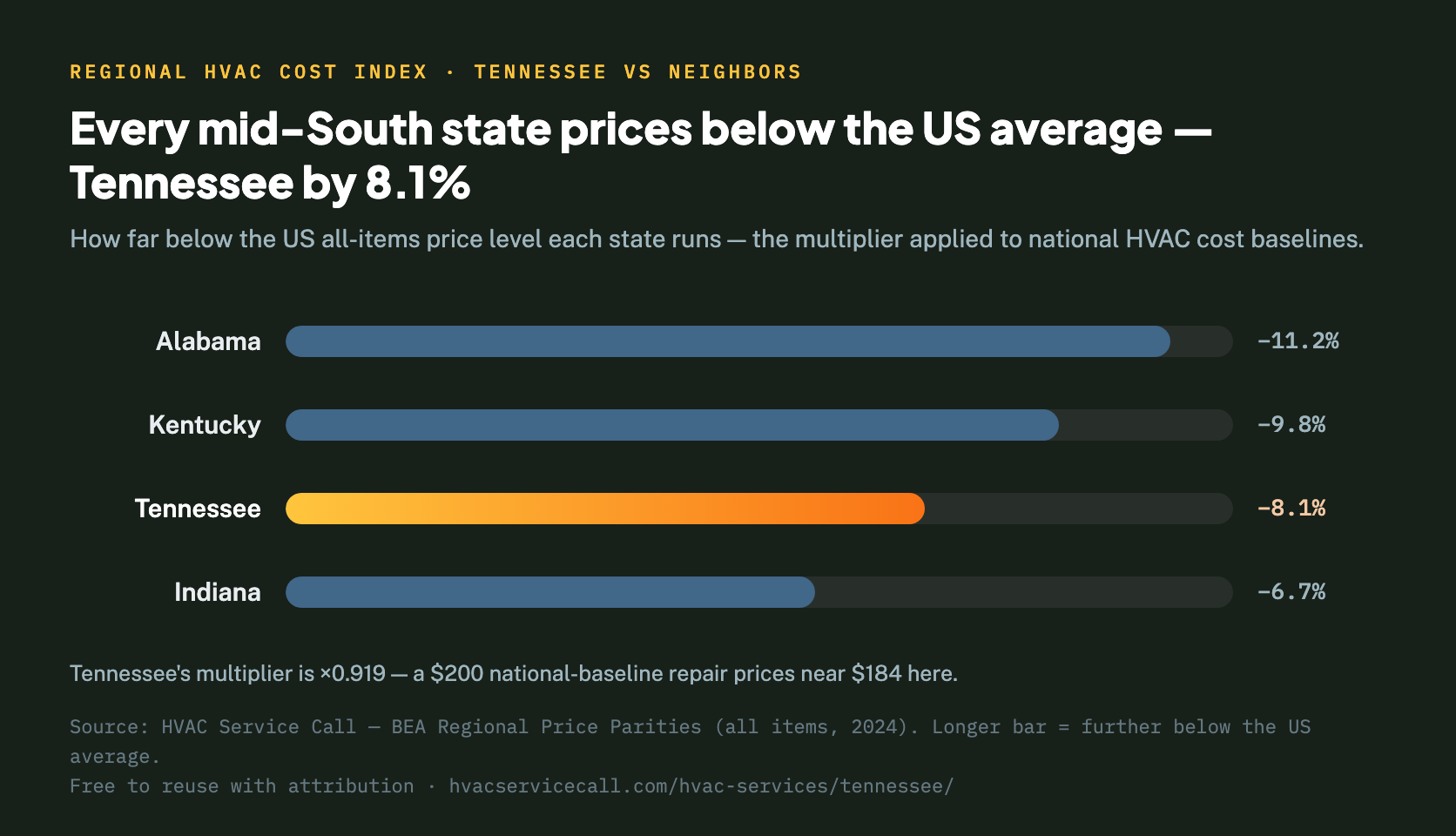
How we price this: national baselines cross-referenced from HomeGuide, Angi and Forbes Home (2026), multiplied by the BEA Regional Price Parity index for Tennessee (×0.919) — the Bureau's official 2024 reading of the state's overall price level. Because one multiplier drives every figure on this page, no two of them can disagree. City pages beneath this hub carry part-by-part detail.
Tennessee licenses HVAC by contract value — not by the work
This is the single most important thing to understand before hiring anyone in Tennessee, and it is genuinely different from both neighbouring states in this network. The Tennessee Board for Licensing Contractors requires a contractor's license — classification CMC-C for HVAC and refrigeration — "prior to contracting (bidding or negotiating a price) whenever the total cost of the project is $25,000 or more." The trigger is the size of the contract, not the nature of the work.
| State | What triggers the license |
|---|---|
| Tennessee | Contract value — $25,000 or more (CMC-C) |
| Alabama | The work itself — any install, service or repair (HACR certification, no dollar floor) |
| Kentucky | The work itself — master license for any HVAC work (815 KAR 8:010) |
Read honestly, that table says something no contractor page in this state will tell you: the person fixing your furnace in Tennessee may hold no state contractor license at all, because a repair almost never reaches $25,000. That is not a loophole or a scandal — it is how the statute is written. But it does mean "are you licensed?" is a weaker screening question here than in Alabama or Kentucky, and that three other checks carry the weight instead: federal EPA Section 608 certification, which anyone handling refrigerant needs whatever the job is worth; a current certificate of liability and workers' compensation insurance; and any local registration or permit rules, which vary by municipality below the state threshold. A full replacement is the case where it flips — that job can cross $25,000, and then the license genuinely is required.
One more detail worth knowing, because it decides who can take a big job: every Tennessee license carries a monetary limit, set at 10 times the lesser of working capital or net worth, with an unlimited limit requiring $300,000 in both. Projects may not be split into phases to slip under it. On a whole-system replacement it is that number — not the classification letters — that determines whether a contractor can legally sign. Look it up free at verify.tn.gov.
Current as of July 2026 — two rules changed on July 1 and most guides have not caught up. The Board's exam provider moved from PSI to Prov; applicants already booked with PSI may keep that date (PSI continues scheduled exams through September) or rebook through Prov. And contractors may now use a new Contractors' Surety Bond, set at a minimum of 50% of the monetary limit requested, as an alternative to a CPA-reviewed or audited financial statement. Source: Tennessee Board for Licensing Contractors, tn.gov (page last modified July 7, 2026).
Finally, a cross-border note this network can answer directly: you cannot work in Tennessee on another state's license. Tennessee does grant a trade-exam waiver to contractors actively licensed in Alabama (General, Electrical, Residential and HVAC), plus Louisiana, Mississippi, North Carolina, Ohio, South Carolina, West Virginia and Arkansas, and it accepts the NASCLA national commercial exam — but the Tennessee license itself still has to be obtained. If someone quoting a Tennessee job tells you they are "licensed in Alabama", that is the distinction to press on.
Tennessee utilities, energy costs, and rebates
Most of Tennessee buys electricity from a local distributor of the Tennessee Valley Authority — KUB in Knoxville, NES in Nashville, MLGW in Memphis, EPB in Chattanooga, and dozens of municipal systems and cooperatives besides. Residential power averages about 13.18¢/kWh (EIA), close to Kentucky and well under Alabama's 16.1¢. Because the state sits behind one wholesale supplier, the incentive path is unusually consistent: TVA EnergyRight applies almost everywhere, which is the same programme north-Alabama homeowners use and a different one from the Alabama Power rebates that govern Birmingham.
EnergyRight pays on heat pumps, ductless mini-splits, geothermal, higher-SEER2 air conditioning, tune-ups, duct sealing, insulation and smart thermostats. The condition people miss is not the equipment rating but the installer: the work must be completed by a Quality Contractor Network member, or the rebate is forfeited entirely. Amounts and funding change, so treat a contractor's flyer as a starting point and check the current figure with EnergyRight directly. With the federal 25C credit closed since December 31, 2025, these utility programmes are what remains.
Tennessee's winter-weighted emergency season
File Tennessee under "the South" and the emergency calendar surprises you. The state runs more heating degree-days than cooling ones, an electric-heating majority depends on a single machine, and East Tennessee ice storms take out power and heat in the same hour — so a no-heat house during a hard cold stretch is the call this state produces most. The summer case is real too: a failure during a run near the 95°F design high turns dangerous fast in households with a newborn, an older resident, or anyone taking medication that blunts heat tolerance. Any gas odour or CO alarm skips the queue entirely — everyone outside first, then the utility and 911 from outdoors. Emergency HVAC covers triage, after-hours pricing, and how to hold heat in a house that has lost both power and its heat pump.
Tennessee HVAC questions, answered
Is the whole state covered, or only the cities with their own page?
Statewide, yes. One call to (888) 810-2291 reaches a local contractor from Memphis across to Knoxville and the Tri-Cities, and the call itself costs nothing. Knoxville, Nashville and Memphis each have a complete local cluster today — their own cost, climate, utility and permit detail — and the rest of the state is being built out city by city. Until your town has a dedicated page, the phone still matches your Tennessee ZIP to a contractor who covers it.
Do HVAC contractors in Tennessee need a state license?
This is where Tennessee genuinely differs from its neighbours, and it is worth understanding before you screen anyone. Tennessee licenses by contract value, not by the work: the Tennessee Board for Licensing Contractors requires a contractor's license — classification CMC-C for HVAC — "prior to contracting (bidding or negotiating a price) whenever the total cost of the project is $25,000 or more." Alabama, next door, requires certification for any install, service or repair with no dollar floor, and Kentucky requires a master license for any HVAC work at all. The practical consequence in Tennessee: the contractor fixing your furnace may legitimately hold no state contractor license, because a repair almost never reaches $25,000. That is how the statute is written, not a loophole — but it means the checks worth making here are different ones.
So what should I actually check on a Tennessee repair?
Three things that apply regardless of contract size. EPA Section 608 certification is federal and required of anyone handling refrigerant, whatever the job is worth. Proof of liability and workers' compensation insurance — ask for the certificate, not a verbal yes. And local registration or permit rules, which vary by municipality below the state threshold. On a full replacement the calculus flips: that job can cross $25,000, at which point a state license genuinely is required and you can look it up free at verify.tn.gov.
What does the number on a Tennessee contractor's license mean?
Every TN contractor's license carries a monetary limit — a per-project ceiling — and the Board publishes exactly how it is set: 10 times the lesser of working capital or net worth, plus required experience. An unlimited limit takes $300,000 in both. There is a 10% tolerance, and a job may not be split into phases to slip under a cap. So on a large replacement it is that dollar figure, rather than the CMC-C letters, that decides whether a contractor can legally sign the contract — and verify.tn.gov shows it.
How much does HVAC repair cost in Tennessee?
A diagnostic visit runs $70–$185 statewide and is commonly credited toward the repair you approve, though that is local practice rather than a rule — get its treatment in writing. Beyond that, heat-pump work usually lands $140–$825, furnaces $90–$550, and air conditioning $115–$735, with an installed replacement roughly $3,490–$11,490. These are national baselines adjusted to Tennessee by the BEA Regional Price Parity index (×0.919, about 8.1% under the national average) — the contractor sets the real number after diagnosing on site.
Why is Tennessee a heat-pump state?
Because it heats far more than it cools, and it heats with electricity. At the Knoxville benchmark the state logs 3,408 heating degree-days against 1,606 cooling, and 65% of Knox County homes heat electrically against 33% on gas. Add mild-but-real winters — a 16°F design low rather than a northern one — and the heat pump is simply the right machine for the climate. It also means the single system in most Tennessee homes is doing both jobs, which is why two service visits a year is justified here rather than an upsell.
What HVAC rebates can Tennessee homeowners get?
Most of Tennessee buys power from a local distributor of the Tennessee Valley Authority, so the live programme statewide is TVA EnergyRight — the same one north-Alabama homeowners use. It pays on heat pumps, ductless mini-splits, geothermal, higher-SEER2 air conditioning, tune-ups, duct sealing, insulation and smart thermostats, with one condition people miss: the work must be done by a Quality Contractor Network member or the rebate is forfeited. Amounts and funding move, so check the current figure with EnergyRight rather than assuming last season's number still stands. The federal 25C credit has been closed since December 31, 2025.
Does Tennessee accept an out-of-state contractor's license?
No — you cannot operate in Tennessee on another state's license. What Tennessee does offer is a trade-exam waiver: contractors actively licensed in Alabama (General, Electrical, Residential and HVAC), Louisiana, Mississippi, North Carolina, Ohio, South Carolina, West Virginia or Arkansas may skip the TN trade exam, and the NASCLA national commercial exam is accepted too. They still have to obtain the Tennessee license itself. Worth knowing if a contractor tells you they are "licensed in Alabama" while quoting a Tennessee job.
When is an HVAC problem an emergency in Tennessee?
Most often in winter, which surprises people who file Tennessee under "the South". A no-heat house during a hard cold stretch is the call this state produces most, and East Tennessee's ice storms take out power and heat together for an electrically heated majority. A cooling failure during a run near the 95°F design high is the summer equivalent and turns dangerous fast for infants, elderly residents and anyone whose medication affects heat tolerance. A gas odour or CO alarm is never a repair question: get everyone outside first, then call the utility and 911 from outdoors.
When is a Tennessee contractor actually easy to book?
October for heating and March or April for cooling — the two quiet windows either side of the load. The search data on this page shows why it matters: statewide interest is overwhelmingly cooling-weighted and spikes with the first sustained heat, so every schedule in Tennessee fills in the same few summer weeks. Because most homes here run a heat pump doing both jobs, the autumn visit is the more valuable of the two. Booking in a quiet week also sidesteps any after-hours premium.
Is HVAC Service Call the company that comes to my house?
No. (888) 810-2291 is a free routing line that matches your Tennessee ZIP and your symptom to an independent local contractor. Every figure on the eventual invoice is theirs, quoted after a diagnosis and before any work starts — nothing on it originates with us. Asking for proof of insurance, and checking verify.tn.gov when the job is large enough to require a license, stays your step.
HVAC trouble anywhere in Tennessee?
One call reaches a local contractor who covers your ZIP — free to place, any hour, with every dollar approved by you before the work starts.
☏ (888) 810-2291Where these numbers come from
Every figure on this page comes from a published dataset rather than an estimate. The sources are listed below with the vintage of each, so you can check any number yourself — and so you can see when a figure is due for a refresh.
- Degree-days & design temperatures Open-Meteo ERA5 · 2014-2023 normals · retrieved 2026-07-15
- Heating fuel mix & housing age Census ACS5 2022 (county) · Knox County, Tennessee table · retrieved 2026-07-15
- Residential electricity rate U.S. Energy Information Administration · state average, cents per kWh · retrieved 2026
- National cost ranges (before local adjustment) HomeGuide, Angi, Forbes Home, corpus-observed 2026-07 · retrieved 2026-07-15
- Local price adjustment BEA SARPP all-items · all-items RPP, applied to the national range · retrieved 2026-07-15
- Contractor licensing & verification Tennessee Board for Licensing Contractors · retrieved 2026-07-15
Cost ranges are national published ranges adjusted to local price levels, not quotes. The independent licensed contractor who takes the call sets the actual price, in writing, before any work begins.