HVAC services in Knoxville, TN, connected to a licensed local contractor
Looking for HVAC services in Knoxville, TN? Call (888) 810-2291 — a free call that puts an independent, licensed local pro on your heat pump, furnace, air conditioning or after-hours emergency. The diagnostic visit runs $70–$185 at Tennessee prices. Routing covers all 35 Knox County ZIPs, from downtown, Fort Sanders and the Old City out through Bearden, Sequoyah Hills, Fountain City and West Hills to Halls, Powell, Karns, Hardin Valley and Farragut. This is the Knoxville hub: what the work costs here, what an East-Tennessee year does to the equipment, who sells the power, and which license tier a contractor actually needs for your job.
Part of HVAC services in Tennessee ↑
Local facts that shape every Knoxville repair
Knoxville sits in the Tennessee River valley on the mixed-humid line, and its year is longer on the heating side than its latitude suggests: 3,408 heating degree-days against 1,606 cooling, a 16°F winter design low and a 95°F summer design high. 4 months average a daily high at or above the 78°F comfort line; 1 average lows under freezing. The fact that reorganises everything else is the fuel split: Knox County heats 65% electrically against 33% with gas. Gas is the minority fuel here, so the machine most households depend on year-round is a heat pump rather than a furnace-plus-air-conditioner pair. Add a median build year of 1984 — houses now on their second or third system, running through ductwork sized for the first — and most of what a Knoxville technician meets is explained before they open the van.
Knoxville HVAC contractors handle four kinds of call
The cards run in the order this county's equipment accumulates hours, which is not the order a Tennessee city is usually written in. Heating leads because two houses in three heat with electricity and the heat pump does both jobs on one machine. Each card opens the full local page — symptoms, part-level costs, what the visit involves — and whoever answers is matched to your ZIP and to the system that quit.
Why Knoxville's HVAC year is decided in winter
Two numbers set the whole shape of service here. The first is the degree-day split — 3,408 heating against 1,606 cooling, roughly 2.1 times as much heating work as cooling work in an average year. The second is the fuel mix: 65% of Knox County homes heat with electricity. Neither number is dramatic on its own; together they mean the typical Knoxville system is a heat pump that runs in every month of the year, and that the parts under load in January are the parts nobody thinks about in July — the reversing valve, the defrost board, the backup strips.
Two practical consequences follow, and both cost money if you get them backwards. The autumn service visit is worth more here than the spring one, because the season that stresses the equipment hardest is the one people book for last. And a regional power failure in this county is not an inconvenience — with an electric-heating majority, an ice-storm outage is a no-heat event for most households at the same moment, which is why the emergency page below leads with freezing rain rather than with heat.

Which HVAC repairs get searched for — and when?
Five years of Google Trends data show the statewide split running well ahead of what Knoxville's load would predict: “ac repair” takes roughly 85% of repair-type search interest across Tennessee, with furnace and heat-pump queries splitting the rest. The national month-by-month curves crest in July for cooling and January for heating. That distance between what a county runs and what its residents type is the useful part — in Knox County the heating equipment carries more of the year, but almost nobody searches for it until the week it fails, which is the same week every contractor's diary is already full. A tune-up booked in a quiet month is bought at a different price than the same visit during a cold snap.
Knoxville HVAC repair & replacement costs
Every range below is a national baseline carried down to Tennessee's price level, which the Bureau of Economic Analysis puts about 8.1% under the national average (Regional Price Parity, ×0.919). The ordering follows the router: heating first, because that is what most of these houses run.
| Work | Typical Knoxville range |
|---|---|
| Diagnostic / service call | $70–$185 |
| Heat pump repair | $140–$825 |
| Furnace repair | $90–$550 |
| AC repair | $115–$735 |
| Full system replacement (installed) | $3,490–$11,490 |

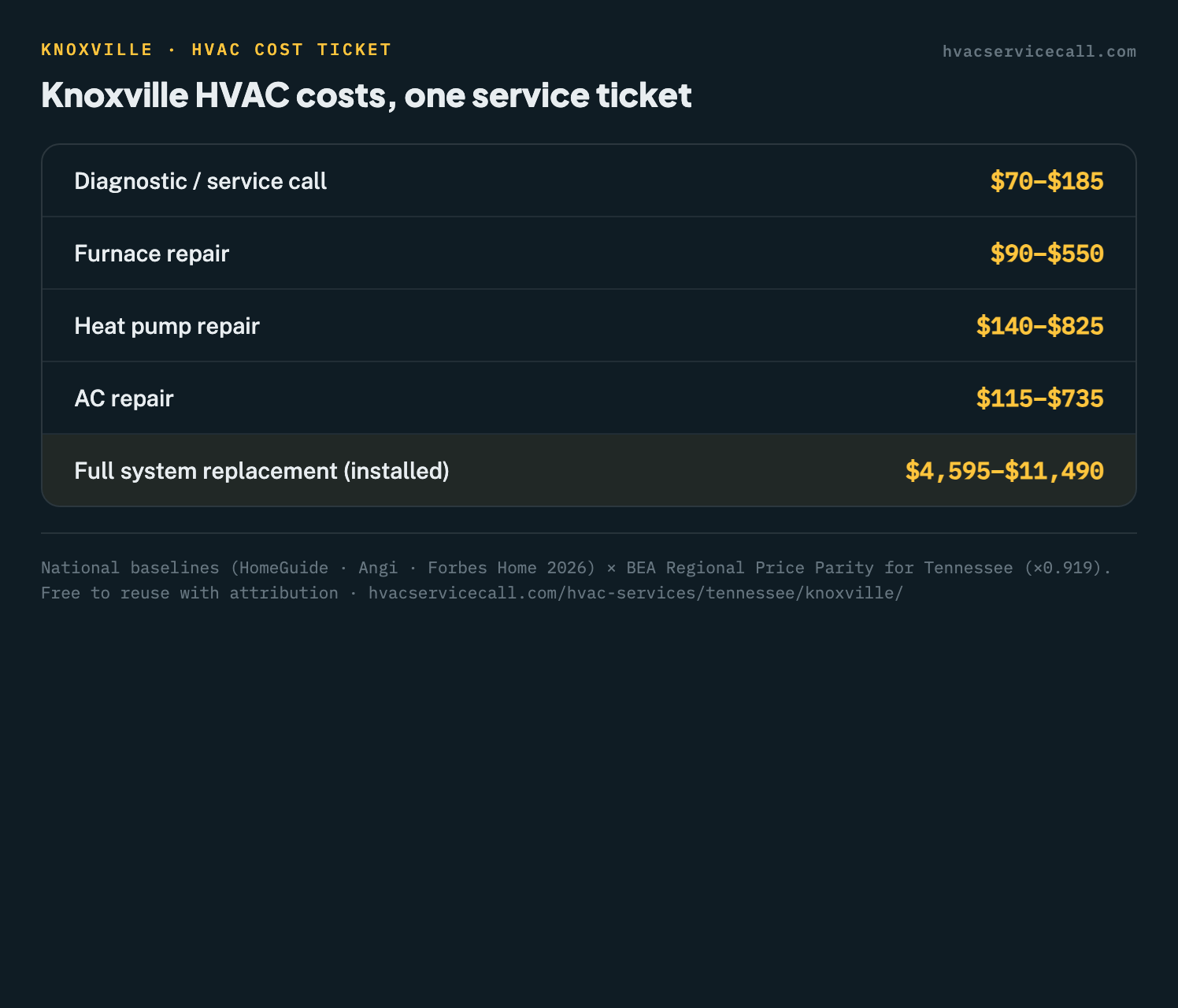
How we price this: one function generates every figure on this page. localCost() takes cost baselines cross-referenced from HomeGuide, Angi and Forbes Home (2026) and multiplies them by the BEA Regional Price Parity index for Tennessee — the Bureau's official 2024 reading, putting the state's price level roughly 8.1% below the U.S. average. Because it is a single source applied everywhere, no two numbers on this hub can disagree with each other, and any figure here can be recomputed from what is printed. That is worth stating because the cost tables that rank for this city do not survive the same test — one page-one roundup prices a whole packaged system below its own line item for cleaning a condenser. Part-by-part breakdowns belong to the four service pages above; on the diagnostic fee, ask how it is treated before you approve anything and get the answer in writing.
One utility sells Knoxville both its power and its gas
Most cities split their energy between two companies and leave the homeowner to work out whose failure it is. Knoxville does not: KUB, the Knoxville Utilities Board, is a single municipal system supplying electricity, natural gas, water and wastewater. At two in the morning that matters more than it sounds — whichever service has gone down, it is one utility and one number, and the question of whether the problem is upstream of your equipment gets answered in a single call.
KUB buys its power wholesale as a TVA distributor, and residential electricity runs about 13.18¢ per kWh. That relationship, rather than any state programme, sets the incentive path: TVA EnergyRight runs efficiency incentives and a quality-contractor network through local distributors like KUB. We deliberately do not print a rebate amount here — EnergyRight's eligible equipment, amounts and funding windows move, and a stale figure on a page is worse than none. Confirm the current offer with EnergyRight or KUB before you sign, and treat any quote still discounting for the federal 25C tax credit as out of date: that credit ended December 31, 2025.
What license does a Knoxville HVAC contractor actually need?
Search this question and you will be told, on more than one well-ranked page, that Tennessee requires a license only above $25,000. That is one tier of two, and the missing tier is the one most repairs fall into. Tennessee licenses HVAC work through the Tennessee Board for Licensing Contractors, and Knox County adopted the lower threshold: a project from $3,000 to $24,999 requires a Home Improvement license, while $25,000 and above requires the full contractor license with its mechanical classification. Federal EPA Section 608 certification sits on top of both for anyone opening a refrigerant circuit, at any dollar value at all.
Read against a real invoice, the gap is not academic. A condenser plus a stretch of duct repair lands around $$4,000 in this market — comfortably inside the tier that the $25,000-only version says does not exist. Verification is free at verify.tn.gov, takes about two minutes, and is worth doing before work starts rather than after a dispute. Because this network hands you to an independent business rather than employing the technician, that check is genuinely your step to make — and a legitimate local company will hand you the number without being asked twice.
Permits split on the city line. Inside the corporate limits, a system changeout is permitted through City of Knoxville Plans Review & Permits; outside them and still in the county, through Knox County Codes Administration. A repair needs no permit; a replacement does, is reviewed against the residential code and a Manual J load calculation, and is pulled by the contractor rather than by you. The one question worth putting on a replacement quote is simply which office they are filing with.
How HVAC Service Call connects you with a Knoxville contractor
Worth saying plainly, because the results for this city do not: a city list is not a coverage map. The ranked roundups of “HVAC companies in Knoxville” mix in businesses whose own printed addresses are in Seymour, Sevierville and Oak Ridge, and the local companies at the top of those results publish service areas reaching across four counties. None of that is dishonest — East Tennessee contractors really do work across county lines — but it means the list answers who exists, and never who will drive to your street tonight. The threads sitting alongside those lists in the results ask a blunter version of the same thing: who here is honest, and how do I judge this quote? This service is built around those two questions, and the mechanism has four steps and no fine print.
- You dial (888) 810-2291. Free, day or night. Name the system and describe what it is doing.
- Your ZIP does the matching. The call lands with an independent, licensed Tennessee contractor whose working territory actually covers your part of Knox County.
- Pricing belongs to that contractor. They diagnose, they quote, and the work happens only once you have said yes — no figure on the invoice originates with us.
- Verification stays with you. Independent means independent: ask for proof of insurance and confirm the license at verify.tn.gov.
No diagnosis over the phone, and no headline figure that changes when the truck arrives — the local contractor owns both the estimate and the work.
What counts as an HVAC emergency in Knoxville
The urgent list here leans toward winter, and the reason is regional rather than personal. East Tennessee's signature hazard is freezing rain, which takes down lines rather than roofs, and in a county where 65% of homes heat with electricity a wide outage and a no-heat emergency are the same event for the majority at the same hour. The paired danger is the generator people reach for next — run indoors or too close to a window, it is the largest carbon-monoxide source most homes will ever have. The summer version is real too: a dead system in a 95°F stretch turns dangerous quickly for infants, older adults and anyone whose medication affects heat tolerance. Any gas odor or CO alarm skips the queue entirely — everyone outside first, then KUB and 911 from outdoors. Emergency HVAC in Knoxville carries the triage, the after-hours fee windows, generator and CO safety, and what Tennessee law does and does not require a landlord to fix.
Which other Tennessee cities are covered?
Knox County is the eastern end of the I-40 corridor. The two Tennessee markets below are covered to the same depth, with their own hazards, utilities, and cost ranges.
- HVAC services in Nashville, Tennessee — west on I-40, Middle Tennessee's metro.
- HVAC services in Memphis, Tennessee — the far western end of the same interstate.
Where these numbers come from
Every figure on this page comes from a published dataset rather than an estimate. The sources are listed below with the vintage of each, so you can check any number yourself — and so you can see when a figure is due for a refresh.
- Degree-days & design temperatures Open-Meteo ERA5 · 2014-2023 normals · retrieved 2026-07-15
- Heating fuel mix & housing age Census ACS5 2022 (county) · Knox County, Tennessee table · retrieved 2026-07-15
- Residential electricity rate U.S. Energy Information Administration · state average, cents per kWh · retrieved 2026
- National cost ranges (before local adjustment) HomeGuide, Angi, Forbes Home, corpus-observed 2026-07 · retrieved 2026-07-15
- Local price adjustment BEA SARPP all-items · all-items RPP, applied to the national range · retrieved 2026-07-15
- Contractor licensing & verification Tennessee Board for Licensing Contractors · retrieved 2026-07-15
Cost ranges are national published ranges adjusted to local price levels, not quotes. The independent licensed contractor who takes the call sets the actual price, in writing, before any work begins.
Questions Knoxville homeowners ask
Which parts of Knoxville does HVAC Service Call reach?
All 35 Knox County ZIP codes — downtown and the Old City, Fort Sanders, Bearden, Sequoyah Hills and Rocky Hill, North and South Knoxville, Fountain City, West Hills and Cedar Bluff, out to Halls, Powell, Karns, Hardin Valley and Farragut. Dialing (888) 810-2291 costs nothing, and the company that picks up is the independent contractor whose territory covers your street rather than whoever bid highest for the ZIP.
Do HVAC contractors in Knoxville need a license for a small job?
Often yes — and this is the point most Knoxville search results get wrong. The commonly repeated line is that Tennessee only requires a license above $25,000, which describes one tier of two. Knox County adopted the lower one, so a project from $3,000 to $24,999 calls for a Home Improvement license, and $25,000 or more calls for a full contractor license from the Tennessee Board for Licensing Contractors. Anyone opening the refrigerant circuit also needs federal EPA Section 608 certification, whatever the invoice says. A $4,000 condenser-and-duct ticket is an ordinary Knoxville job and it lands squarely in the tier that gets left out. Checking a number at verify.tn.gov is free and takes about two minutes.
How much does HVAC repair cost in Knoxville?
Budget $70–$185 for the diagnostic visit. Past that, heat-pump work usually lands $140–$825, furnaces $90–$550, air conditioning $115–$735, and an installed replacement runs roughly $3,490–$11,490 depending on the system and how much duct and air-handler work rides along. Those are national baselines scaled to Tennessee prices by the BEA index (×0.919); the figure that counts gets set at your house, after somebody has looked at the machine.
Why does this hub list heating before cooling in a Southern city?
Because the meters and the housing stock both say so. Knox County logs 3,408 heating degree-days against 1,606 cooling — about 2.1 times as much heating work — and 65% of homes heat with electricity against 33% on gas. Put those together and the machine carrying the most annual runtime in this county is a heat pump, doing both jobs on one compressor. Summer is still the busiest phone month and the AC page is the biggest of the four; ordering the cards by what the equipment actually does, rather than by what a Tennessee summer feels like, is the honest version.
Is a company on a ranked “HVAC companies in Knoxville” roundup guaranteed to serve my street?
No, and that is worth knowing before 9pm on a Friday. The ranked roundups for this city routinely mix in businesses whose own printed addresses sit in Seymour, Sevierville or Oak Ridge, and the local companies that rank well here publish service areas spanning four counties. None of that is dishonest — East Tennessee contractors genuinely work across county lines — but a city list answers who exists, not who is on call for your ZIP tonight. That second question is the only one this line is built to answer.
Who supplies power and gas in Knoxville, and what does electricity cost?
KUB — the Knoxville Utilities Board — supplies both, along with water and wastewater, which makes it unusual: one municipal system and one number to call whichever service fails. KUB buys wholesale power as a TVA distributor, and residential electricity runs about 13.18¢ per kWh. That single relationship is why the incentive path here is TVA EnergyRight rather than a state utility program, and why the electric-heating majority in this county is a rational choice rather than an accident.
What HVAC rebates or incentives can Knoxville homeowners get?
Because KUB distributes TVA power, the program to ask about is TVA EnergyRight, which runs efficiency incentives and a quality-contractor network through local distributors. Amounts, eligible equipment and funding windows change from year to year, so confirm the current offer with EnergyRight or KUB before you sign anything rather than trusting a figure printed on a contractor's flyer. One thing is settled: the federal 25C tax credit ended December 31, 2025, so any quote still discounting for it is out of date.
Do I have a heat pump or an air conditioner?
In Knox County the odds favour a heat pump, and the data plate on the outdoor unit settles it in a minute: a heat pump lists a reversing valve and a defrost control, an air conditioner lists neither. The faster household test is whether that outdoor unit ever runs on a cold morning — if it does, it is heating the house, which an air conditioner cannot do. It matters because the two machines fail differently, carry different parts, and route to different pages above.
Which office issues the permit for an HVAC replacement in Knoxville?
Inside the city limits it is City of Knoxville Plans Review & Permits; outside them but still in the county it is Knox County Codes Administration. A repair needs no permit. A full changeout does — it is reviewed against the residential code and a Manual J load calculation, and the contractor pulls it, not you. So the useful question on a replacement quote is which office they are filing with; a replacement quote with no permit line at all deserves a follow-up before you sign.
When does an HVAC problem in Knoxville count as an emergency?
Any gas odor or CO alarm, immediately — everyone outside first, then call KUB and 911 from outdoors. After that it is about who is in the house: no heat as the temperature runs down toward the 16°F design low, or no cooling in a 95°F stretch, with an infant, an older adult or anyone medically fragile at home. East Tennessee adds its own version — freezing rain takes down lines, and in a county where 65% of homes heat electrically a regional outage is a no-heat event for the majority at once. Emergency HVAC in Knoxville has the triage and the after-hours fee windows.
I rent in Knoxville — is my landlord required to fix the heat?
For heat, yes. Tennessee's Uniform Residential Landlord and Tenant Act applies in the larger counties and Knox County is covered, and it names heat, gas and electricity as essential services a landlord must maintain. Air conditioning is not on that list, which surprises people every July — a broken AC is a lease question rather than a statutory one unless your lease says otherwise. Notify the landlord in writing, keep the copy, and the statute sets out what follows if nothing happens.
Which HVAC brands do Knoxville contractors work on?
The mainstream lineup — Trane, Carrier, Lennox, Goodman, Amana, Rheem, Bryant, American Standard — plus the ductless names (Mitsubishi, Daikin, Fujitsu) that turn up on additions and on the older housing here that never got full ductwork. Brand mostly changes parts logistics rather than whether anyone will come out; what decides if you are running again tonight is which component failed and whether it rides on the van.
When is the easiest time to book HVAC service in Knoxville?
October for heating and March or April for cooling — the two quiet windows either side of the load. Because most systems in this county are heat pumps doing both jobs, two visits a year is genuinely justified rather than an upsell, and in a heating-led market the autumn visit is the more valuable of the pair. Booking in a quiet week also sidesteps the after-hours premium entirely.
Is HVAC Service Call the company that shows up at my door?
No. (888) 810-2291 is a free routing line that matches your Knox County ZIP and your symptom to an independent, licensed Tennessee contractor. Every figure on the eventual invoice is theirs, quoted after a diagnosis and before any work starts — nothing on it originates with us. Confirming their license at verify.tn.gov and asking for proof of insurance stays your last step, and a legitimate local company answers both without hesitating.
HVAC trouble anywhere in Knoxville?
One call turns into a licensed local contractor at your door — matched by Knox County ZIP, free to place, any hour, with every dollar approved by you before the work starts.
☏ (888) 810-2291HVAC coverage across Knoxville, TN
Coverage runs to 35 ZIP codes across Knoxville and Knox County — downtown, the Old City and Fort Sanders through Bearden, Sequoyah Hills, Rocky Hill and West Hills, north to Fountain City, Halls and Powell, west through Cedar Bluff, Karns and Hardin Valley to Farragut, and south across the river through South Knoxville. That footprint is Knox County, stated precisely: contractors here often work into Blount, Loudon, Anderson and Sevier as well, but the ZIPs below are what this hub routes.
Knoxville-area ZIPs the hub routes for: