AC repair in Huntsville, AL
Looking for AC repair in Huntsville, AL? Call (888) 810-2291 — one free call routes you to a trusted, licensed local contractor, 24/7. Repairs typically run $110–$710 on a $65–$180 diagnostic visit. Technicians run Five Points, Blossomwood, Hampton Cove, Research Park and Madison, and every Madison County ZIP behind them — 35801, 35802, 35806, 35758 and 35763 included.
What actually breaks an air conditioner in Huntsville?
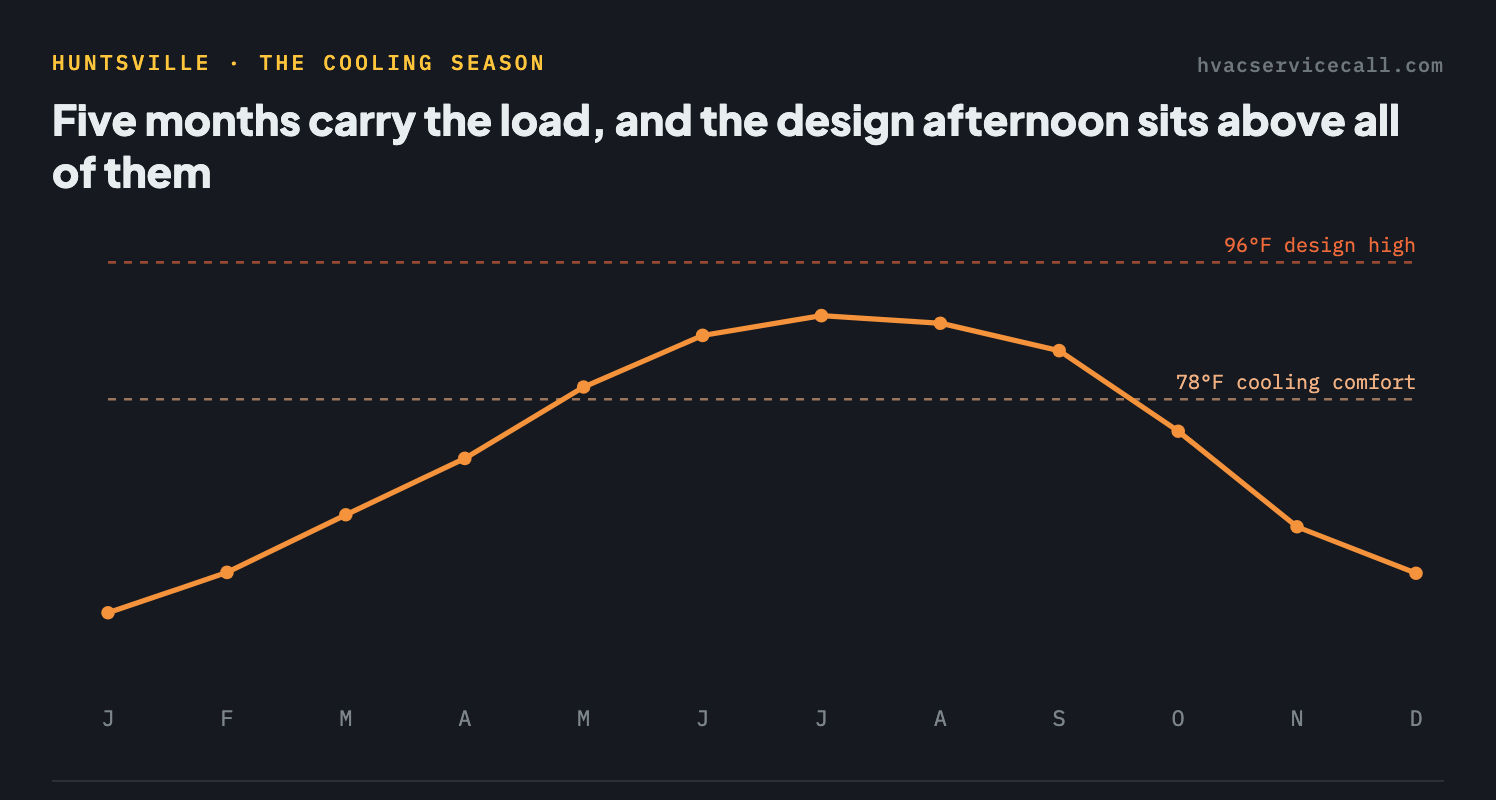
Huntsville's cooling season is long rather than extreme. The city logs 1,889 cooling degree-days against a 96°F design high, with July averaging a 89°F afternoon and 5 months of the year averaging highs at or above the high seventies. That is a real load — Huntsville Utilities counted 53 days above the average high between June 1 and August 31 of 2025, better than half the summer — but it is a moderate one next to the Gulf-side cities, and it means most equipment here dies of hours and heat cycling rather than of one catastrophic afternoon.
What that produces, in order: electrical parts that fail under heat soak (the run capacitor first, the contactor close behind), coils and drains that clog in a humid mixed climate, and compressors that go on units old enough that the rest of the machine was already tired. The county's median home dates to 1990, so a large share of local systems are second-generation equipment sitting in ductwork nobody has measured since it was installed.
One local number is worth carrying into every decision on this page: the utility's own guidance is that an air conditioner begins losing efficiency once it is asked to hold more than about 20 degrees below outdoor air. On a 96°F afternoon that puts the honest expectation around 76°F indoors, not 68°F — which is the difference between a system that is failing and a system that is being asked for something it was never sized to do.

Is that outdoor unit an air conditioner, or a heat pump in cooling mode?
In Madison County the answer is usually the second one. 74% of homes here heat electrically and only 21% burn gas (U.S. Census ACS 5-year), which makes this the most electric-dominant county on our coverage map — and means roughly four outdoor units in five are heat pumps that spend the summer doing exactly what an air conditioner does. The machine you call your air conditioner is, in most Huntsville houses, also your furnace.
That is not a technicality, because it changes what can fail in July. A heat pump carries a reversing valve that can stick or lose its solenoid and leave the system trying to heat while you ask it to cool; a defrost board that can call at the wrong time of year; and a set of auxiliary heat strips that a miswired or failing thermostat can energise during a cooling call — which shows up as a startling power bill rather than as a comfort complaint, and is worth ruling out before anyone condemns a compressor.
Settling which machine you own takes a minute. Read the data plate on the outdoor unit: a heat pump publishes a heating capacity and an HSPF or HSPF2 rating beside its cooling numbers, and carries a brass reversing valve in the refrigerant lines with a solenoid coil clipped on top. A straight air conditioner has neither, and its thermostat has no "emergency heat" setting. The distinction also decides the replacement conversation later on this page, because the rebate on a heat pump is a different figure from the rebate on an air conditioner.
The grid tells the same story from the other end. Huntsville Utilities' own resource planning describes a system that peaks in winter, with a material summer peak behind it — its published demand shows a January 2026 peak roughly 1.4× the previous July's. A Deep South utility working hardest in January is what a county that heats with compressors and resistance strips looks like from the substation, and it is the same fact that makes your "air conditioner" a two-season machine. The heat pump versus air conditioner guide covers the equipment difference in full, and the Huntsville heat pump page covers the heating side of the same box.
How does a Huntsville air conditioner announce that it is failing?
Eight signals, ordered the way a cooling system actually presents them in a humid climate — no cold air first, then ice, then water, then the electrical and mechanical outliers. Each links through to its full troubleshooting guide.
Each signal narrows to one or two entries on the repair list below — and two of them, the tripping breaker and the electrical smell, skip the list and become a same-day call.
What AC repairs do Huntsville contractors handle?
A cooling system splits into three parts that fail in different ways: an electrical side that starts and runs it, an airflow-and-water side that keeps the coil working, and a sealed refrigerant circuit that is a different class of job the moment it is opened. Fourteen types below, with a note on whether each is normally carried on the van or ordered in. Prices for the common ones are charted further down the page.
- Run or start capacitor replacement
- The most common cooling failure in this climate — a heat-stressed capacitor loses capacity and the compressor or fan will not start. Van stock, one visit, and the reason a July call can end in twenty minutes.
- Contactor replacement
- The relay that lets high voltage into the outdoor unit. Contacts pit and weld from thousands of summer cycles; a cheap part with a whole-system symptom.
- Condenser fan motor
- Moves air across the outdoor coil. When it fails the system loses its ability to reject heat and trips on high pressure — often mistaken for a refrigerant problem.
- Blower motor or ECM module
- Moves the conditioned air indoors. Older PSC motors are commonly stocked; variable-speed ECM motors and their modules are usually ordered.
- Compressor replacement
- The pump at the centre of the sealed system. It is the repair that turns into a replacement conversation on anything past roughly twelve years, because refrigerant and labour ride on top of the part.
- Evaporator coil replacement
- The indoor coil. Formicary corrosion and pinhole leaks make this one of the two big-ticket sealed-system jobs; it is ordered in, and the recharge is part of the price.
- Refrigerant leak search & repair
- Pressure test, dye or electronic sniffer to locate the loss, then brazing or component replacement. The step that makes a recharge a repair instead of a delay.
- Refrigerant recharge
- Restoring the correct charge by weight after the leak is fixed. On R-410A equipment the per-pound price is doing more of the work in the invoice than it used to.
- Expansion valve (TXV) replacement
- Meters refrigerant into the evaporator. A failing TXV mimics both low charge and a failing compressor, which is why it gets ruled in or out before anyone quotes the expensive part.
- Condensate drain clearing & pump replacement
- A small invoice, and one of the most common calls of a Huntsville summer. A slimed line backs the pan up and a float switch shuts the system down deliberately.
- Reversing valve or solenoid
- Heat-pump only, which in this county means most systems. A valve stuck in the heating position is a machine that runs beautifully and warms the house in August.
- Defrost board & sensors
- Heat-pump only. A failed board can call for defrost in summer or leave the outdoor coil iced in winter — the same part, two seasons of symptoms.
- Hard-start kit
- Helps an ageing compressor break away on a hot afternoon. A legitimate bridge on an older unit and an honest one only when described as exactly that.
- Thermostat & control wiring
- Presents as a dead system and is fixed for a fraction of one. On a heat pump it matters twice over, because a miswire can run auxiliary strips during cooling.
All fourteen reach the same number at any hour, and the frequent ones carry Huntsville prices further down this page.
Broken AC in Huntsville, AL?
That one sentence usually cuts the list above to two or three candidates. A licensed Madison County technician takes it from there, any hour.
☏ Call (888) 810-2291Availability is subject to provider participation, location, technician availability, and demand.
Which AC problems turn out not to be repairs?
Five checks that catch the non-failures. Four are worth trying before you book; the fifth is the one that stops all troubleshooting.
- The thermostat, set to COOL and not FAN: fan-only moves room-temperature air convincingly enough that plenty of calls end here. Confirm the mode, confirm the setpoint sits below room temperature, and change the batteries if it takes them.
- The filter: a restricted filter is the most common root cause of a frozen coil in this climate, because the coil needs airflow across it to stay above freezing. One to three months is the working interval, toward the short end with pets or pollen season.
- Both disconnects: there are two, and people usually check one: the breaker in the panel, and the pull-out disconnect in the box on the wall beside the outdoor unit — which gets pulled for yard work and landscaping and not always put back.
- The condensate float switch: if the drain pan filled, a safety switch has shut the system off on purpose. Clearing the drain line often restores everything, and it is worth knowing this before you are told the system is dead.
- The one that is not a check: if the coil or the line set is iced, stop. Set the system to OFF with the fan ON and let it thaw completely — running an iced system is how a compressor is asked to swallow liquid, and that turns a cheap fault into the expensive one.
Need AC repair in Huntsville, AL?
Mention which checks you ran and what the system does when you call for cooling. That combination puts a Huntsville technician most of the way to the diagnosis before the van arrives.
☏ Call (888) 810-2291Availability is subject to provider participation, location, technician availability, and demand.
How much does AC repair cost in Huntsville, AL?
A diagnostic visit runs $65–$180 in Madison County. Whether that fee comes off the repair is worth settling before anyone drives out: crediting it against approved work is common local practice, but it is not universal here — at least one Huntsville company publishes plainly that its diagnostic is a separate charge — so get the answer on the estimate rather than in conversation. The service-call fee guide explains how that credit normally works. Completed repairs mostly land between $110–$710, with drain clears and capacitors near the floor of that band and sealed-system work near its ceiling.

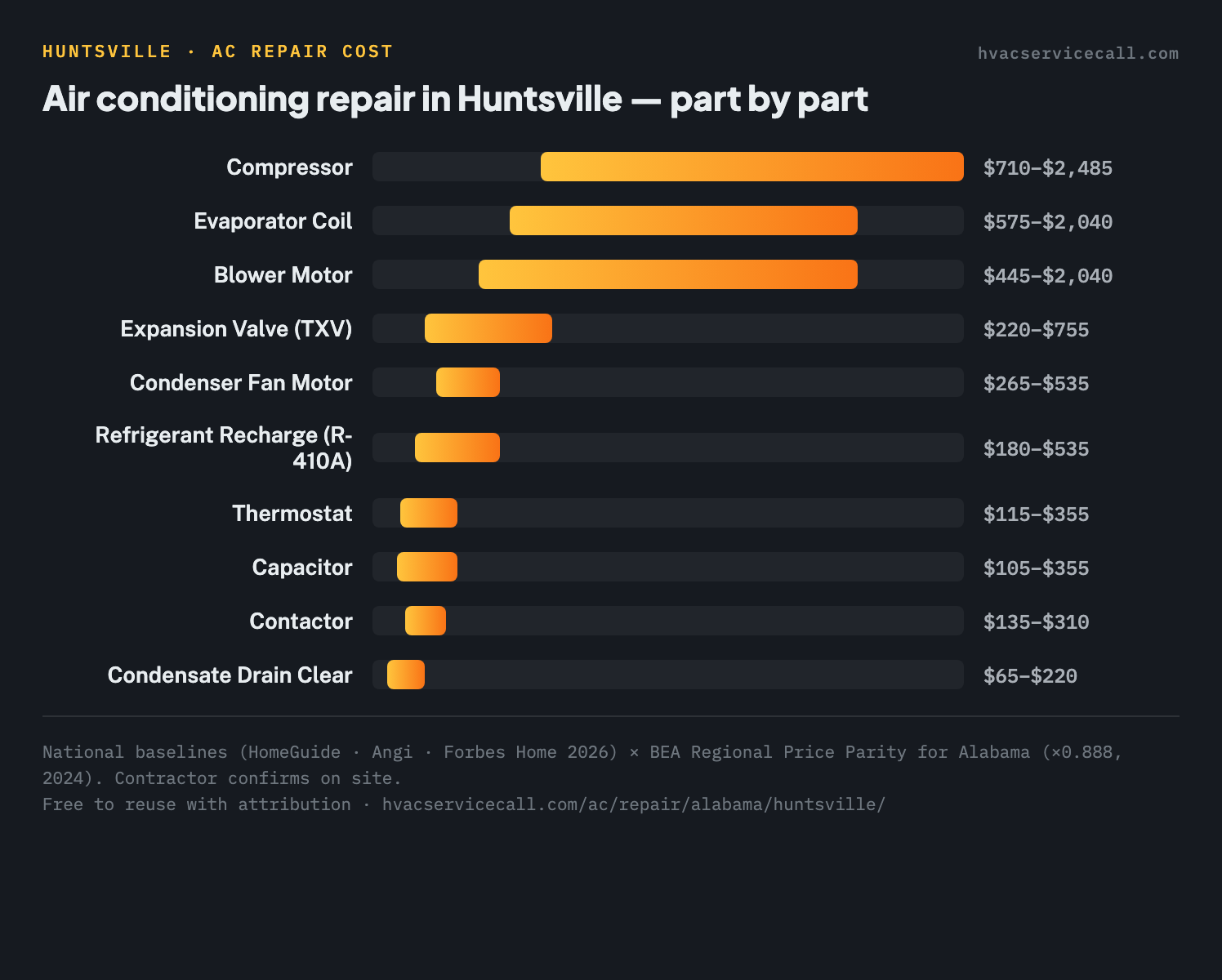
| Repair | Low | Typical | High | Note |
|---|---|---|---|---|
| Diagnostic / service call | $65 | $125 | $180 | credited against approved work by many shops, not all |
| Compressor | $710 | $1,600 | $2,485 | where replacement usually wins on a unit past twelve |
| Evaporator Coil | $575 | $1,310 | $2,040 | ordered in; the recharge rides on top |
| Blower Motor | $445 | $1,245 | $2,040 | an ECM module is ordered, a PSC motor usually is not |
| Expansion Valve (TXV) | $220 | $490 | $755 | ruled in or out before any compressor verdict |
| Condenser Fan Motor | $265 | $400 | $535 | commonly on the truck |
| Refrigerant Recharge (R-410A) | $180 | $360 | $535 | money spent twice unless the leak is found |
| Capacitor | $105 | $230 | $355 | the part that fails first on a hot afternoon |
| Thermostat | $115 | $235 | $355 | on a heat pump, wired wrong it runs the strips in July |
| Contactor | $135 | $225 | $310 | pitted contacts, cheap part, whole-system symptom |
| Condensate Drain Clear | $65 | $145 | $220 | the float switch shut the system off on purpose |
| Typical repair, all parts | $110 | $290 | $710 | where the majority of calls land |
| After-hours service call | $100 | $230 | $360 | 1.5–2× windows: nights, weekends, holidays |
| AC replacement (installed) | $3,375 | $6,060 | $8,745 | before any TVA rebate; a heat pump prices higher and rebates higher |
How we price this: identical work costs different money in different states, and the federal Bureau of Economic Analysis publishes the measure of that difference — its 2024 reading places Alabama's overall price level about 11.2% below the national average. Published national baselines from HomeGuide, Angi and Forbes Home go in, the ×0.888 figure is applied, and what comes out is the Huntsville column above. Two different things fill the Typical column: on the overall-repair row it is the survey average run through the multiplier; on each part row it is the midpoint of that part's local range, since individual components carry no survey average of their own. You will also find Huntsville companies publishing their own price lists, and those sit higher than this table — reasonably so, because a single company's number is its retail price with its own margin in it, while this is a market range. Neither replaces the on-site diagnosis, which is why no honest shop prices a repair sight-unseen. National context continues on the AC repair cost guide.
Confirm a technician already covers your road
The table above is what is normal to pay in Madison County. Your ZIP answers the other half: whether a Huntsville air conditioning contractor is already working nearby today.
In a hurry? Call (888) 810-2291 now.
Licensed contractors serve . One call routes you to one for .
☏ Call (888) 810-2291Availability is subject to provider participation, location, technician availability, and demand.
What moves an AC estimate up or down in Madison County?
Five levers move an estimate within — occasionally past — the typical band.
- Which part failed
- the band runs from a $65 drain clear to a $2,485 compressor, and naming the component settles most of the invoice before labour is counted.
- Whether the sealed system gets opened
- a capacitor or contactor is a bolt-on part. Opening the refrigerant circuit is a different class of work on the same machine: recovery equipment comes out, the technician needs a federal refrigerant credential, and a leak search happens before anything is filled.
- How much refrigerant is involved
- R-410A remains legal to buy and to put into an existing system, but supply is tighter since manufacturers stopped building new equipment for it, and per-pound prices have moved accordingly. On an older unit, a large loss is often the single line item that decides against repairing it.
- Whether it is actually a heat pump
- with 74% of the county heating electrically, most outdoor units here run in both directions — which adds a reversing valve, a defrost board and a set of aux-heat controls to the list of things that can fail in a cooling call.
- When you call
- nights, weekends and holidays typically carry a 1.5–2× premium on the visit fee; local shops quote after-hours surcharges in that range.
What happens during an AC service call here?
A technician works the system in the order it fails: thermostat call, then filter and airflow, then the indoor coil and its drain, then the outdoor unit's electrical side under load — capacitor, contactor, fan, compressor draw — and finally pressures with superheat and subcooling read on a system that has been allowed to stabilise. Expect the diagnosis itself to take 5 to 60 minutes. It ends where every one of these visits should end: a written quote in your hand, with nothing replaced before you have approved it. Whether the repair happens that afternoon depends on the van — capacitors, contactors, fan motors and drain work ride on it, while a coil, an ECM module or a compressor usually means one to three days.
Two requests are worth making here specifically. Ask for the temperature split to be measured and written down — the difference between return and supply air is the number that separates a charge problem from an airflow problem, and it is the first thing a second opinion will want. And if the outdoor unit is a heat pump, ask for the reversing valve and defrost board to be checked while the technician is already there, rather than discovering them in November on a separate call.
Humidity, frozen coils, and the drain that shuts the system off
Cooling in a mixed-humid climate is two jobs at once: the coil drops the air temperature, and in doing so it condenses water out of it — gallons a day on a humid Madison County afternoon. That water has one route out, and the failures cluster around it. A drain line that has grown a biofilm backs the pan up until a float switch cuts the system off on purpose, which reads to a homeowner as a dead air conditioner and is usually the least expensive call of the year. The alternative failure is worse: a coil starved of airflow by a loaded filter or a dirty evaporator drops below freezing, ice locks the surface, and a system left running in that state hands its compressor liquid it cannot compress.
The other half of the humidity story is sizing, and it produces the complaint people find hardest to describe: cold and clammy at setpoint. An oversized system satisfies the thermostat quickly, shuts off, and never runs long enough to dry the house — which is why TVA's own guidance tells homeowners to insist on a Manual J load calculation rather than accepting a matched-tonnage swap. Long, low-speed runtime is what removes moisture; short cycles are what leave it behind. The AC sizing guide covers what a Manual J actually involves, and the filter guide covers the airflow half.
R-410A, R-454B, and what the changeover means for a repair here
Two facts settle most of the anxiety on this subject. New residential systems are no longer manufactured with R-410A as of January 1, 2026 — and existing R-410A systems remain legal to service, repair and recharge, with no deadline by which a working one must be replaced. Nobody is going to tell you your air conditioner is illegal, and any sales pitch built on that idea deserves a second opinion.
What genuinely changed is the price of a mistake. With production shifted to the new low-GWP refrigerants, R-410A on the service side has become more expensive, so a slow leak that used to be an annoyance is now a real number, and a large loss on an older unit moves the repair-or-replace decision by itself. That is the practical local consequence: not urgency, but arithmetic — which is why the leak search on this page's repair list matters more than it did three years ago.
The replacement refrigerant, R-454B, carries a far lower global-warming rating and is classed A2L, or mildly flammable, which means its own gauges, recovery equipment and handling practice. It is not a drop-in and nobody will convert your existing system to it. What it does mean for a Huntsville homeowner is that new equipment quoted this year will be charged with it, and that any refrigerant work at all — on either gas — requires EPA Section 608 certification on top of Alabama's own credential. The national picture is on the refrigerant phase-out guide.
Does a higher-efficiency system pay for itself on Huntsville power?
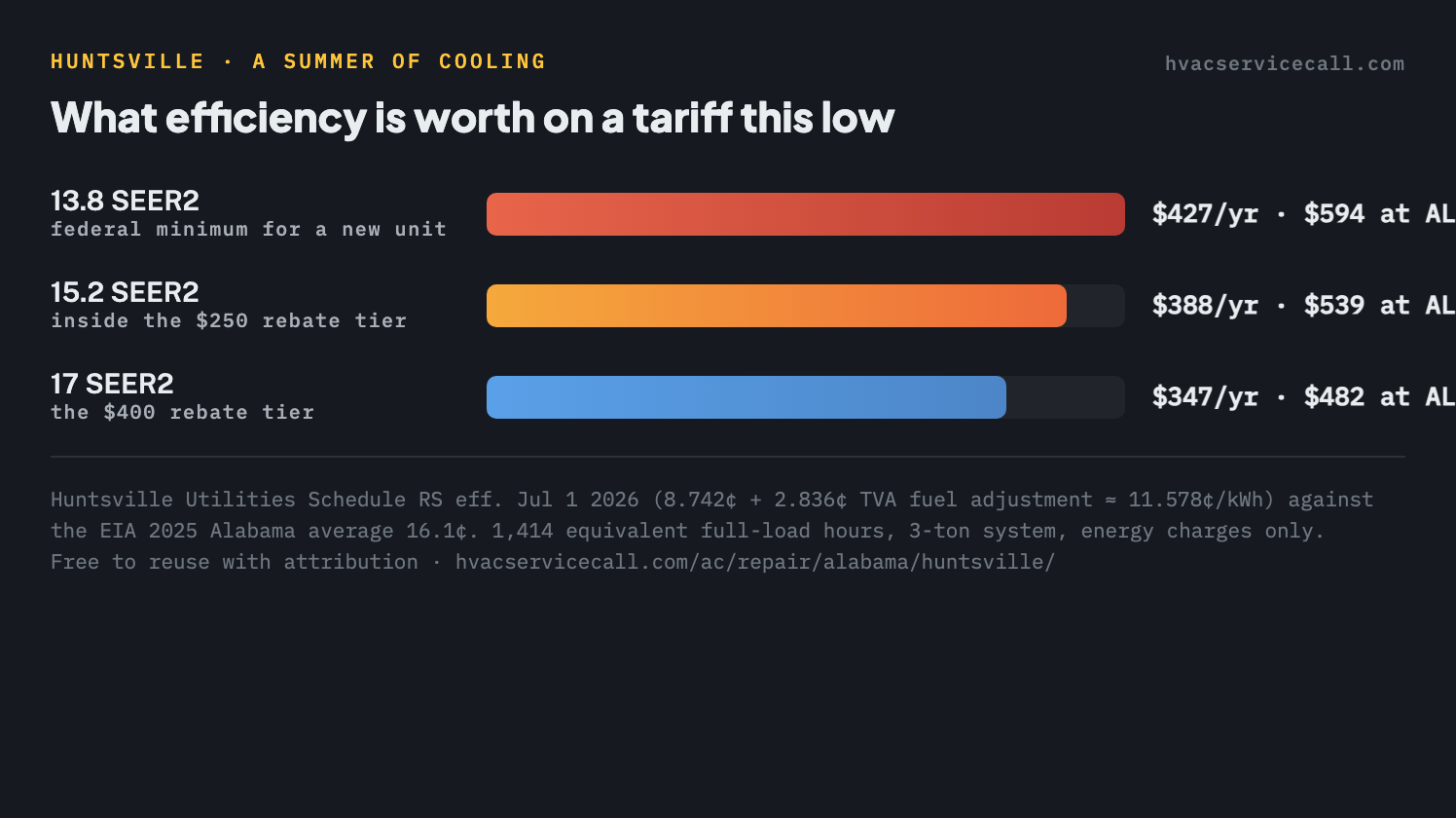
This is where Huntsville departs from most of Alabama, and the honest answer is not the one an efficiency pitch usually gives. Because Huntsville Utilities is a municipal TVA distributor, the residential energy charge here is 8.742¢/kWh plus a TVA Fuel Cost Adjustment of 2.836¢/kWh — about 11.578¢/kWh effective, roughly 28% under the 16.1¢ Alabama average that Alabama Power territory pays. Cheap power is good news on every bill you have already received. It also means every kilowatt-hour a higher-efficiency system saves you is worth about 28% less here than it would be an hour and a half down I-65.
Run the numbers rather than asserting them. A typical 3-ton Huntsville home works out near 1,414 equivalent full-load cooling hours a season — scaled from a comparable Birmingham figure by the ratio of the two cities' cooling degree-days (1,889 against 2,098). Season energy is those hours × 36,000 Btu ÷ the efficiency rating, and at the local rate that gives:
| Equipment | Season kWh | At 11.578¢ (Huntsville) | At 16.1¢ (AL average) |
|---|---|---|---|
| 13.8 SEER2 — the federal minimum for a new unit | 3,689 | $427 | $594 |
| 15.2 SEER2 — inside the $250 rebate tier | 3,349 | $388 | $539 |
| 17 SEER2 — the $400 rebate tier | 2,994 | $347 | $482 |
Stepping from the federal minimum to the top rebate tier saves about 695 kWh a season. On Huntsville power that is roughly $80 a year; on statewide-average power the identical equipment would return about $112. So the finding this page can state and its competitors cannot: in Huntsville the efficiency premium is repaid mostly by the rebate, not by the monthly bill. The $150 difference between the two TVA rebate tiers is worth about 1.9 years of the efficiency saving — which is why the rebate rules below deserve more attention here than the efficiency label does.

When is a Huntsville AC failure actually an emergency?
Heat is a health question before it is a comfort question, and that is the line worth drawing honestly. Against a 96°F design high and a summer that ran 53 days above its own average, a house without cooling gains temperature through the afternoon at a rate that matters for infants, older residents, anyone medically vulnerable to heat, and anyone on medication that affects temperature regulation. If that describes your household, say so when you call — dispatch triages by severity and that sentence moves you up the queue.
Three things are a tonight call rather than a morning one: a breaker that trips repeatedly on the outdoor unit, a burning or electrical smell from the equipment, and water reaching drywall, ceiling or flooring. A system blowing warm on a mild evening, a thermostat that has stopped responding, or a drain that has backed up into a pan that is holding are all genuinely fine until business hours — and cost less then. "Air conditioning repair near me," searched from a Huntsville address, resolves by where you are rather than how you phrased it: Research Park, MidCity, South Huntsville, Hampton Cove, Harvest, Meridianville and every Madison County ZIP behind them reach whichever company is already covering that part of the county. For the hours in between, the no-cooling guide covers keeping a Madison County house liveable — shade, airflow, and which room to consolidate into — and the emergency service page covers how after-hours dispatch works.
Does homeowners insurance cover AC repair in Huntsville?
What caused the damage decides the answer. Covered perils — a lightning strike or the surge behind it taking out a control board, hail flattening the condenser fins, wind or a falling limb crushing the outdoor cabinet, fire — fall under dwelling coverage less your deductible, and north Alabama's storm season produces those claims every year. Wear, age and mechanical breakdown — the capacitor that finally gave out, the compressor that aged into failure, the coil that corroded through — are excluded from standard policies, per Allstate's and Progressive's published policy guidance.
Two practical notes for this market. Photograph the equipment before anyone repairs or removes anything after a storm, and file promptly — an outdoor unit that stood in floodwater is a documented claim while it is still standing there, and an assumption once it has been replaced. For the excluded half, an equipment-breakdown endorsement is the inexpensive rider that covers mechanical failure, while a home warranty sells you a service contract instead of coverage. Read the carve-outs on either before buying: pre-existing conditions and refrigerant are the two that catch Huntsville homeowners out, because an ageing R-410A system is exactly the machine both documents are written to avoid paying for.
Which AC brands do Huntsville contractors repair?
All the major platforms, and on cooling equipment the badge matters less than most homeowners expect. Failures cluster almost identically across manufacturers — capacitor and contactor first, fan and blower motors next, the sealed system as the expensive outlier — because those parts come from a short list of suppliers regardless of whose logo is on the cabinet. Two things about your specific machine matter far more than its brand: whether it is a heat pump, and which refrigerant it holds. Sister brands frequently share a platform and therefore a parts source, which usually works in your favour on availability.
Tier describes market positioning — efficiency ceiling and parts pricing — rather than a quality ranking; the standard of the installation outlives the logo either way. Source: manufacturer 2026 lineups. The data plate on your outdoor unit carries the model and serial that actually decide parts availability.
Repair the air conditioner, or replace the outdoor system?
Start where the arithmetic is simple: multiply the repair quote by the age of the unit, and once the product clears 5,000, replacement is generally the better money. What that rule hides, and what matters more here, is which side of the machine failed. Electrical and airflow parts — a $220 drain clear, a capacitor, a contactor, a fan motor — are worth fixing on almost any unit still cooling, because they restore a working system for a few hundred dollars. A sealed-system failure is the real fork: a compressor or an evaporator coil, with refrigerant on top, lands close enough to a replacement that the rebate and the efficiency step enter the conversation.
Then comes the question this county asks that most do not. With 74% of Madison County homes already heating electrically, the replacement in front of you is often a heat pump rather than an air conditioner — the same cooling, plus the heating season, on equipment that carries a $500 TVA rebate where a central air conditioner carries $250 or $400 depending on its efficiency. If your house heats with gas, that is a genuine fuel decision rather than a formality, and the Huntsville furnace page runs the local operating-cost comparison that settles it. If your house already heats electrically, replacing a heat pump with a cooling-only air conditioner would be an odd choice, and it is worth checking which one you are actually being quoted.
One more honest note, because Huntsville homeowners post about it regularly: replacement quotes in this market are frequently well above the installed band in the table on this page. That is usually scope rather than sharp practice — tonnage, efficiency tier, a new air handler or coil, duct or electrical work, and the difference between an air conditioner and a heat pump all sit inside the same word "replacement". Ask for the quote itemized that way and the gap normally explains itself. The repair-or-replace guide covers the national version of this decision.
When should you schedule an AC replacement in Huntsville?
Two windows have slack in them: late February into March, and October into November once the cooling calls have stopped. In a cooling-dominated city the October window would be the obvious pick — the season just ended, installers are quiet, and the equipment has eight months before it is tested. Huntsville complicates that in a way worth naming, because most of what gets replaced here is a heat pump: an October changeout puts a brand-new machine straight into its heating season, on a grid that peaks in January, with no mild weather in front of it to shake out an installation problem.
So the practical rule for a Huntsville system past its twelfth summer with one significant repair behind it: put the decision on the calendar for late February if the equipment is a heat pump, when the heating season is ending and the cooling season has not started, and take the October window if it is a cooling-only air conditioner. Either way the point is the same — a planned changeout is the version of this purchase where you compare two or three itemized quotes, rather than accepting the one company that can come today.
Which AC rebates can a Huntsville homeowner claim?
Because Huntsville Utilities distributes TVA power, this city falls under TVA EnergyRight — not the Alabama Power program that covers Birmingham, which is the single most common mistake made about incentives in this state. And the central air conditioning rebate is tiered, not flat, which most pages covering it get wrong:
| Upgrade | Requirement | Rebate |
|---|---|---|
| Central air conditioner | 17 SEER2 or higher | $400 |
| Central air conditioner | 15 to 16.99 SEER2 | $250 |
| Tune-up, existing AC or heat pump | through a network contractor | $50 |
| Air-source heat pump | replacing an existing system | $500 |
| Ductless mini-split | 17 SEER2 or higher | $800 |
| Geothermal heat pump | replacing an existing system | $1,500 |
| Air sealing & insulation | assessed work | $300 |
| Smart thermostat | qualifying enrolled model | $65 |
Two details decide whether any of it reaches you. First, the federal minimum for new equipment is 13.8 SEER2, so the $250 tier begins barely above the legal floor — the rebate is reachable on ordinary equipment, and the $400 tier is a deliberate step up rather than an exotic one. Second, and this is the rule competitors leave out: every rebate-eligible upgrade must be completed by a member of the TVA EnergyRight Quality Contractor Network. Hire outside the network and the equipment can meet every efficiency requirement while the rebate simply does not arrive. The contractor files the claim and you receive a redemption code by email, so "are you a QCN member?" is a question to ask before you sign, not after.
Read alongside the efficiency section above, this is the part that carries the decision here: the $150 between the two AC tiers is worth roughly 1.9 years of the running-cost saving on this tariff. The federal 25C tax credit that used to sit on top of all this ended December 31, 2025. Programme amounts and funding move — confirm current figures with Huntsville Utilities or TVA EnergyRight directly rather than trusting any number on a flyer, including these.
Can you finance an AC repair or replacement in Huntsville?
Repairs in the $110–$710 band generally go on a card; the $3,375–$8,745 replacement is the purchase people finance, usually through a 0% intro-APR promotion or a fixed-rate equipment loan arranged by the installer — local companies here advertise both, at rates worth comparing against your own bank rather than accepting at the kitchen table. Two notes specific to this market. TVA EnergyRight advertises $0-down fixed-rate financing through participating local power companies, which is the route that pairs with the rebate list above. And because the rebate is the larger half of the efficiency case in a low-rate city, claim it before the loan is written rather than after — it reduces principal, and on a deferred-interest promotion the principal is what decides whether the promotion works out at all. The structures and their fine print are compared in the HVAC financing guide.
Permits, licensing and the refrigerant rule for AC work in Huntsville
A repair needs no permit. A changeout generally does — and in this metro the question is less whether than which office, because three separate authorities divide Madison County between them. Inside the city limits it is the City of Huntsville Inspection Department at 305 Fountain Circle (256-427-5331), where trade contractors file through the city's online portal and residential minor alterations needing no plan review can be issued as a walk-in. At an unincorporated county address it runs through Madison County Building & Fire Inspection and its CityView portal. The City of Madison permits its own work, asking for a signed application together with a signed contract stating scope and price. Your contractor pulls whichever applies; knowing which one covers your street is a question with a specific answer.
Licensing has two layers here, and the second one belongs to this page more than to any other in the city. Alabama requires an active certification from the Alabama Board of Heating, Air Conditioning & Refrigeration Contractors (HACR) to perform HVAC installation, service or repair anywhere in the state — certification-based rather than a dollar threshold — and you can confirm a contractor's standing in about two minutes at hacr.alabama.gov. The second layer is federal and specific to cooling work: opening the sealed refrigerant circuit requires an EPA Section 608 credential, which the state certification does not include and no homeowner video removes the need for — the DIY-versus-pro guide covers where that line sits.
What to settle before you approve AC work
Two things belong on paper before a part is ordered: an itemized estimate, and a sentence stating what happens to the diagnostic fee — which, as noted above, is genuinely not consistent between companies in this market. Three questions are cooling-specific and worth asking every time. What was the temperature split, and what were the pressures? — numbers, not adjectives, and a shop that measured will simply read them out. If refrigerant is going in, where is the leak and what does fixing it cost? — a recharge without a leak search is a bill scheduled to repeat. And on a heat pump, was the reversing valve ruled in or out? — it is the failure that most often hides behind "your compressor is finished".
On a replacement, add a Manual J load calculation rather than a matched-tonnage swap, an explicit statement of whether you are being quoted an air conditioner or a heat pump and why, the refrigerant the new equipment uses, QCN membership if a rebate is part of the plan, and warranty terms that state labour coverage separately from parts. The red flags are the familiar ones: a replacement quoted over the phone without a site visit, pressure to sign the same day, a large cash deposit up front, a refrigerant top-up sold with no leak search, and any certification you cannot verify yourself at hacr.alabama.gov. A second opinion on a big sealed-system quote is normal practice here — several Huntsville companies offer one at no charge — and it costs you a day.
How do you keep a Huntsville system out of the July queue?
The failures that fill a Madison County July are electrical and airflow-related, and both are exactly what a spring service visit targets: capacitor capacitance measured rather than eyeballed, contactor contacts inspected, condenser coil washed, drain line cleared and treated, charge verified, temperature split recorded so next year's reading has something to compare against. It is the one maintenance item on this page with money attached — TVA EnergyRight pays a $50 rebate for a tune-up on an existing air conditioner or heat pump through a network contractor, which covers a meaningful share of the visit.
Your own share is short. Change the filter on a one-to-three-month cycle, keep the outdoor coil clear of pollen, grass clippings and the shrub that has grown into it, flush the drain line, and run the system in April on a day when nothing depends on it — the same first-warm-afternoon test that turns a July emergency into a scheduled appointment. Heat-pump owners get one extra line, and it is the local one: exercise the system in both directions once a season, because a reversing valve that has not moved since March is a working machine that fails in November. The maintenance guide covers the full annual list.
Which other Huntsville HVAC page do you need?
Cheap TVA power changes the arithmetic on this page — at roughly 11.6¢/kWh, each saved kilowatt-hour is worth about a quarter less here than in Birmingham. That same rate shapes the heating pages below, where 74% of the county is electric.
- Since three homes in four heat electrically — Huntsville heat pump repair is usually the same outdoor unit doing winter duty, and the page where the balance point matters.
- For the gas minority — Huntsville furnace repair covers combustion faults and the honest case for staying on gas at replacement time.
- If prolonged cold or ice takes the power with it — Huntsville emergency HVAC covers outage triage and the freeze risk documented in the January 2026 event.
HVAC services in Huntsville, AL — the city page: all four Huntsville services, the Huntsville Utilities rate structure, and the local cost ranges.
Where these numbers come from
Every figure on this page comes from a published dataset rather than an estimate. The sources are listed below with the vintage of each, so you can check any number yourself — and so you can see when a figure is due for a refresh.
- Degree-days & design temperatures Open-Meteo ERA5 · 2014-2023 normals · retrieved 2026-07-15
- Heating fuel mix & housing age Census ACS5 2022 (county) · Madison County, Alabama table · retrieved 2026-07-15
- Residential electricity rate U.S. Energy Information Administration · state average, cents per kWh · retrieved 2026
- National cost ranges (before local adjustment) HomeGuide, Angi, Forbes Home, corpus-observed 2026-07 · retrieved 2026-07-15
- Local price adjustment BEA SARPP all-items · all-items RPP, applied to the national range · retrieved 2026-07-15
- Contractor licensing & verification Alabama Board of Heating, Air Conditioning & Refrigeration Contractors (HACR) · retrieved 2026-07-15
Cost ranges are national published ranges adjusted to local price levels, not quotes. The independent licensed contractor who takes the call sets the actual price, in writing, before any work begins.
Huntsville AC repair — questions homeowners ask
My air conditioner runs constantly on a 96°F day and never reaches the setpoint. Is it broken?
Possibly not. A correctly sized system in Huntsville is designed against a 96°F outdoor temperature, and on the handful of afternoons that reach it, running nearly continuously is the machine doing its job rather than failing at it. Huntsville Utilities publishes the practical version of this: an air conditioner starts losing ground once it is asked to hold more than about 20 degrees below outdoor air, so 96°F outside and 72°F requested inside is a 24-degree ask. What separates "working hard" from "faulty" is the temperature split — the difference between the air going into the return and the air coming out of a supply register. A healthy split sits roughly in the high teens to low twenties in degrees; a system making 5°F of difference is not keeping up for a reason. That measurement takes a technician two minutes and it is the number to ask for.
How do I tell whether I have an air conditioner or a heat pump?
Read the data plate on the outdoor unit. A heat pump lists a heating capacity and an HSPF or HSPF2 rating alongside the cooling numbers; a straight air conditioner lists cooling only. Two other tells: a heat pump has a reversing valve — a brass cylinder with a solenoid coil on top of it, sitting in the refrigerant lines — and its thermostat usually has an "emergency heat" or "aux heat" setting. It matters more here than in most markets, because 74% of Madison County heats electrically, so the majority of outdoor units in this county are heat pumps and the machine you call your air conditioner probably also runs your winter. It changes the parts list, the diagnosis and the rebate you would qualify for at replacement.
Is adding refrigerant a repair?
No. A sealed system does not consume refrigerant the way an engine consumes oil — if the charge is low, it left through a leak, and the leak is the fault. Adding refrigerant without finding it buys cooling for weeks or months and then the same bill arrives again, which is why a top-up with no leak search is the single most common way people pay twice. What a competent visit looks like: a pressure test or dye to locate the loss, a written price for repairing it, and only then the recharge. On an older R-410A system, the refrigerant is now expensive enough that a large loss is a genuine repair-or-replace conversation instead of a routine top-up.
Why did my power bill jump when only the air conditioning was running?
If the outdoor unit is a heat pump, the first thing to rule out is auxiliary heat energising during cooling — a miswired or failing thermostat, or a stuck reversing valve, can leave resistance strips running while the system tries to cool the house. Those strips draw several times what the compressor does, and at 11.578¢/kWh they are visible on a bill long before anyone notices a comfort problem. The other explanations are duller and more common: a filthy condenser coil or a low charge makes the system run far longer for the same cooling, and a summer that ran hotter than the last one adds hours by itself. A technician can settle it by watching what energises during a cooling call.
Is a $180 diagnostic fee normal here, and does it come off the repair?
The fee is normal — Madison County diagnostics land in the $65–$180 band, and published local prices sit around and above it. Whether it is credited is the part worth pinning down, because practice genuinely varies in this market: some Huntsville companies apply the diagnostic to the repair when you approve the work, and at least one publishes plainly that it does not and treats it as a separate charge. Neither is wrong; what matters is that you know which one you agreed to before the technician arrives. Ask on the phone, and have the answer written on the estimate rather than remembered from the call. What the fee buys either way is a measured diagnosis: temperature split, pressures, electrical readings under load — not a guess from the driveway.
Does a moderate cooling season buy me more years out of this equipment?
Twelve to seventeen years is the honest working range for equipment here, and Huntsville's moderate cooling season — 1,889 cooling degree-days, against cities that log well over two thousand — is not what wears these systems out. Two other things set the ceiling. Most units in this county are heat pumps, so they accumulate run-hours in both seasons rather than sitting idle for half the year. And the county's median home dates to 1990, which means a large share of local systems are on their second machine, in ductwork that has never been evaluated. When the compressor on a fifteen-year-old unit fails, its age is doing more of the talking than the failure is.
I rent, and the air conditioning has been out for a week. What does Alabama law say?
Alabama's Uniform Residential Landlord and Tenant Act, at §35-9A-204, requires a landlord to maintain in good and safe working order the electrical, plumbing, heating, ventilating and air-conditioning appliances that the landlord supplied. So if the cooling came with the unit, keeping it working is the landlord's duty — but note the qualifier: the statute is about equipment the landlord supplied, and it gives them a window to repair after written notice rather than an immediate remedy. Notify in writing, date it, keep the copy, and read §35-9A-204 for what a tenant may do once that window passes. If the indoor temperature has become a health risk for an infant, an older resident or someone with a cardiac or respiratory condition, treat that as urgent regardless of the tenancy question.
Can I still get refrigerant for an R-410A system?
Yes. Manufacturers stopped building new residential equipment charged with R-410A after January 1, 2026, but there is no restriction on servicing, repairing or recharging the systems already installed, and no deadline by which a working one must be replaced. What changed is price and planning: with production going to the new A2L refrigerants, R-410A on the service side has become more expensive, so the calculus on a big leak in an old system has shifted. Its replacement, R-454B, is mildly flammable, carries a much lower global-warming rating, needs its own equipment and handling practice, and is not a drop-in — nobody will be converting your existing system to it.
Does turning the system off while I am at work save money in this humidity?
A setback saves energy; a deep setback in a humid climate can cost you comfort you then pay to recover. Every hour the system is off, the house gains both heat and moisture, and pulling the moisture back out takes runtime that a thermostat schedule does not show you. The workable version in Madison County is a modest setback — a few degrees, not ten — timed to recover an hour before you get home, which keeps the coil cold long enough to keep dehumidifying. If the house feels cold and clammy at setpoint, that is a different problem: a system oversized for the load satisfies the thermostat before it has run long enough to dry anything.
The new system runs much longer than the old one did. Did they oversize it?
Longer cycles usually mean the opposite. Modern two-stage and variable-capacity equipment is designed to run at part load for long stretches rather than blasting and stopping, and long low-speed runtime is what removes humidity in a mixed-humid climate. The failure mode to watch for is the reverse: short, frequent cycles that satisfy the thermostat quickly and leave the house damp — that is the signature of a system too large for the house, which is what a Manual J load calculation at quote time exists to prevent. If the cycles are long and the house is comfortable and dry, the equipment is behaving correctly.
How fast can someone actually get to me in Huntsville?
Same-day is normal for most of the summer, and the exception is the stretch everybody remembers: the first sustained run of upper-nineties afternoons, when every marginal capacitor in Madison County fails within about a week of every other one. Dispatch triages by severity, so say on the call whether the house is climbing rather than just warm, whether anyone in it is medically vulnerable to heat, and whether there is water reaching drywall or a breaker that keeps tripping. (888) 810-2291 reaches a contractor already running routes on your side of the county — Research Park and Monrovia, or Hampton Cove and Owens Cross Roads.
What should I have ready when I call?
Four things shorten the visit. The brand and model from the outdoor unit's data plate — which also settles the heat-pump question above. What the system is actually doing: no air, warm air, ice, water, tripping the breaker. How long it has been doing it, because "since Tuesday" and "since this morning" point at different failures. And whether you have already changed the filter, checked both disconnects and looked at the drain. If the coil is frozen, say so on the call — it changes what the technician can measure on arrival, because pressures read on an iced system tell nobody anything until it has thawed.
Is it worth repairing a twelve-year-old air conditioner?
It depends far less on the age than on which side of the machine failed. Electrical and airflow parts — capacitor, contactor, fan motor, drain, blower — are worth fixing on a twelve-year-old unit almost every time; they restore a working system for a few hundred dollars. A sealed-system failure at that age is the real decision: a compressor or evaporator coil, plus the refrigerant to fill it, lands close enough to a replacement that the rebate and the efficiency step start to matter. The arithmetic people use is the repair quote multiplied by the age of the unit, with roughly 5,000 as the line — and in this county the honest second question is whether the replacement should be a heat pump, since it would carry the heating season too.
Air conditioning repair coverage across Huntsville, AL
All 60 Madison County ZIP codes are on the dispatch map, together with the neighborhoods below — Twickenham and Old Town through Jones Valley and Monte Sano, out past Research Park and Redstone Arsenal to Madison, Harvest, Meridianville, Big Cove and New Hope, and along the I-565 and Memorial Parkway corridors that most of this county's service routes actually follow. Whether the search said air conditioning repair or AC repair changes nothing; the address changes everything, and the Alabama contractor who answers already runs that road.
Huntsville-area ZIPs on the routing list: