Furnace repair in Huntsville, AL
Looking for furnace repair in Huntsville, AL? Call (888) 810-2291 — one free call routes you to a trusted, licensed local contractor, 24/7. Repairs typically run $90–$535, and the $65–$180 diagnostic is usually credited toward the work once you approve it. Technicians run Twickenham, Old Town, Monrovia, Harvest and Meridianville, and every Madison County ZIP behind them — 35801, 35805, 35810, 35811 and 35757 included.
What does it mean to run a gas furnace in a county that heats electrically?
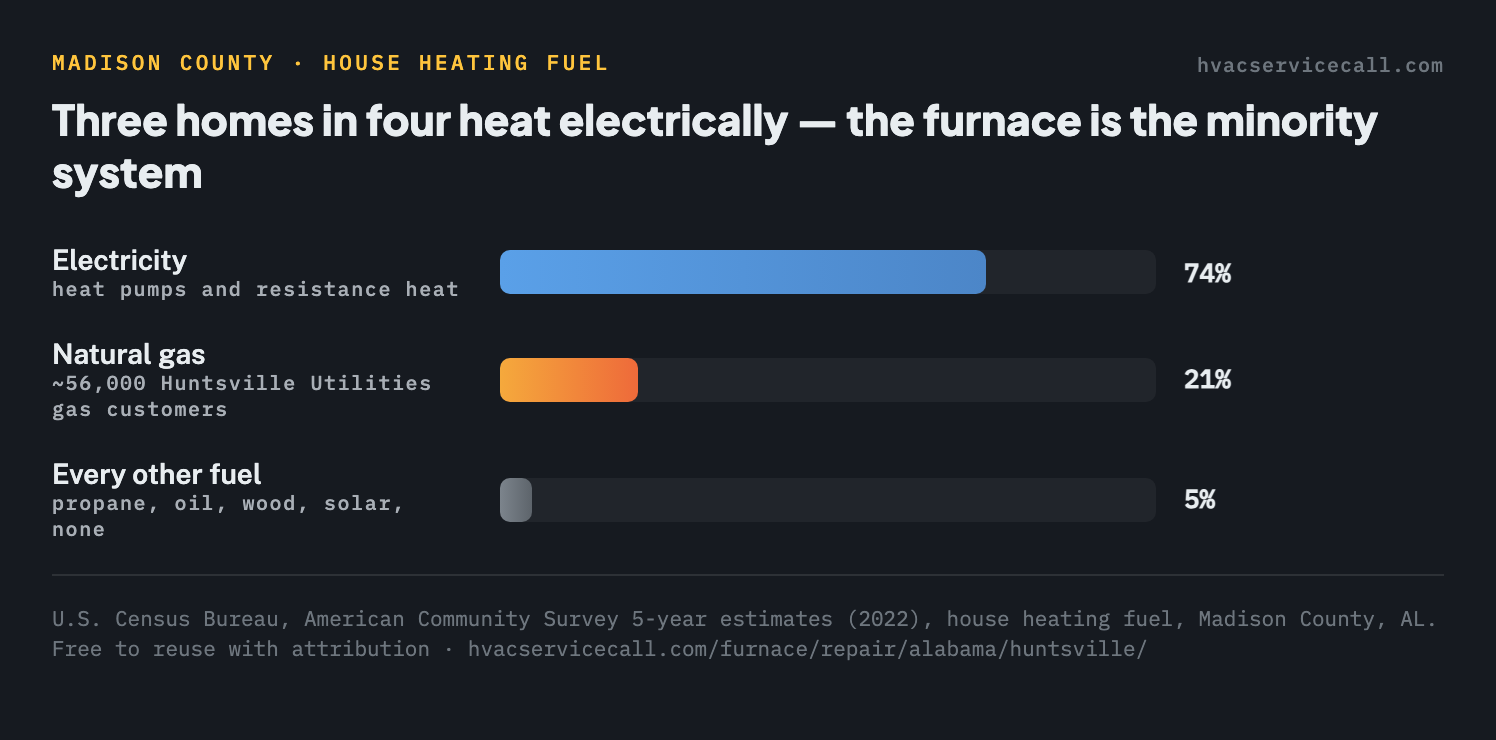
Madison County is the most electric-dominant county on our coverage map: 74% of homes heat electrically and only 21% burn gas (U.S. Census ACS 5-year). If you own a furnace here, you own the minority system — and that changes a few practical things, none of them alarming and all of them worth knowing before you book a call.
Start with geography, because gas service is not everywhere. Huntsville Utilities distributes natural gas to roughly 56,000 customers through more than 1,200 miles of main, a network that reached Hampton Cove in 2016, closed its loop in 2017, and extended west in 2019. Plenty of Madison County addresses simply have no main on the street, which is one reason so much of the county heats electrically in the first place — and why, at replacement time, the fuel question here is genuinely open rather than settled by default.
Then there is the climate, which is the quiet reason a Huntsville furnace fails the way it does. The city logs 2,914 heating degree-days against a 19°F design low, and no month of the year averages a low below freezing. That combination describes a machine that stands idle for most of the year and then gets asked for everything on a handful of nights. The failures below are start-up failures, not wear failures — which is a different list from the one a furnace in a long-winter city would give you.

How does a Huntsville furnace tell you it is failing?
Eight signals, ordered the way a lightly used furnace actually presents them — ignition and start-up faults first, because the season's first cold call is this machine's real test. Each one links through to its full troubleshooting guide.
Each signal narrows to one or two entries on the repair list below, and two of them — yellow flame, CO alarm — skip the list entirely and go straight to the safety section.
What furnace repairs do Huntsville contractors handle?
A gas furnace is a combustion appliance wrapped around an air handler, so its repair list splits cleanly in two: the ignition and gas train on one side, the airflow and safety chain on the other. Twelve types below, with a note on whether each is normally carried on the van or ordered in. Prices for the common ones are charted further down the page.
- Hot-surface igniter replacement
- The silicon-carbide element that lights the burners on most furnaces built since the mid-1990s. Brittle by design and the single most common first-cold-snap failure. Van stock, one visit.
- Flame sensor cleaning or replacement
- A thin rod that proves the burner actually lit. Coated in oxide it stops conducting and the furnace shuts down seconds after ignition. Often cleaned rather than replaced — a fair thing to ask which you are being charged for.
- Gas valve replacement
- Meters gas to the burners. A valve that will not open, or will not stay open, ends the heating call immediately. Gas-side work requiring certification; ordered in on some platforms.
- Inducer motor replacement
- Pulls combustion gases through the exchanger and out the flue. In a furnace that sits idle nine months a year, this one seizes from standing still as often as from wear.
- Pressure switch & hose
- Proves the inducer is actually moving air before gas is allowed to flow. The fault is frequently the hose or a blocked port rather than the switch itself, which is why a competent diagnosis checks both.
- Limit switch replacement
- A safety that shuts the burner down when the exchanger runs too hot. It trips for a reason, so airflow gets investigated before the switch is condemned — replacing a limit that was doing its job is how a small problem becomes a dangerous one.
- Roll-out switch reset or replacement
- Detects flame escaping the burner box. A tripped roll-out is a symptom of a venting or exchanger problem, never something to simply reset and walk away from.
- Control board replacement
- The furnace's sequencing brain. Ordered in almost always, and on older platforms the availability of the board — not its price — decides whether the furnace has a future.
- Blower motor replacement
- Moves the heated air. Variable-speed ECM motors are typically ordered; older PSC motors are commonly stocked. This is the part that also serves the cooling season.
- Heat exchanger inspection & replacement
- The steel barrier between combustion and the air you breathe. A confirmed crack is a replacement decision far more often than a repair, and it is the finding you should always ask to see documented.
- Condensate trap, drain & neutralizer
- Only on condensing furnaces. A blocked trap backs water into the pressure switch and stops the furnace as effectively as a dead board would.
- Thermostat & control wiring
- A miswired or failed thermostat presents exactly as a dead furnace and is fixed for a fraction of one. Ruled out first on any competent visit.
All twelve reach the same number at any hour, and the frequent ones carry Huntsville prices further down this page.
Broken furnace in Huntsville, AL?
That one sentence usually cuts the list above to two or three candidates. A licensed Madison County technician takes it from there, any hour of the night.
☏ Call (888) 810-2291Availability is subject to provider participation, location, technician availability, and demand.
Which furnace problems turn out not to be repairs?
Five checks that catch the non-failures. Four are things worth trying; the fifth is the one that ends all troubleshooting immediately.
- Thermostat, mode and batteries: confirm it calls for heat and that the setpoint sits above room temperature. Dead batteries in a battery-powered stat look exactly like a dead furnace, and they die in spring when nobody notices.
- The filter you last changed in April: a short heating season tempts everyone to leave the filter alone. A furnace pulls through it just as hard in December as the air conditioner did in July, and a restricted one trips the limit switch.
- Breaker and the furnace's own switch: there are two: the breaker in the panel, and a wall switch beside the equipment that looks like a light switch and gets flipped by whoever last carried something through the attic or crawlspace.
- Registers and returns: closed supply registers and a return blocked by furniture or storage starve the blower, and the furnace protects itself by shutting down. Open them and try one more cycle before you book.
- The one check that is not a check: if you smell the rotten-egg odorant, none of the above applies. Leave the house without touching a switch or a phone, then call Huntsville Utilities at 256-535-4448 from outside. Gas odour is never a homeowner diagnostic.
Who fixes furnaces in Huntsville, AL?
Mention which checks you ran and what the furnace does when the heat calls. That combination puts a Huntsville technician most of the way to the diagnosis before the van arrives.
☏ Call (888) 810-2291Availability is subject to provider participation, location, technician availability, and demand.
How much is furnace repair in Huntsville, AL?
A diagnostic visit runs $65–$180 in Madison County, and crediting it against the repair once you approve the work is ordinary local practice — the service-call fee guide explains how that credit normally works. Completed repairs mostly land between $90–$535, with sensors and igniters near the floor of that band and exchanger or gas-train work near its ceiling.

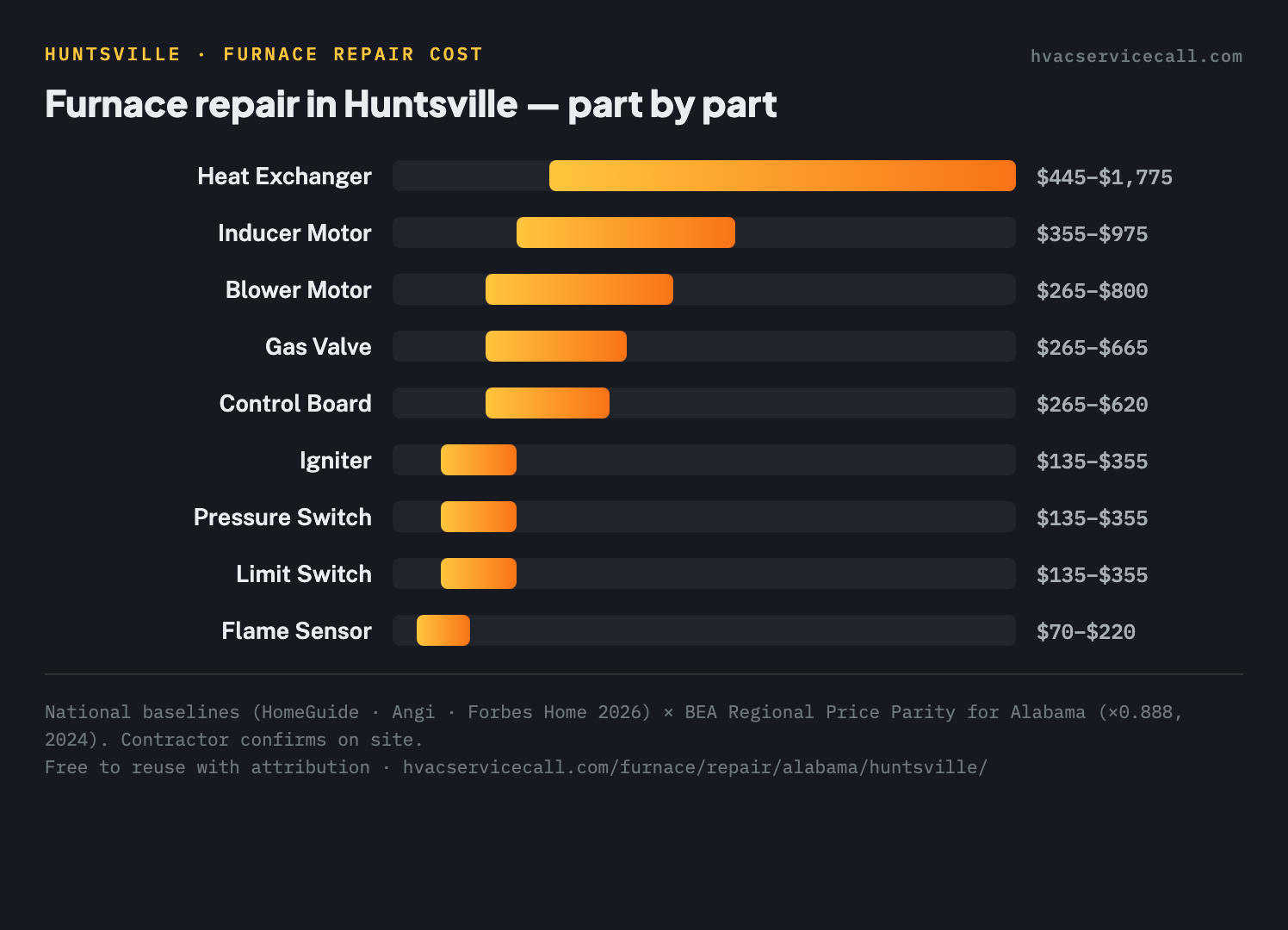
| Repair | Low | Typical | High | Note |
|---|---|---|---|---|
| Diagnostic / service call | $65 | $125 | $180 | normally credited against approved work |
| Heat Exchanger | $445 | $1,110 | $1,775 | the repair that is usually a replacement decision instead |
| Inducer Motor | $355 | $665 | $975 | seizes from sitting idle as often as from wear |
| Blower Motor | $265 | $535 | $800 | parts + labor |
| Gas Valve | $265 | $465 | $665 | gas-side work; certification required, ordered on some platforms |
| Control Board | $265 | $445 | $620 | parts + labor |
| Igniter | $135 | $245 | $355 | van stock; the common first-cold-snap failure |
| Pressure Switch | $135 | $245 | $355 | frequently the hose or port, not the switch itself |
| Limit Switch | $135 | $245 | $355 | trips for a reason — airflow gets checked before it is replaced |
| Flame Sensor | $70 | $145 | $220 | often cleaned rather than replaced — ask which you are paying for |
| Typical repair, all parts | $90 | $205 | $535 | where the majority of calls land |
| After-hours service call | $100 | $230 | $360 | 1.5–2× windows: nights, weekends, holidays |
| Furnace replacement (installed) | $3,375 | $5,905 | $8,435 | no utility rebate applies to gas heat |
How we price this: the same repair costs different money in different states, and the federal Bureau of Economic Analysis measures precisely that gap — its 2024 reading puts Alabama's overall price level about 11.2% below the national average. So we take published national baseline ranges from HomeGuide, Angi and Forbes Home, apply that ×0.888 figure, and print the result as the Huntsville column. The number you actually pay comes from the on-site diagnosis, which is why no honest shop prices a repair sight-unseen. Two different things fill the Typical column, and it is worth knowing which is which: on the overall-repair row it is the published survey average, run through the same multiplier; on each part row it is simply the midpoint of that part's local range, because individual components have no survey average behind them to adjust. National context continues on the furnace repair guide.
Confirm a technician already covers your road
The table above is what is normal to pay in Madison County. Your ZIP answers the other half: whether a Huntsville furnace contractor is already working nearby tonight.
In a hurry? Call (888) 810-2291 now.
Licensed contractors serve . One call routes you to one for .
☏ Call (888) 810-2291Availability is subject to provider participation, location, technician availability, and demand.
What pushes a furnace invoice up or down here?
Five levers move an estimate within — occasionally past — the typical band.
- Which part gave out
- the band runs from a $70 flame sensor to a $1,775 heat-exchanger job, and naming the component settles most of the invoice before labour is counted.
- How the furnace vents
- an 80% atmospheric furnace venting into a masonry chimney and a sealed-combustion condensing unit with PVC intake and exhaust are different jobs on the same call — the second adds a condensate path that can itself be the fault.
- The age of the control platform
- with Madison County's median home dating to 1990, plenty of local furnaces run boards that manufacturers no longer stock; an obsolete board is a sourcing problem before it is a price problem.
- Nine months of standing still
- a lightly used furnace collects a specific set of faults — seized inducer bearings, a glazed flame sensor, a pressure-switch hose gone brittle. They are cheap parts that turn into after-hours calls because they all surface on the same cold night.
- When you call
- nights, weekends and holidays typically carry a 1.5–2× premium on the visit fee.
What does a furnace service call actually involve?
A technician works the sequence the furnace itself follows: thermostat call, then filter and airflow, then the ignition sequence watched end to end, then gas pressure and the character of the flame, then the safety chain — pressure switch, limits, roll-outs — and finally the heat exchanger. Expect the diagnosis itself to take 5 to 60 minutes. It ends where every one of these visits should end — a written quote in your hand, and no part touched until you have said yes to it. Whether the repair happens that afternoon depends on the van: igniters, sensors and switches ride on it, while a gas valve, a control board or an exchanger usually means one to three days.
Two requests are worth making here specifically, both born of the fact that this furnace sits idle most of the year. Ask them to run the ignition sequence from a cold start rather than a warm restart, because an intermittent igniter or a marginal flame sensor will often behave perfectly on a unit that ran ten minutes ago and fail on the first call of the evening. And ask for the heat-exchanger inspection result stated on the paperwork either way — "inspected, no defect found" is as useful a record as the alternative, and it is the sentence you will want next winter when someone else looks at the same furnace.
Gas or electric heat in Huntsville — which one actually costs less to run?
This question is usually answered with national averages. In Huntsville it does not have to be, because Huntsville Utilities is a single non-profit municipal system selling the electricity and the natural gas — unlike Birmingham, where power and gas come from two different companies. Both tariffs are published side by side on one page, so the comparison can be made with this city's own numbers.
The published residential gas rate is $11.03 per 1,000 cubic feet, and 1,000 cubic feet of natural gas carries about 1.037 million Btu. The published electric energy charge is 8.742¢/kWh plus a TVA Fuel Cost Adjustment of 2.836¢/kWh — about 11.578¢/kWh effective — and a kilowatt-hour is 3,412 Btu. Divide each by how much of that energy actually reaches the rooms, and the four ways a Huntsville house can make heat line up like this:
| How the heat is made | Efficiency assumed | Per million Btu delivered |
|---|---|---|
| Gas furnace, older atmospheric | 80% AFUE | $13.30 |
| Gas furnace, condensing | 96% AFUE | $11.08 |
| Heat pump, compression cycle | COP 3 | $11.31 |
| Electric resistance / backup strips | 100%, no multiplication | $33.93 |
Read that table honestly and it says something the national advice does not. In Huntsville a gas furnace and a heat pump cost roughly the same to run — an older 80% furnace a little more, a condensing furnace a little less, with the heat pump sitting between them. The outlier is electric resistance heat at about $33.93, some 3 times a gas furnace, which is why a heat pump that has quietly failed over to its backup strips produces such a memorable power bill. The figures use energy charges only; the monthly availability charges ($10.00 on gas, $17.23 on electric) sit on top of both and only matter much at very low usage.

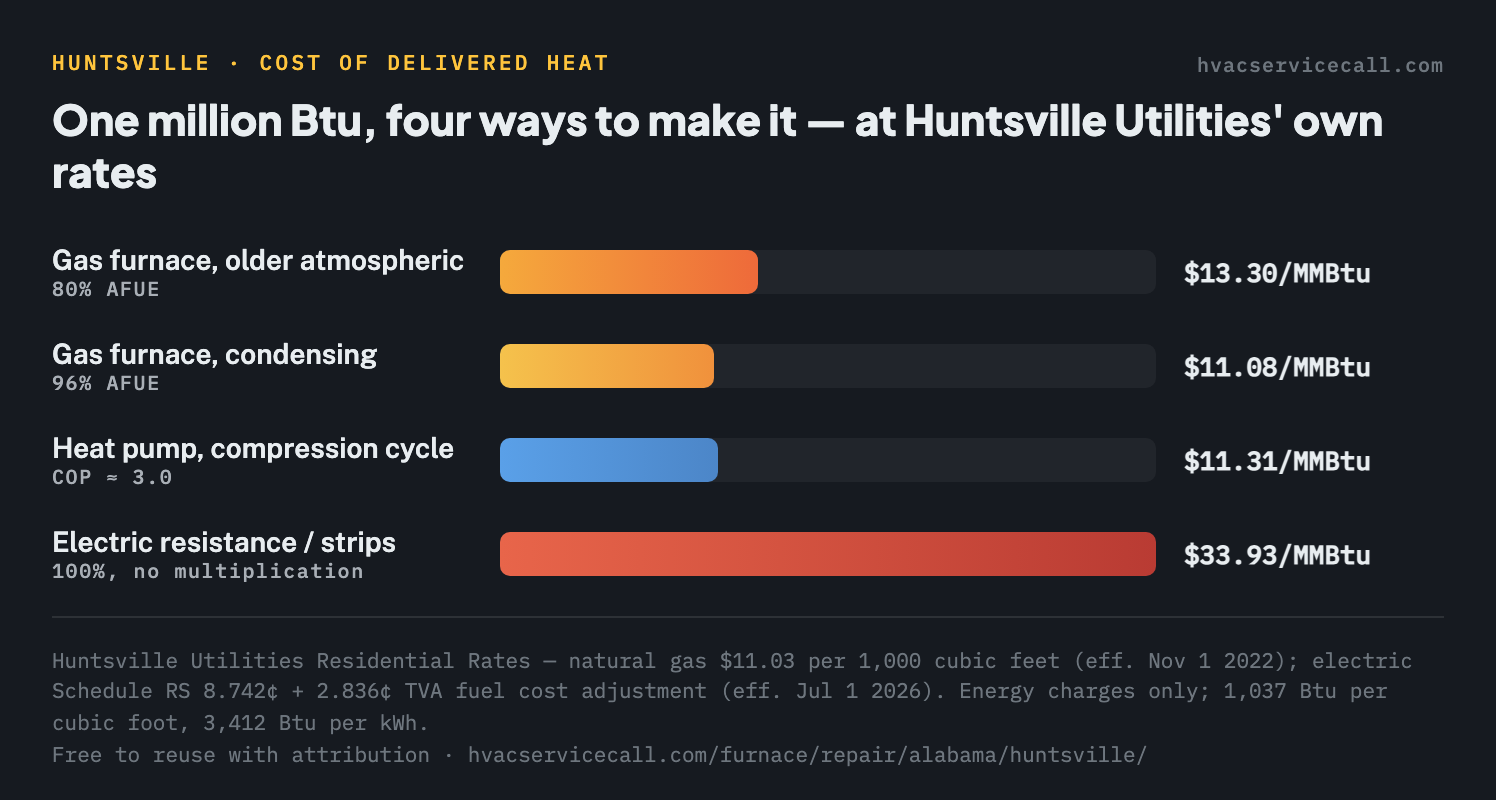
Two consequences follow for a furnace owner. First, if your furnace is running properly, there is no operating-cost emergency pushing you to change anything — the case for keeping gas is perfectly sound here. Second, when a large repair quote does arrive, the fuel question is genuinely open rather than rhetorical, which is why the repair-or-replace section below has three answers instead of two. The national comparison, without the local rates, sits on the gas versus electric furnace guide.
Who lights the pilot, and does your furnace even have one?
Here is a genuinely local answer that is hard to find written down anywhere: Huntsville Utilities will light your pilot. The utility lights pilots on gas heating systems, water heaters and gas fireplace logs — call (256) 532-8342, Monday to Friday, 7 a.m. to 3 p.m., or file the request through the utility's online form. A service charge may apply, and once cold weather arrives the wait can run two to three days on volume, which is why the utility's own advice is to call early rather than on the first freezing morning.
The boundary matters as much as the service. Huntsville Utilities lights pilots; it does not service or repair appliances. So a pilot that lights and then goes out again is not a utility call at all — that pattern points at a failing thermocouple, a dirty pilot orifice or a gas valve that is not holding, and it belongs to a licensed contractor. Booking the utility for that problem costs you two or three days in the middle of a cold snap.
And there is a good chance the whole question does not apply to you. Standing pilots largely disappeared from residential furnaces after the mid-1990s in favour of electronic ignition — a hot-surface igniter that glows, or an intermittent spark. With Madison County's median home built in 1990, most furnaces in this market ignite electronically and have no pilot to light. If your furnace clicks, hums for thirty seconds and then gives up, you are almost certainly looking at an igniter or a flame sensor, not a pilot — the pilot light guide shows how to tell which system you have in about a minute.
The heat exchanger, carbon monoxide, and the number to call
The heat exchanger is the steel wall that keeps combustion gases apart from the air circulating through your house. When it cracks, some of those gases — carbon monoxide among them — can cross into the supply air. There is no smell and no colour to warn you; the symptoms are headache, dizziness, nausea and fatigue that get better when you leave the house and return when you come back. A sounding CO alarm is not a diagnostic step. Get everyone outside, then call 911 from outdoors, and let the furnace question wait until people are safe.
Gas odour is a different emergency with a different number. Huntsville Utilities odorizes its gas with mercaptan — the rotten-egg smell — so that a leak is detectable well below the concentration at which it could ignite. The utility's published instructions are specific: do not light matches, do not turn lights on or off, and do not operate doorbells, cell phones or any other electrical equipment inside the building. Get everyone out, then call 256-535-4448 from outside; that line is answered any hour. Do not go back in until the utility has cleared the building.
Two pieces of local context are worth having. Huntsville Utilities' gas system is inspected annually by the Alabama Public Service Commission for compliance with federal pipeline safety rules, and the utility runs a public-awareness programme that includes carbon-monoxide education alongside leak recognition. Separately, the most common route to a cracked exchanger is mundane and preventable: a restricted filter chokes airflow, the exchanger runs hotter than it was designed to, and repeated overheating cycles crack the metal. The furnace and carbon monoxide guide covers alarm placement and what the readings mean.
When does a furnace problem become an emergency in Huntsville?
A gas-heated Huntsville house has one disadvantage its electric-heated neighbours do not, and it runs against the usual assumption. A heat pump that fails still has resistance strips to fall back on — expensive, but warm. A furnace that fails leaves nothing behind it. Against a 19°F design low — three degrees colder than Birmingham's — a house without heat loses temperature through the night at a rate that matters for infants, older residents and anyone with a cardiac or respiratory condition. Say so when you call; dispatch sorts by severity and that detail moves you up the queue.
Two situations skip the queue entirely. A carbon-monoxide alarm means evacuate and call 911. The smell of gas means evacuate without touching a switch and call Huntsville Utilities at 256-535-4448. Everything else — no heat, a furnace that will not stay lit, a blower that will not stop — is a call to make tonight rather than a wait until morning. "Furnace repair near me," searched from a Huntsville address, resolves by where you are, not by how you phrased it: Twickenham, Big Cove, Harvest, Gurley, Toney and every Madison County ZIP behind them reach whichever company is already covering that part of the county tonight. The emergency service page covers what to do while you wait.
Does homeowners insurance cover furnace repair in Huntsville?
What caused the damage decides the answer. Covered perils — a lightning strike or the surge behind it taking out the control board, fire, wind or falling-tree damage to the flue — fall under dwelling coverage less your deductible, and north Alabama's storm season produces those claims every year. Wear, age and mechanical breakdown — the igniter that finally cracked, the inducer that seized, the exchanger that fatigued after twenty winters — are excluded from standard policies, per Allstate's and Progressive's published policy guidance.
If a storm was involved, photograph the equipment before anyone moves or repairs anything, file promptly, and have your maintenance records to hand. For the excluded half, an equipment-breakdown endorsement is the inexpensive rider that covers mechanical failure, and a home warranty is the service-contract alternative — read what each one excludes before buying either, because heat exchangers and pre-existing conditions are common carve-outs.
Which furnace brands do Huntsville contractors repair?
All the major platforms, and on a furnace the badge matters less than the vintage of its control board. Failures cluster almost identically across manufacturers — igniters and flame sensors first, inducers and pressure switches next, exchangers and gas valves as the expensive outliers. Where a minority-gas market does differ is the parts shelf: with 21% of the county on gas, local inventory of gas-specific components turns over more slowly than it would in a gas-majority metro, so "is that part on the truck?" is a more useful question here than elsewhere. Sister brands frequently share a platform and therefore a parts source, which often works in your favour.
Tier describes market positioning — efficiency ceiling and parts pricing — rather than a quality ranking; the standard of the installation outlives the logo either way. Source: manufacturer 2026 lineups. The label inside your furnace door carries the model and serial that actually decide parts availability.
Repair the furnace, or switch the house to a heat pump?
Start with the arithmetic everyone uses: multiply the repair quote by the age of the furnace, and once the product clears 5,000, replacement is generally the better money. A $$1,775 exchanger quote on a twenty-year-old unit answers itself; a $$220 flame sensor on the same unit does not.
What is different in Madison County is that "replace" has two answers rather than one. In a county where 74% of homes already heat electrically, replacing a dying furnace with a heat pump is an ordinary local choice rather than an exotic one — and the operating-cost table above is the honest evidence for it: the two options run at close to the same cost per delivered Btu here, so neither fuel wins the argument on running costs alone. What tips the ledger is elsewhere. A heat pump replaces the air conditioner at the same time, and it carries a $500 TVA EnergyRight rebate where a gas furnace carries none. Against that, a furnace makes heat that does not care how cold the night gets, and if you already have a gas line and gas appliances, keeping it is a defensible answer.
There is a third path worth naming, because this climate suits it: a dual-fuel system pairs a heat pump with the gas furnace as its backup, running the compressor through the mild majority of the season and handing over to the burners below the balance point. It costs more to install than either alone, and it is the option that most directly uses the fact that both fuels cost about the same here. The dual-fuel guide works through the balance-point maths, and the Huntsville heat pump page covers what owning the other option is actually like. Whichever way it goes, the timing question comes next.
When should you schedule a furnace replacement in Huntsville?
Two windows have slack in them: late February into March, once the heating calls have thinned out, and September into October before the first cold snap. In a long-winter city the February window is the obvious one. Here the September window is the more useful of the two, for a reason particular to a short heating season — a furnace that limped through January on a patched repair will not be asked for anything for eight months, which makes it very easy to forget until it fails again on the same kind of night, with the same county-wide queue in front of you.
So the practical rule for a Huntsville furnace past its fifteenth winter, with one significant repair already behind it: put the decision on the calendar for September rather than waiting for the equipment to choose the date. Installers are least booked before the season starts, not after it ends, and a planned changeout is the version of this purchase where you compare quotes instead of accepting the one that can come today.
Which rebates apply when your heat comes from gas?
An honest answer that most pages avoid: there is no rebate for a gas furnace here. Because Huntsville Utilities distributes TVA power, this city falls under TVA EnergyRight, and EnergyRight's residential list is an electric-efficiency programme — heat pumps, mini-splits, geothermal, central air conditioning. A high-efficiency gas furnace is not on it, and the federal 25C tax credit that once helped ended December 31, 2025.
What a gas-heated Huntsville home can claim is the envelope side of the same programme: $50 for duct sealing with an HVAC tune-up, $300 for air sealing and insulation, and $65 through TVA's Smart Thermostat Rewards for enrolling a qualifying Wi-Fi thermostat. Those are worth having, and duct sealing in particular pays twice in a house that also runs air conditioning against a 96°F design high.
★ One condition governs all of it, and it is the rule competitors leave out: the work must be completed by a member of the TVA EnergyRight Quality Contractor Network. Hire outside that network and the work can meet every requirement while the rebate does not arrive. Ask the question before you sign, not after. And note where this leaves the fuel decision — the $500 heat pump, $800 mini-split and $1,500 geothermal amounts sit entirely on the electric side of the choice discussed above. Programme amounts and funding move, so confirm current figures with Huntsville Utilities or EnergyRight directly rather than trusting any number on a flyer, including these.
Can you finance a furnace repair or replacement in Huntsville?
Repairs in the $90–$535 band generally go on a card; the $3,375–$8,435 replacement is the purchase people finance, usually through a 0% intro-APR promotion or a fixed-rate equipment loan arranged by the installer. Two notes specific to this market. TVA EnergyRight advertises $0-down fixed-rate financing through participating local power companies — but that route follows the electric-efficiency list, so it applies if you are switching to a heat pump rather than replacing gas with gas. And on any deferred-interest promotion, the principal is what decides whether it works out, which is why the envelope rebates above are worth claiming before the loan is written rather than after. The structures and their fine-print traps are compared in the HVAC financing guide.
Permits and licensing for furnace work in Huntsville
A repair needs no permit. A changeout generally will, and here the more interesting question is not whether but where — three separate permitting authorities divide this one metro between them, so your address decides which counter the paperwork crosses. Inside the city limits, the City of Huntsville Inspection Department at 305 Fountain Circle (256-427-5331, Monday to Friday, 7:30 a.m. to 5 p.m.) issues it, and trade contractors file mechanical and gas permits through the city's online portal — on a furnace the gas half of that is not incidental. Residential minor alterations and repairs that need no plan review can be issued as a walk-in permit. At an unincorporated Madison County address it runs through Madison County Building & Fire Inspection and its CityView portal, and the City of Madison permits its own work again, asking for a signed application together with a signed contract stating scope and price.
On licensing, Alabama sets a stricter bar than the states that regulate only above a dollar threshold: the Alabama Board of Heating, Air Conditioning & Refrigeration Contractors (HACR) requires an active certification to perform HVAC installation, service or repair anywhere in the state, and you can confirm a contractor's standing in about two minutes at hacr.alabama.gov. Gas-train work carries its own competence expectations on top of that, which is a reasonable thing to ask about when the repair involves the valve or the burners.
What should you settle before approving furnace work?
Two things belong on paper before a single part is ordered: an itemized estimate, and a sentence saying what happens to the diagnostic fee if you go ahead. Three questions are furnace-specific and worth asking every time. Show me the heat-exchanger finding — a photograph or camera image with the estimate, whichever way it went. Was the flame sensor cleaned before the board was condemned? — the two failures look alike from the thermostat and differ by several hundred dollars. And was combustion measured or eyeballed? — a combustion analyzer reading is evidence; flame colour by eye is an impression.
On a replacement, add a Manual J load calculation (a furnace oversized for a 2,914-degree-day climate short-cycles and wears its ignition components out early), a venting plan if you are moving from an 80% atmospheric unit to a condensing one — that change means a new PVC flue and a condensate route, which is a real line item in an older Huntsville house and not a detail to discover mid-install — and warranty terms that state labour coverage separately from parts. The red flags are the familiar ones: a replacement quoted over the phone without a site visit, pressure to sign the same day, a large cash deposit up front, and any certification you cannot verify yourself at hacr.alabama.gov.
How do you keep a lightly used furnace reliable?
Annual service earns its keep differently here than in a long-winter market. You are not fighting wear — you are fighting nine months of standing still. A tune-up (roughly $75–$150) should therefore cover the things that fail from idleness: the full ignition sequence run from a cold start, the flame sensor cleaned, the inducer checked for bearing noise, the pressure-switch hose inspected rather than assumed, combustion measured, and the heat exchanger looked at properly.
Your own share is short. Change the filter on the same one-to-three-month schedule you use in summer, keep returns clear of furniture and storage, and — the one habit that matters most in this climate — run the heat for fifteen minutes in September, on a day when nothing depends on it. If the furnace is going to fail on its first call of the season, and in Huntsville that is exactly when furnaces fail, this is how you find out on a mild afternoon with an open schedule instead of on the coldest night of the year with the whole county calling at once.
Owensboro, Kentucky is the mirror of this market: 65% of homes there burn gas against Madison County's 21%, which changes parts availability, service-area density, and the honest answer at replacement time — furnace repair in Owensboro covers the majority-fuel version.
Which other Huntsville HVAC page do you need?
Only 21% of Madison County heats with gas, so this page addresses a genuine minority — and the fuel question stays open at replacement time. The pages below cover the majority system, the cooling season, and the cold event that tests both.
- For the 74% electric majority — Huntsville heat pump repair is the county's default heating system and the page that prices the strip-heat failure mode.
- The cooling season runs 1,889 degree-days — Huntsville AC repair covers the summer half and what cheap TVA power does to the efficiency-upgrade case.
- If the heat is gone during a multi-day freeze — emergency HVAC in Huntsville carries the after-hours triage plus the gas-leak order for combustion equipment.
HVAC services in Huntsville, AL — the city page: all four Huntsville services, permit and licensing rules, and BEA-adjusted local pricing.
Where these numbers come from
Every figure on this page comes from a published dataset rather than an estimate. The sources are listed below with the vintage of each, so you can check any number yourself — and so you can see when a figure is due for a refresh.
- Degree-days & design temperatures Open-Meteo ERA5 · 2014-2023 normals · retrieved 2026-07-15
- Heating fuel mix & housing age Census ACS5 2022 (county) · Madison County, Alabama table · retrieved 2026-07-15
- Residential electricity rate U.S. Energy Information Administration · state average, cents per kWh · retrieved 2026
- National cost ranges (before local adjustment) HomeGuide, Angi, Forbes Home, corpus-observed 2026-07 · retrieved 2026-07-15
- Local price adjustment BEA SARPP all-items · all-items RPP, applied to the national range · retrieved 2026-07-15
- Contractor licensing & verification Alabama Board of Heating, Air Conditioning & Refrigeration Contractors (HACR) · retrieved 2026-07-15
Cost ranges are national published ranges adjusted to local price levels, not quotes. The independent licensed contractor who takes the call sets the actual price, in writing, before any work begins.
Huntsville furnace repair — questions homeowners ask
Why does my furnace only break on the first cold night of the year?
Because that is the first time anything asks it to work. Huntsville logs 2,914 heating degree-days and no month whose average low sits below freezing, so a furnace here stands idle roughly nine months a year and then gets a full-load call with no warm-up. The parts that fail are the ones that dislike sitting: hot-surface igniters that crack on their first thermal shock of the season, flame sensors glazed with a summer's dust, inducer bearings that have dried out, pressure-switch hoses gone stiff. It also means every furnace in the county is tested on the same night, which is exactly why the queue is longest then. Running the system for fifteen minutes in September, when nobody else needs a technician, converts a January emergency into an appointment.
In plain dollars, does gas heat or electric heat cost more in Huntsville?
They land closer together here than most national advice suggests, and you can check it against one utility's own published rates because Huntsville Utilities sells both. Per million Btu actually delivered into the house, an 80% furnace works out near $13.30, a 96% condensing furnace near $11.08, and a heat pump running at a seasonal COP around 3 near $11.31. Electric resistance heat — baseboards, or a heat pump's backup strips — sits near $33.93, roughly 3 times a gas furnace. Those figures use the energy charges only; the monthly availability charges ($10.00 gas, $17.23 electric) sit on top and do not change the comparison much unless your usage is very small.
My pilot light went out — will Huntsville Utilities relight it?
Yes, for a standing-pilot appliance. Huntsville Utilities lights pilots on gas heating systems, water heaters and gas fireplace logs; the number is (256) 532-8342, Monday to Friday, 7 a.m. to 3 p.m., and there is an online request form. A service charge may apply, and once cold weather arrives the wait can stretch to two or three days because everyone calls at once — their own advice is to call early. Two limits worth knowing before you dial: the utility lights pilots and does not service or repair appliances, so a pilot that lights and then will not stay lit is a thermocouple or gas-valve fault that needs a contractor. And if your furnace was installed after the mid-1990s it almost certainly has no pilot at all.
Can a cracked heat exchanger actually be repaired?
Almost never, and any shop that offers to weld one deserves a second opinion. The heat exchanger is the steel wall separating combustion gases from the air your house breathes; once it has cracked, the manufacturer's remedy is a new exchanger or a new furnace, and on any unit past roughly twelve years the exchanger part price plus its labour usually approaches the $3,375–$8,435 a full replacement costs. What you are entitled to before accepting that verdict is evidence — ask for the camera image or the photograph, in writing, with the estimate. It is a legitimate finding on an old furnace and it is also the finding most often used to sell a replacement, so both things are true and the photograph settles which one you are looking at.
What exactly should I do if I smell gas?
Leave first and diagnose nothing. Huntsville Utilities adds mercaptan to its gas so a leak smells like rotten eggs well below the flammable range, and its published guidance is explicit: do not light matches, do not turn lights on or off, and do not operate doorbells, cell phones or any other electrical equipment inside. Get everyone out of the building, then call Huntsville Utilities from outside at 256-535-4448 — that line is answered any hour. Do not go back in until the utility has cleared the building. Only after that does anyone talk about the furnace.
Only 21% of the county heats with gas — will I struggle to find someone who works on furnaces?
No. Every full-service HVAC company in Madison County services gas furnaces, and Alabama's certification covers the work regardless of fuel. What the ratio genuinely changes is smaller than most people fear and worth knowing anyway: gas-specific parts — a particular control board, a gas valve for an older platform — turn over more slowly on local shelves than they would in a gas-majority metro, so an ordered part is somewhat likelier here than a van-stock fix. Asking "is that part on the truck or is it coming in?" at the moment of diagnosis is how you find out whether you are waiting a day.
How often should I change the filter if the heat only runs a few months?
On the same schedule as the rest of the year, because the same blower moves the same air for the air conditioner. One to three months is the working range, toward the short end with pets or a recent renovation. The reason this matters more on the heating side is what a restricted filter does to a furnace specifically: airflow drops, the heat exchanger runs hotter than designed, and the limit switch shuts the burner down to protect it. Repeat that cycle for a season and you have converted a filter into a service call — and, over years, added thermal stress to the exchanger itself.
I rent, and the heat has been out for days. What can I actually do in Alabama?
Alabama's Uniform Residential Landlord and Tenant Act, at §35-9A-204, requires a landlord to maintain heating facilities in reasonable working order. Notify them in writing — text or email is fine and creates the record you will want — and state the date the heat failed. Alabama gives the landlord a repair window after written notice rather than an immediate remedy, and the statute sets out what a tenant may do if that window passes, so read §35-9A-204 rather than acting on general advice. If a room is genuinely unsafe cold, or if a CO alarm has sounded, that is not a tenancy question at that moment: get out and call 911.
How fast can someone actually get here?
Same-day is normal outside the cold snaps, and the cold snaps are precisely when everyone needs someone — a county-wide first freeze puts every furnace in the queue on one evening. Dispatch triages by severity, so say plainly on the call whether the house is losing temperature, whether anyone in it has a health condition a cold room would put at risk, and whether a CO alarm has sounded. (888) 810-2291 reaches a contractor already running routes on your side of the county, whether that is Monrovia and Harvest or Owens Cross Roads and New Hope.
Is a $180 diagnostic fee normal, and what does it buy?
It sits inside the normal Madison County band, which runs $65–$180. Most local shops will then take that amount off the repair if you approve it — common practice here, but a courtesy rather than an obligation, so it belongs on the estimate in writing rather than in a verbal promise. What the fee buys is time and instruments: a full ignition sequence watched from a cold start, gas pressure read, temperature rise measured across the exchanger, safety switches tested, exchanger inspected. What it does not buy is parts or the labour to fit them. A company willing to price the repair over the phone without any of that is guessing, and you are the one paying for the guess.
How long does a furnace last in a climate this mild?
Longer than the national 15-to-20-year figure, in principle — a Huntsville furnace accumulates far fewer run-hours than the same unit in Ohio. In practice the ceiling is set by two things that ignore run-hours: the heat exchanger's thermal cycling, which depends on how many times it heats and cools rather than how long it stays hot, and parts availability for the control platform. With the county's median home built in 1990, a great many local furnaces are original or on their first replacement, and the ones that get retired are usually retired by an exchanger finding or an unobtainable board, not by wearing out.
What should I have ready when I call?
Four things shorten the visit measurably. The brand and model from the label inside the furnace door; what the system is actually doing (clicking without lighting, running then quitting, blowing cool air); any error code the control board is flashing, which most furnaces display through a small window as a repeating blink pattern; and whether you have already changed the filter and checked the breaker and the service switch. If a CO alarm has sounded at any point, lead with that — it changes the dispatch priority and what the technician brings.
Does a new furnace need a permit, and will my address change who issues it?
A repair does not; a changeout generally does, and yes — the metro spans three separate permitting authorities, which is unusual and catches people out. Inside the city limits it is the City of Huntsville Inspection Department at 305 Fountain Circle, where trade contractors file mechanical and gas permits through the online portal. At an unincorporated Madison County address it runs through the county's Building and Fire Inspection office and its CityView portal. In the City of Madison, that city permits its own work and asks for a signed application plus a signed contract stating scope and price. Your contractor pulls whichever applies; asking which one covers your street is a question with a specific right answer.
Furnace repair coverage across Huntsville, AL
All 60 Madison County ZIP codes are on the dispatch map, together with the neighborhoods below — from Downtown and MidCity out through Research Park and Village of Providence to Big Cove, Owens Cross Roads, New Hope, Gurley and Toney. The phrasing of the search changes nothing; the address changes everything, and the Alabama contractor who answers already runs that road.
Huntsville-area ZIPs on the routing list: