Emergency HVAC repair in Huntsville, AL
Looking for emergency HVAC repair in Huntsville, AL? Call (888) 810-2291 — the call is free and reaches a licensed local contractor on emergency duty 24 hours a day, whether the heat quit in a hard freeze or the air conditioning folded on a 96°F afternoon. The diagnostic visit runs $65–$180, and you hear the figure before anyone drives out. Routing covers Madison County end to end — Hampton Cove, Harvest, Meridianville, Madison and Owens Cross Roads among them — and all 60 ZIPs, 35801, 35805, 35810, 35824 included.
What counts as an HVAC emergency in Huntsville — and which season brings them?
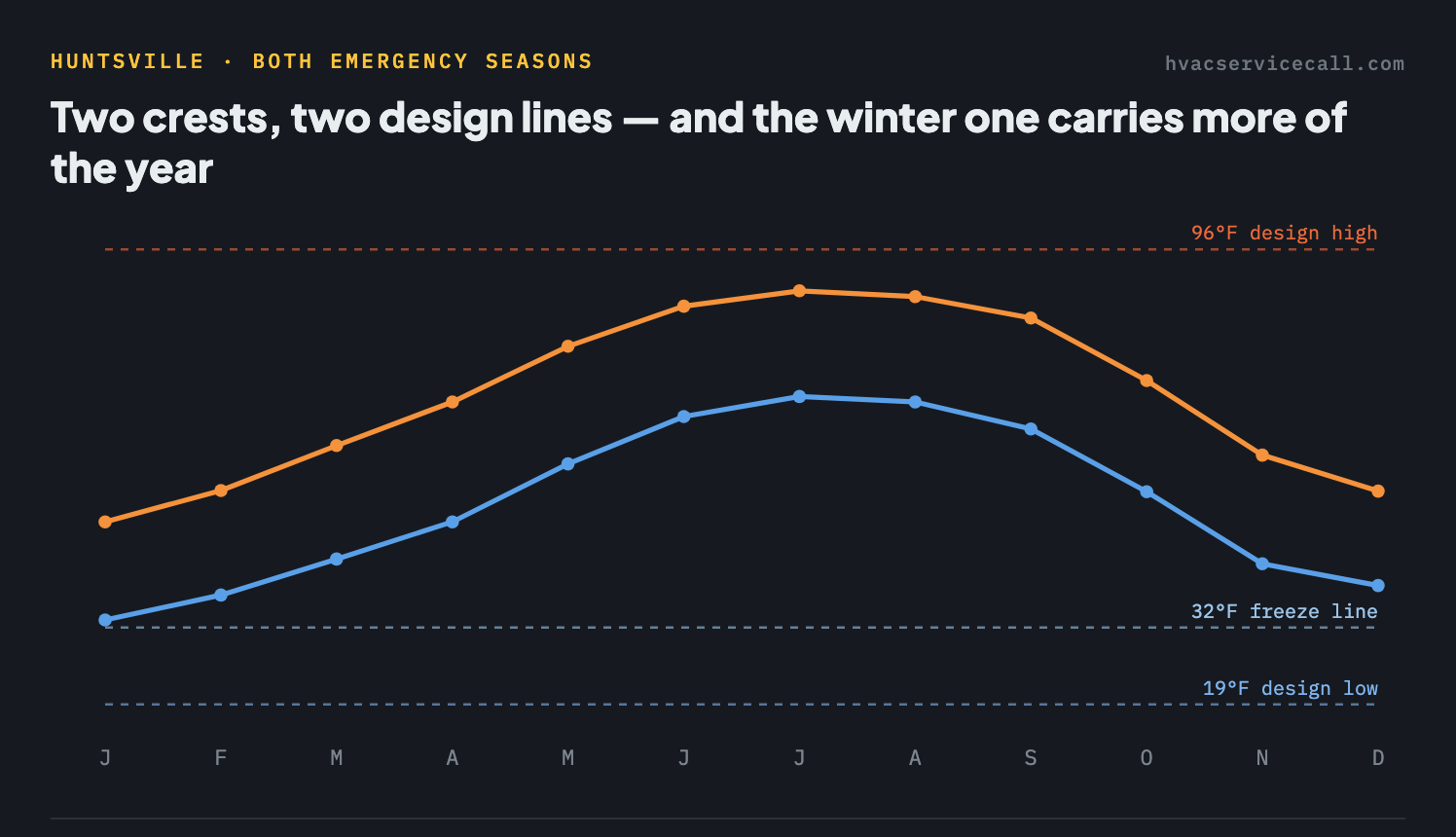
Huntsville runs two emergency seasons, and the heavier one is winter. Madison County logs 2,914 heating degree-days against 1,889 cooling, sits against a 19°F winter design temperature, and heats 74% electrically — so a no-heat failure lands on a county where the heating system, the water heater and the cooking are all on the same wire. The summer half is real too: a 96°F design high, and Huntsville Utilities' own count of 53 days above the average high between 1 June and 31 August 2025. Two things outrank the calendar in any month — a gas odour or a carbon-monoxide alarm, which sends everyone outside before anyone dials, and a power event, which is a different problem from a broken machine and is diagnosed differently.

Why the January stretch, not one cold night, is the failure Huntsville plans for
The National Weather Service office in Huntsville documented what a bad winter actually looks like here. An arctic air mass crossed north Alabama from 23 to 26 January 2026: an Ice Storm Warning for the north-west counties, where half an inch to an inch of ice brought down trees and left thousands without power for days; a winter weather advisory over Madison County with lighter icing; wind chills between −5 and 5°F; and then the number that matters most for a heating system — 17 consecutive days with a below-freezing low at Huntsville, running through 8 February, the twentieth-longest such run on record at that station. Two weeks later it was in the seventies.
That is a different design problem from a single cold night. A furnace or a heat pump that limps through one 19°F morning has a whole mild afternoon to recover; in a stretch it never gets one, and neither does the house. Marginal parts that survive an ordinary January — a tired capacitor, a defrost board that mostly works, a strip-heat sequencer with one dead contact — fail on day three or four, and they fail across the whole county on the same morning, which is exactly when every contractor's queue is longest.
Huntsville Utilities adds the operational half that no contractor page mentions: in an ice event, its own storm guidance is blunt that icy roads mean crews take longer to reach outages. So in the first hour the things you control matter more than any estimated arrival time — close the house down to one room, protect the plumbing, and arrange somewhere warm for anyone who cannot ride out a cold night. The utility's own cold-weather advice runs the same way: thermostat as low as is comfortable, rooms closed off, layers indoors, one faucet dripping, and never approach a downed line — report it through the HSVUTIL app or on 256-535-4448, which covers electricity, gas and water at any hour.
What the EM HEAT button actually costs on Huntsville power
With 74% of Madison County heating electrically, the most-pressed control of any cold snap is the one marked emergency heat — and pressing it is a billing decision as much as a comfort one. Emergency heat shuts the compressor out and runs the house on resistance strips. On Huntsville Utilities' residential tariff (8.742¢ plus a 2.836¢ TVA fuel cost adjustment, so about 11.578¢ a kilowatt-hour) those strips deliver warmth at roughly $34 per million Btu, against about $11 for the same heat moved by the compressor — call it 3 times the running cost for an identical warm house. The full arithmetic, both fuels, sits on the Huntsville furnace page.
So the practical rule: auxiliary heat is normal, emergency heat is a decision. Aux switching itself in below the balance point is the system topping up as designed, and it steps back out on its own. Emergency heat is for a compressor that has genuinely stopped — and left on through a fortnight of freezing mornings it is how a power bill triples. What is worth an overnight call is lukewarm air with the outdoor unit silent, or a strip breaker that will not stay closed; what is worth a daytime one is strips engaging when it is mild outside, which usually means a thermostat wired or configured wrongly.
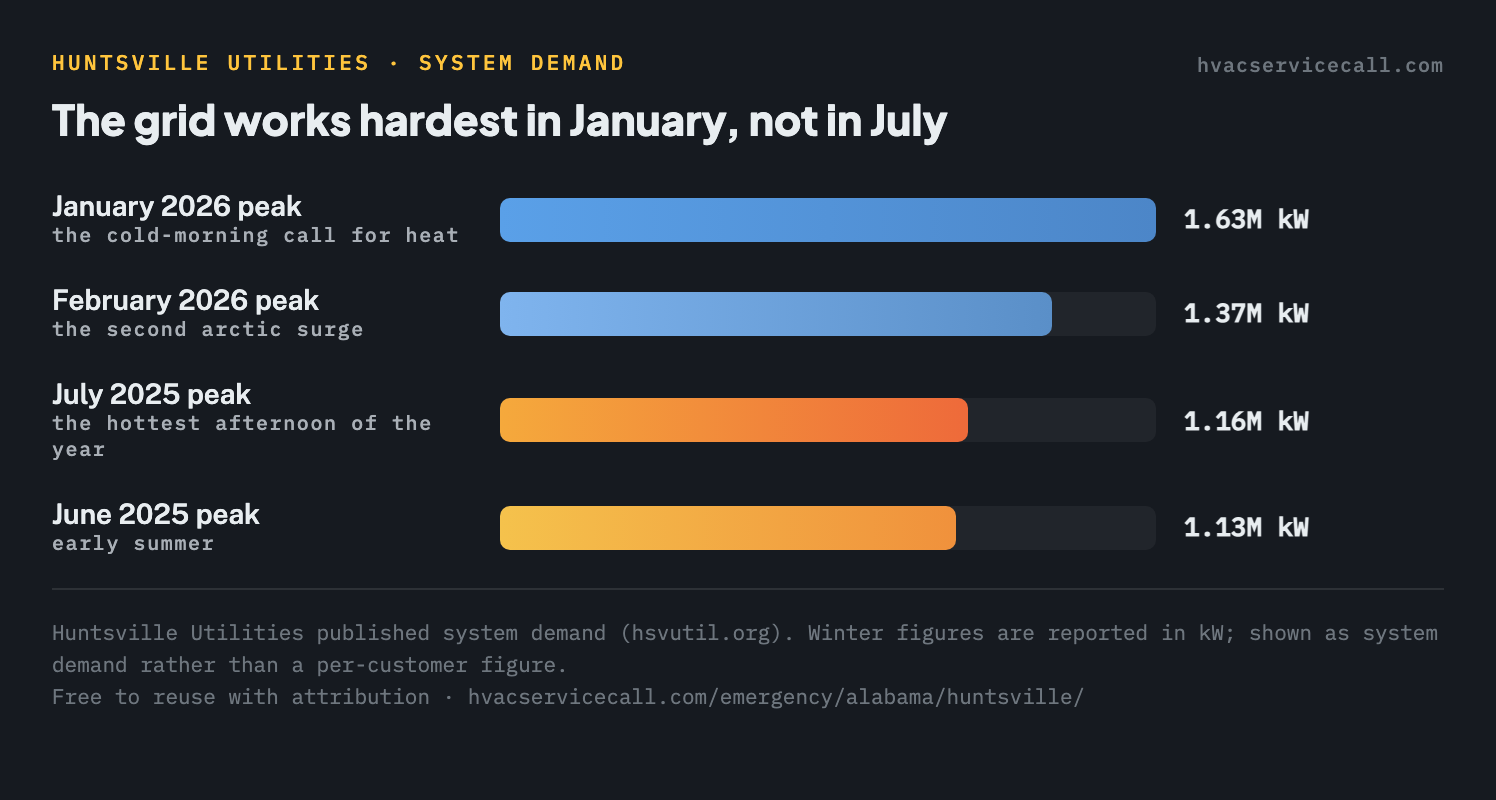
The same effect is visible at city scale, and it is why the emergency calendar here is inverted from the Deep-South default: Huntsville Utilities' published system demand peaked at about 1.63 million kW in January 2026 against roughly 1.16 million in July 2025 — around 1.4 times — because the electric-heat majority all asks for resistance heat on the same cold morning.

Call now, wait until morning, or check it yourself first?
Run the triage before deciding what kind of call this is — the after-hours premium is only worth paying when the situation genuinely cannot hold.
Call now
- A gas odour anywhere in the house, or a carbon-monoxide alarm sounding
- Burning, hot-plastic or electrical smells from a vent, the air handler or the outdoor unit
- No heat with a multi-day freeze in the forecast — the 19°F design low is one night, a January stretch is not
- No cooling in a 96°F spell with an infant, an older resident, or anyone medically fragile in the house
- A breaker that trips again immediately after one reset, or a strip-heat bank that will not stay on
- Water spreading from the air handler toward drywall, ceiling or wiring
Usually holds until morning
- A system that drifts two or three degrees behind setpoint at the peak of a 96°F afternoon while it keeps running
- One room that sits off-temperature while the rest of the house holds
- A rattle that comes and goes on a system still heating and cooling normally
- Frost on the outdoor coil on a damp winter morning that clears within a cycle — that is defrost working, not failing
Check these first
- Thermostat mode and setpoint, and the batteries if it takes them
- Both disconnects — the breaker in the panel and the pull-out beside the outdoor unit
- The filter, which starves airflow in either season before anything else fails
- After an outage, give the compressor its restart delay before deciding it is dead
Longer walk-throughs: AC won't start, furnace won't start, and HVAC smells.
What to do in the hours before the technician arrives
Help is booked and there are hours to fill. Huntsville heats mostly with electricity — about three homes in four — so a winter no-heat call is usually a heat pump that has stopped holding temperature, or an outage that took the strip heat with it; either way the move is to close down to one room and layer up rather than reach for anything that burns. In summer, under a 96°F design high, the job flips to keeping people cool: a low shaded floor, water within reach, blinds down on the sunny side.
The hour-by-hour version of each is written up separately — no heat in freezing weather and no cooling in dangerous heat — worth opening while the contractor is on the way.
Gas odour or a sounding CO alarm: this overrides everything above — everyone leaves the house immediately, touching no switches, and the calls to Huntsville Utilities on 256-535-4448 and to 911 are made from outside.
Carbon monoxide in a county that mostly heats without a flame
Most carbon-monoxide advice is written for gas-heated cities. Madison County is not one: 21% of homes burn gas and 74% heat electrically, so the risk splits in two and the halves belong to different households.
The gas minority. One in five homes here has a combustion appliance, and the classic source is a cracked heat exchanger or a blocked flue putting exhaust into the supply air. Huntsville Utilities supplies the gas as well as the electricity, so a gas odour has one number — 256-535-4448, any hour — dialled from outside, alongside 911. Nobody re-enters until the utility clears the house, and no repair is scheduled before that.
The electric majority. A heat pump and a strip bank produce no combustion gases at all, so for three homes in four the heating system is not the hazard — the outage is. Carbon monoxide arrives here with the portable generator, the grill dragged into the garage and the unvented kerosene heater, during exactly the ice events that take the power out. Generators run outdoors only, well clear of doors, windows and vents, with the exhaust aimed away from the house; a garage with the door open is still indoors. The poisoning imitates flu without the fever:
Detectors belong on every level and near sleeping areas — not beside the equipment — tested each autumn, in all-electric homes as much as gas ones. An alarm means everyone outside first, calls from the street second. The full guide: carbon-monoxide safety.
The signs that make it a 911 call rather than an HVAC call
A lost system lands hardest on infants, older residents and anyone managing a chronic condition — and in a multi-day freeze the cold version is the one that creeps up, because nothing about it feels sudden. The equipment is the contractor's problem. These signs in a person are not.
Too cold
Warning: Early cold stress: hard shivering, numb fingers and toes, deep fatigue.
Call 911: Hypothermia (call 911): the shivering has stopped, speech is slurred or muddled, and the person keeps drifting off.
Too hot
Warning: Heat exhaustion: heavy sweating, cramps, weakness, light-headedness.
Call 911: Heat stroke (call 911): hot dry skin, confusion, body temperature above 103°F.
What does a 24-hour HVAC call cost in Huntsville?
The daytime diagnostic in Huntsville runs $65–$180 — walk away after it and that is the whole bill. Approve the repair and many shops fold the fee into the total, though that is worth confirming rather than assuming: at least one company ranking in this city publishes that its diagnostic is a separate charge and is not credited. The mechanics are in the service-call fee guide.
After hours, the honest answer has two parts. The industry norm is a premium that lands somewhere between half again and double the daytime figure, and that is what the windows below model. But it is not universal in Huntsville — one of the companies ranking for emergency work here publishes that it charges no overtime rate at all, the same price whatever the hour. So the useful move on the phone is not haggling; it is asking three questions before the truck moves: what the call-out fee is, what the after-hours uplift is if any, and whether the fee is credited against the repair.

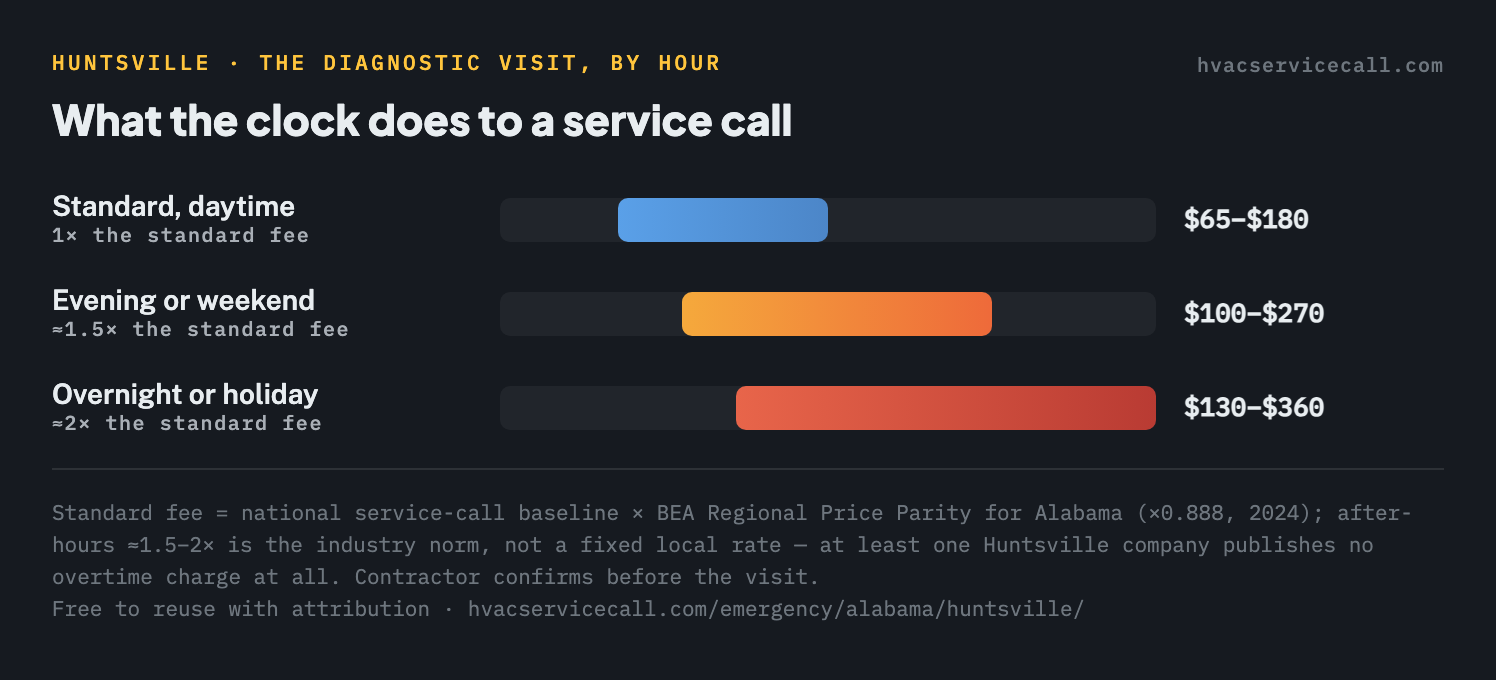
| Time window | Low | High | Vs daytime |
|---|---|---|---|
| Standard, daytime | $65 | $180 | 1× |
| Evening or weekend | $100 | $270 | ≈1.5× |
| Overnight or holiday | $130 | $360 | ≈2× |
Is this a power problem or an equipment failure?
Rule out the panel and the utility before declaring the machine dead — after a north-Alabama ice event, a good share of "failures" are neither.
- The whole house is dark
- then it is the utility's event, not your equipment. Huntsville Utilities runs electricity, gas and water on one number — 256-535-4448, any hour — and its outage map and the HSVUTIL app carry the restoration picture. In an ice event expect that clock to run long: the utility says plainly that icy roads slow the crews reaching the outage.
- One dead circuit
- check the main panel, then the pull-out disconnect beside the outdoor unit. A single tripped breaker earns exactly one reset.
- It trips again
- the second trip is the system reporting a fault rather than a nuisance — often surge damage once power comes back after a grid event. Leave it off and make the call; resetting into a fault is how a compressor or a strip bank dies.
- Power is back but the system is not
- give it several minutes. Compressors hold a start delay after a power loss, and a heat pump that has sat cold may run its defrost cycle before it produces warm air. Three minutes of patience settles a surprising number of calls.
Which HVAC emergencies do Huntsville contractors take?
Every failure below has a taker on the overnight roster. Heat pumps head the list for a reason — in a county this electric, the same machine is behind both the no-heat and the no-cool call.
What can actually be fixed tonight — and what waits for morning?
Set the expectation before the driveway conversation: overnight work is bounded by what is already on the truck, and everything else gets diagnosed, quoted and bridged.
- Done on the overnight visit (truck stock)
- Capacitors, contactors, hot-surface igniters, flame-sensor cleanings, thermostats, fuses, low-voltage repairs, drain clears — and the one this county needs most in a freeze, a failed strip-heat sequencer or relay, which is what strands an all-electric house while the compressor is still perfectly healthy.
- Diagnosed tonight, finished later (ordered parts)
- Compressors, coils, reversing valves, defrost boards, blower and inducer motors, control boards, gas valves. The night visit produces the diagnosis and a written quote; the part lands in one to three days.
- Bridged in the meantime
- For the electric majority, the backup strips can carry a house through a cold night on their own — at roughly 3 times the running cost, which is a fair trade for one night and a poor one for a fortnight. In a heat spell it is a thawed coil, fans and a shaded lower floor. Whichever it is, the technician names the bridge before leaving.
- Never done at night
- A condemned heat exchanger or an active gas leak stops the visit where it stands — Huntsville Utilities clears the house before any repair is scheduled. That is the safety line, not a service gap.
Will homeowners insurance pay for an HVAC emergency in Huntsville?
The cause decides the claim. Equipment that simply gave out — the compressor that quit mid-heat-wave, the igniter that failed on the fourth freezing morning — is wear and tear, which standard homeowners insurance excludes and both Allstate and Progressive spell out plainly. A covered peril is different, and north Alabama supplies its own list: an ice-loaded limb through the outdoor unit, wind damage, a restoration surge that takes out a control board, and the expensive one in a long freeze — pipes that burst while the heat is off, where the water damage is usually the claim and the heating repair rides alongside it.
If a peril caused it: photograph everything before it is disturbed, file quickly, keep the emergency invoice, and ask the technician to write the cause of failure into the diagnosis — that sentence is what an adjuster reads. For plain mechanical death the only cover is an equipment-breakdown endorsement, and it has to be bought before the failure, never after. Upstream, surge protection on the condenser or at the panel is the cheap defence in a city whose grid takes its hardest hit every January.
No heat or no cooling as a renter — what Alabama law requires
Alabama's Uniform Residential Landlord and Tenant Act (Ala. Code § 35-9A-204) requires a landlord to keep the electrical, plumbing, sanitary, heating, ventilating and air-conditioning appliances supplied with the unit in good and safe working order. The detail worth knowing is that air conditioning is named. That is unusual — Tennessee's equivalent statute, an hour up the interstate, treats heat as essential and does not extend the same protection to A/C — so a July cooling failure in a Huntsville rental with landlord-supplied equipment sits inside the statute where the identical failure across the state line may not.
The lever is written notice. Put the fault in writing, keep a dated copy, and note the indoor temperature and the time you reported it; that record starts the repair window, and the window compresses when health or safety is at imminent risk. A licensed contractor can be routed to the property either way — but who owes for the work is a landlord-tenant question, so the paperwork comes before the invoice.
How fast can someone reach you across Madison County?
The line answers around the clock. How quickly a truck follows depends on that night's on-call rosters and on the weather — a hard freeze or a post-ice outage stacks the queue county-wide at once, which is precisely what late January does here. A search for "emergency HVAC near me" in Huntsville resolves through your location, so a call from Five Points, Blossomwood or Research Park, from the Redstone Arsenal side, or from Madison, Harvest, Meridianville, Hazel Green, Toney, New Market, Brownsboro or Owens Cross Roads, lands with an Alabama contractor who covers that ground — all 60 Madison County ZIPs are in the routing, 35801, 35805, 35810 and 35824 among them.
Two things genuinely shorten the wait. Call earlier in the evening rather than at midnight when a cold snap is forecast, because the roster fills in order. And say on the call if there is an infant, an older resident, or someone whose medication or equipment depends on temperature in the house — dispatch triages by severity, and that is the detail that moves a job up the list.
How do you avoid the 2 a.m. call in the first place?
Most overnight failures announce themselves weeks ahead. Maintenance is how you hear them; surge protection is how you survive the grid event you cannot forecast.
- Book the heat-pump check in autumn rather than spring. The machine that strands you in January is the same one that cooled the house all summer, and the two parts that matter in a freeze — the defrost control and the strip bank — are the two nothing tests in July.
- Claim the $50 TVA EnergyRight tune-up on an existing heat pump or air conditioner. It is the only maintenance line on this page with money attached, and the work has to be done by a Quality Contractor Network member for the rebate to pay.
- Change the filter on a one-to-three-month cycle. Starved airflow freezes a coil in July and overheats a limit switch in January — the same neglect, two seasons, two callouts.
- Fit whole-home or condenser surge protection. This grid takes its hardest hit every January, and restoration surges take out control boards that were fine an hour earlier.
- Test carbon-monoxide detectors each autumn even in an all-electric house — the risk here arrives with the generator, not with the furnace.
- Find the panel, the outdoor disconnect and the HSVUTIL app before the night you need them in the dark with no power.
What a visit actually covers: HVAC maintenance & tune-ups.
What should you read once the house is stable?
Huntsville's reference emergency is prolonged cold rather than a storm — arctic air, ice, and a stretch of below-freezing lows. Once heat is restored, the equipment still needs a diagnosis; these three pages carry it.
- If the heat pump quit and the strips took over — Huntsville heat pump repair explains the failure that leaves the house warm and the bill unrecognisable, on 74% of county homes.
- If cooling was the season that failed — Huntsville AC repair covers the summer failure set and the repair ranges behind it.
- If a gas furnace stopped — Huntsville furnace repair covers ignition and exchanger faults for the county's 21% gas minority.
HVAC services in Huntsville, AL — the city hub: all four Huntsville services, the utility picture, and the local cost ranges.
Where these numbers come from
Every figure on this page comes from a published dataset rather than an estimate. The sources are listed below with the vintage of each, so you can check any number yourself — and so you can see when a figure is due for a refresh.
- Degree-days & design temperatures Open-Meteo ERA5 · 2014-2023 normals · retrieved 2026-07-15
- Heating fuel mix & housing age Census ACS5 2022 (county) · Madison County, Alabama table · retrieved 2026-07-15
- Residential electricity rate U.S. Energy Information Administration · state average, cents per kWh · retrieved 2026
- National cost ranges (before local adjustment) HomeGuide, Angi, Forbes Home, corpus-observed 2026-07 · retrieved 2026-07-15
- Local price adjustment BEA SARPP all-items · all-items RPP, applied to the national range · retrieved 2026-07-15
- Contractor licensing & verification Alabama Board of Heating, Air Conditioning & Refrigeration Contractors (HACR) · retrieved 2026-07-15
Cost ranges are national published ranges adjusted to local price levels, not quotes. The independent licensed contractor who takes the call sets the actual price, in writing, before any work begins.
Huntsville emergency HVAC — questions homeowners ask
It is a holiday weekend, the AC is out, and there are small children and pets in the house — is anyone actually working?
Yes — emergency rosters in Madison County run through weekends and holidays, which is exactly when this question gets asked. Call (888) 810-2291 and say who is in the house: an infant, an older adult, a pet that cannot shed heat, or anyone on medication that affects temperature regulation. Dispatch triages by severity, and that detail moves you up the list far more reliably than calling twice. While you wait, get everyone downstairs to a shaded room, close the blinds on the sun side, run fans for circulation, and keep water going round. If the vents are blowing warm and there is frost on the refrigerant line, switch the cooling off and leave the fan running so the coil can thaw — a technician cannot diagnose a block of ice, and running it that way is how the compressor gets hurt.
Should I press EM HEAT when the heat pump is not keeping up, and what does it cost?
Only if the compressor has genuinely failed. Emergency heat locks the system onto resistance strips and shuts the heat pump out entirely — and on Huntsville Utilities' tariff, resistance heat delivers warmth at roughly $34 per million Btu against about $11 for the compression cycle, so it costs something like 3 times as much for the same warm house. Auxiliary heat switching itself on during a cold morning is different: that is the system topping up below its balance point, exactly as designed, and it turns itself off again. The rule of thumb is that AUX appearing on the display is normal, EM HEAT is a decision, and leaving EM HEAT on "to be safe" through a long freeze is how a January bill triples. If the air is lukewarm with the outdoor unit silent, that is the call worth making tonight.
How long can a Huntsville house hold its heat if the system dies overnight?
Less time than most people expect, and the answer depends on the stretch rather than the night. A reasonably tight house loses a few degrees an hour once the heat stops at a 19°F outdoor temperature; a house that has already been cold for days has lost the heat stored in its walls, floors and furniture, so it falls faster each time. That is why the January 2026 pattern matters here — 17 consecutive days with a below-freezing low at Huntsville, the twentieth-longest such run on record at that station. Close down to one room, layer up, and treat plumbing as the clock that actually matters: pipes on outside walls start being at risk long before the house becomes unliveable.
The heat pump is blowing air that feels cool on a cold night. Is the whole system dead?
Usually not. Heat-pump supply air is genuinely cooler than furnace air — it often measures in the high 80s or low 90s, which feels cool against skin at body temperature — so "cool air" alone is not a diagnosis. What separates a working system from a failed one is whether the house is holding its setpoint. If it is losing ground, switch to emergency heat briefly: if the air turns properly warm, the compressor side needs attention; if it does not, the strip bank or its sequencer has failed and that is the overnight repair. In a county where 74% of homes heat electrically, the strip bank is one of the most common no-heat calls of the winter.
There is ice on the outdoor unit in January. Emergency or not?
A light frost or a coat of ice on the outdoor coil that clears within a cycle is the defrost cycle doing its job — the unit reverses briefly, steams, and goes back to heating. What is not normal is a unit encased in ice for hours, ice building over the top of the cabinet, or a fan blade audibly striking it. That points at a defrost control board, a sensor or a stuck reversing valve, and running it that way risks the compressor. Switch the system off, do not chip at the ice or pour hot water over the coil, and call. Cold rain and freezing drizzle — the exact pattern of the January 2026 event — is when this failure shows up here.
The power came back after an outage but the heating did not. What now?
Wait a few minutes first: compressors carry a built-in restart delay, and a heat pump that has sat through a cold outage may run a defrost cycle before it delivers warm air. Then check that the thermostat has power, and check the main panel and the outdoor disconnect. One reset is reasonable. A breaker that will not hold is reporting a real fault — after a Huntsville grid event, often surge damage to a board or a contactor — and forcing it repeatedly is how a repair becomes a replacement. That is the point to stop and call (888) 810-2291.
What should I have ready when I call at 2 a.m.?
Four things make the call short and the visit accurate: your ZIP code, since routing is filtered by it and a Hazel Green address and a Hampton Cove one do not reach the same on-call roster; what the system is — a heat pump, a gas furnace, or a straight air conditioner — which the data plate on the outdoor unit settles in a minute; what it is doing rather than what you think is wrong ("outdoor unit silent, indoor fan running, air is cool"); and whether anyone in the house is vulnerable to heat or cold. Then ask three questions of your own: the call-out fee, whether there is an after-hours uplift, and whether the diagnostic gets credited against the repair.
I can smell gas near the furnace. What is the exact order?
Get everyone out first, touching no switches, no lighters, no phones until you are outside — a spark is the risk you are avoiding. From the street, call Huntsville Utilities on 256-535-4448 and 911. Huntsville Utilities supplies gas as well as electricity here, so one number covers it at any hour. Nobody goes back inside until the utility clears the house, and no HVAC repair happens before that clearance. This outranks every other instruction on this page, including a house that is getting cold.
Is the after-hours fee negotiable?
The more useful question is whether there is one at all. Half again to double the daytime diagnostic is the industry norm for an overnight or holiday window, and it is what the figures on this page model — but it is not universal in this market: at least one company ranking in Huntsville publishes that it charges the same rate regardless of the hour. So rather than haggling, ask three things before the truck moves: what the call-out fee is, what the after-hours uplift is if any, and whether the fee is credited when you approve the repair. Get the answers before the visit, not on the invoice.
I rent in Huntsville and the air conditioning has been out for a week in July. Does Alabama law help?
It does, and Alabama is unusual in this respect. The Alabama Uniform Residential Landlord and Tenant Act (Ala. Code § 35-9A-204) requires a landlord to maintain in good and safe working order the electrical, plumbing, sanitary, heating, ventilating and air-conditioning appliances supplied with the unit — air conditioning is named, where Tennessee's equivalent statute across the state line covers heat and explicitly does not cover A/C. Put the problem in writing, keep a dated copy, and note indoor temperatures and the time you reported it; written notice is what starts the repair window, and that window shortens when health or safety is at imminent risk. A contractor can be routed to the property either way, but who pays the bill is a landlord-tenant question, so the paper trail comes first.
Can I run a generator in the garage if the door is open?
No. An open garage door does not clear carbon monoxide — the concentration builds inside the structure and moves into the house, and this is the failure mode that kills people during exactly the kind of ice-storm outage north Alabama saw in January 2026. Generators run outdoors only, well away from doors, windows and vents, with the exhaust pointed away from the building. The same applies to grills, camp stoves and unvented kerosene heaters brought inside for warmth. In a county where 74% of homes heat electrically and the heating system itself produces no combustion gases at all, the generator is the carbon-monoxide risk, not the furnace.
My January power bill was enormous after the cold snap. Was something broken?
Possibly, but a large January bill after a long freeze is often the system working correctly under an unusual load. Below its balance point a heat pump needs help, and the help is resistance heat at roughly 3 times the cost per unit of warmth. Days of that in a row is what the bill reflects — and it is the same effect at city scale that makes Huntsville Utilities' system demand peak in winter, about 1.4 times the summer peak. What is worth investigating: strips running when it is mild outside, a thermostat wired so auxiliary heat engages unnecessarily, or emergency heat left switched on after the cold passed. Those are faults, and they are worth a daytime visit rather than an overnight one.
When does an HVAC failure stop being a contractor call and become a 911 call?
When the person, not the machine, is in trouble. In a hot house that means heat stroke — hot dry skin, confusion, a temperature above 103°F. In a cold one it means hypothermia: shivering that stops, slurred speech, drowsiness. A gas odour and a sounding carbon-monoxide alarm are also 911 territory, once everyone is outside. The equipment itself never is; that is the contractor's call to take, and it can be taken from the same phone a minute later.
Emergency HVAC coverage across Huntsville, AL
Overnight routing spans 60 ZIP codes — Huntsville itself, the city of Madison, and the Madison County towns beyond them — plus the neighborhoods below. Whether the search was "24-hour HVAC repair near me in Huntsville," a bare ZIP, or your own street's name, the contractor who answers is filtered to where you actually are, not to a call centre.
Madison County ZIPs with emergency routing: